About Me

My photo
Bristol , United Kingdom
Poet and poetry facilitator. Neurodishevelled. Co-founder of the Leaping Word Poetry Consultancy, which provides advice for poets on writing, editing and publishing, as well as qualified counselling support for those exploring personal issues in their work - https://theleapingword.com. My sixth poetry collection, Love the Albatross, is now available from Indigo Dreams or directly from me.

Wednesday, 10 October 2018

The Leaping Word has a website ...


I can now reveal What I Did On My Holiday - and this will amaze anyone who knows me. 


I Built A Website for our poetry consultancy, The Leaping Word.

I know, right? Though I feel I need to point out a couple of things here. Firstly, I didn't do it by myself. Dru Marland drew our wonderful logo, and I had lots and lots of help from my dear friend, Helen Dewbery of Elephant's Footprint and Poetry Film Live, particularly with the setting up of the thing. 

Secondly, please don't tell any of my colleagues. I get a lot of mileage out of maintaining I'm too old to learn new tricks. ('We didn't have any computers when I was at school. Queen Elizabeth was on the throne then, of course. Queen Elizabeth I, that is ... ') So if they discover I'm not as incompetent as I make out, I'll have all sorts of extra work to do.

Anyway, here's a link to the website. All of us here at The Leaping Word (that's me, the Northerner and Ted the Border Collie) are very smug about it. 


Monday, 8 October 2018

The Bluebell Railway

Despite being in their late 20s, the kids are still into trains. And increasingly we have to go further afield to find lines we haven't been on. Yesterday it was the Bluebell Line in Sheffield Park, East Sussex. 
After a sunny week, the weather was a bit galling but I perked up as we walked up to the station, as I'm still into the Arts and Crafts Movement myself, and it has a fair bit of pleasing detailing. 


And, of course, nostalgia in spades. And buckets. Buckets and spades of nostalgia. 


Our train was already in the station.


It wasn't long before we were climbing into a non-corridor single compartment ... 


... which immediately made me shudder and think of this. 
 

I remember a woman my name and age was found murdered in one of these compartments at Victoria as late as 1988. (I believe London and its suburbs were the only places this type of rolling stock was still being used.)


Fortunately, my travelling companions were quite safe, if a bit silly.


We'd decided to alight at Kingscote Station, for a nice country walk to a nice country pub for a nice country lunch but it was tipping with rain. 


So we explored the station instead while we waited for the next train back. 


When it arrived, it was being pulled by the same engine as before.


This time, though, our carriage had a corridor. 


While the kids got all nostalgic about Dementors and Bertie Botts' Every Flavour Beans, I was transported back to every childhood rail journey ever. 

Even the weather was atmospheric. 


Back at Brighton, the wind had put in its teeth and was pretending to be winter so we gave the beach a miss.

Maybe we'll try again some time next year. 


Friday, 5 October 2018

On Shadow Factories

Quite a lot of my early childhood was spent going up and down the Gloucester Road in Bristol on the bus. 


My mother had grown up in Bishopston, and kept her allegiance to the family doctor and many of the local shops after her marriage and subsequent exile out on the edge of the city in Filton. So what with this and weekly visits to my grandmother, who still lived in Bishop Road, I was familiar with every inch of the journey and the buses that made them.

Later, in the 70s, the 73 bus went to Filton and the 74 to Patchway, but back in the 60s, we had a choice of the 3, 6, 36 and 98. The buses I liked best were the ones whose rollsigns bore the legend PATCHWAY [SHADOW FACTORY]. 


Not that I ever got to see this fabled place. The Shadow Factory was at the junction of Gypsy Patch Lane (itself an enticing name) and the A38, quite a few stops past where we got off, at the Fine Fare in Filton Park (formerly the Cabot Cinema). 


What did a Shadow Factory make? Now I know it was a Back-Up Factory established Before The War, to Implement Additional Manufacturing Capacity; then I didn't dare ask for fear of being disappointed. 


Which sounded far less exciting than my preferred answer, which was 'shadows'.  


The Shadow Factory is long gone, demolished in 2oo9. The site lay unused for many years, and is currently being redeveloped, with retail units, a hotel, warehouses, and showrooms mushrooming every time I drive past. But in my head it's still there, always will be there and can manufacture whatever it likes. Poems, for instance. 


Which is why my next collection of poems from my publishers Indigo Dreams will be called The Shadow Factory.  It's due to be published next year. More details when I have them. 


Thursday, 4 October 2018

Two Poems for National Poetry Day 2018

Today is National Poetry Day and the theme this year is Change, of which there has been a lot lately, and not all of it good. Nationally and internationally we've seen that progress is not linear, and change can set us back to a point where hard-won gains have to be fought for all over again. It's pretty dispiriting. 

A more welcome change for me recently was the annual observance of Flannelette Sheet Night, which always falls around this time and which is, I think, the best night of the year, when autumn starts to bite and the bedding becomes ever so slightly fuzzy.  

Here's a poem which mentions flannelette sheets, although the real changes in it are far more fundamental. It was partly inspired by the death of DJ Derek in 2015, and was highly commended in the International Welsh Poetry Competition 2018 earlier in the summer. 


where he lay undiscovered


In the never-quite-dark
of those first summer nights
I heard police helicopters sweep overhead
seeking the heat of suspects in hiding
trespassers, burglars, car thieves, murderers,
cannabis farmers.
                                
It was blow flies that found me.
After the buzzing, lascivious squirms
the memory of rotting plums forgotten in a fruit bowl,
then squadrons of beetles homing in
the family of foxes that fed on my lungs,
the bone of my shin.
                                                                                                                                     
As for you lot driving past
after tiles for your bathroom, this week’s fashion
upgrades for last year’s mobile phone
who don’t notice me in elders and brambles
on your daily commute to your home,
there’s no need for guilt.              
                                            
You’ve not ignored insects crawling on windows
snowdrifted mail behind a glass door
and I like it here. Already
a second year is turning,
I wait for dead leaves to tuck me in, ground frosts
soft as flannelette               
                                 untongued, undone
I don’t call out.


Another poem of mine about change, 'A Pint at the Shifting Sky', is published today on the poetry and prose webzine, Ink Sweat & Tears. Thanks to Helen Ivory and Kate Birch for giving it a home. 


Friday, 28 September 2018

Twmbarlwm the easy way

I love Twmbarlwm. It has a feel about it. The views of the River Severn and the Bristol Channel from the top are familiar but at the same time strange, being in reverse from the ones I'm more used to on the opposite side. But the last time I climbed it, from Cwmcarn Visitor Centre, it nearly killed me. So this time we ascended from the much higher car park round the back, which we only noticed after we'd summited last time. 


'Summited' is ironic, of course. The whole hill is only 1,375 feet. But I am somewhat elderly these days. And it's still quite steep this way up too, though far shorter a route. 
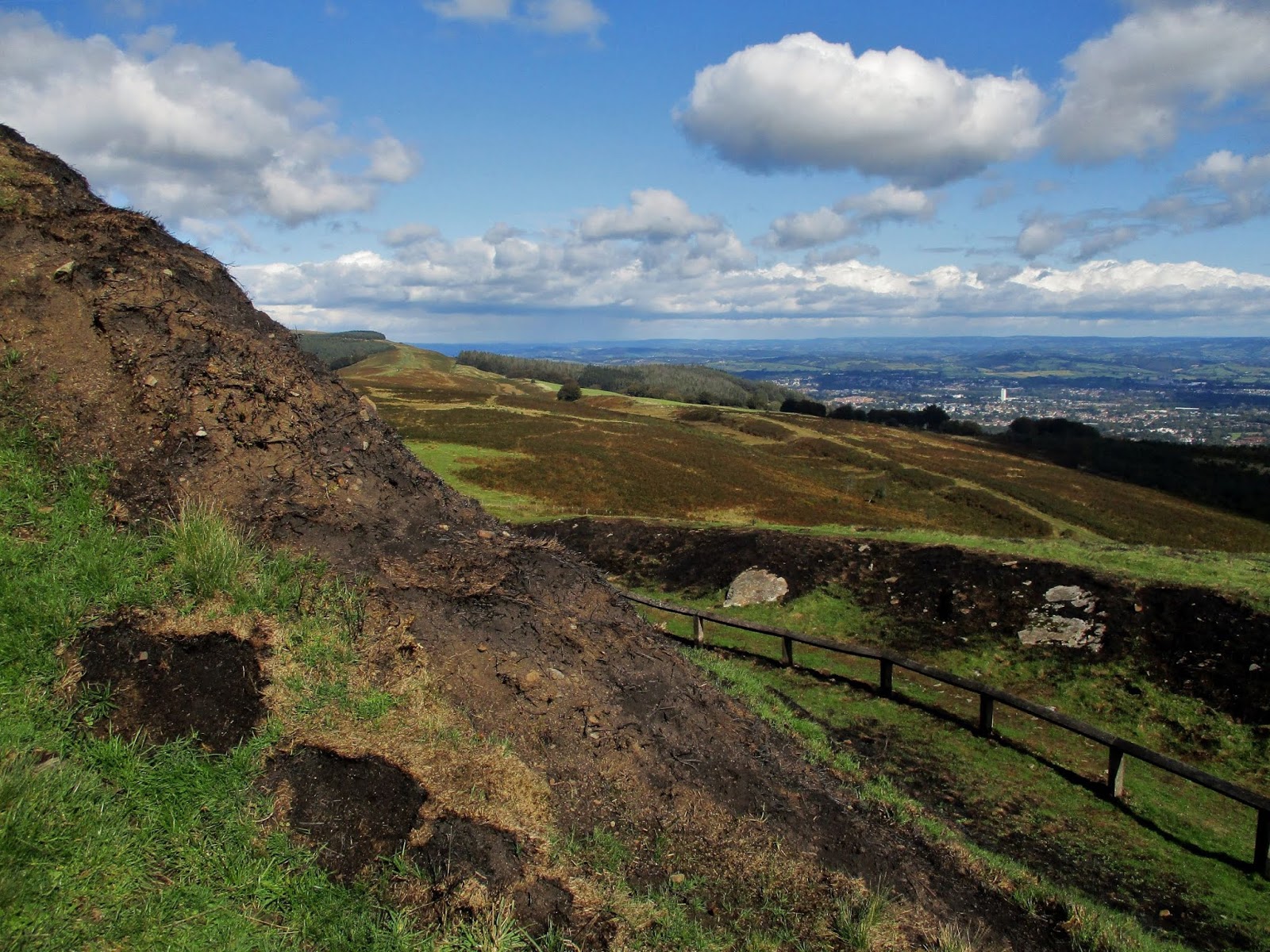

Evidence of the wildfire that raged on Twmbarlwm (and the surrounding hills) during the summer heatwave was clearly visible, both as we climbed and at the top. 


Looking over to Cwmbran


It was a very different sight from early May when we made our first climb.


Here's a couple of before and after photos.


We decided to walk the bounds of the Iron Age hill fort on the summit. 


The views were still beautiful, although a lot of young trees have been lost. 
Clearly some wildlife survived, though. 


Looking over to the River Severn ...


Back down to the car park and home