About Me

My photo
Bristol , United Kingdom
Poet and poetry facilitator. Neurodishevelled. My sixth poetry collection, Love the Albatross, is available from Indigo Dreams or directly from me.
Showing posts with label Rottingdean. Show all posts

Thursday, 4 May 2023

When day trips to Brighton turn bad, and why - if you get there - you shouldn't drink sea water


Seven hours it took us to drive 169 miles from Bristol to Saltdean, the hold-up on the M25 - caused by an accident near Cobham, which happened just before we got there and apparently left two men with serious injuries - being the sort where you turn off your engine (multiple times) and everyone gets out and wanders about on the carriageway because they can, except we couldn't because we had Cwtch with us on her first major car trip, which turned out to be more than twice as long as expected, and we didn't want to risk her being spooked by anything.

Although this wasn't the longest traffic jam I've ever been in: that formed a large part of the 13 hours it took me to drive from Leeds to Bristol back in December 2017, after a man killed his ex-partner and jumped off a motorway bridge over the M1. And I feel I should give an honourable mention to the six hours it once took Son the Elder and me to drive a mere 34 miles from Gloucester. 

On the plus side, we spotted the legendary Stuart 'Psycho' Pearce at Pease Pottage Services 

And so our day's itinerary was necessarily truncated. Instead of a visit to Clayton to see the windmills, we diverted to the Plough in Rottingdean for an extremely late lunch.

Living in Bristol, which doesn't have the most obsequious of citizens, it was a bit of a shock to see all the Union Jack-ery for the coronation in a few days' time. I'm so glad not to be confronted with this sort of thing on a daily basis. It would make me feel quite bilious.


Apart from a bit of community ribboning outside, the Plough was blessedly free of such nonsense. 


Look at me in the pub with all my people!


Then we had a quick trip to the beach at Saltdean, so that Cwtch could stretch her legs. (We went on the part that's dog-friendly all year round.) 


sea anemones


Unfortunately, just like our old collie,Ted, at Traeth Yr Afon, Cwtch decided to try drinking sea water, and as a result - just like Ted - had an attack of the squits. Even more unfortunately, this happened in my daughter's boyfriend's kitchen, while we were singing Happy Birthday to Son the Elder.  


There's nothing like an emergency kitchen floor clean to finish off a simultaneously excellent and very trying day.


Back home - finally - a gloat over hagstones, three of them with the smaller pebble that bored the hole still lodged in place.


Friday, 26 August 2022

Visiting Beacon Mill

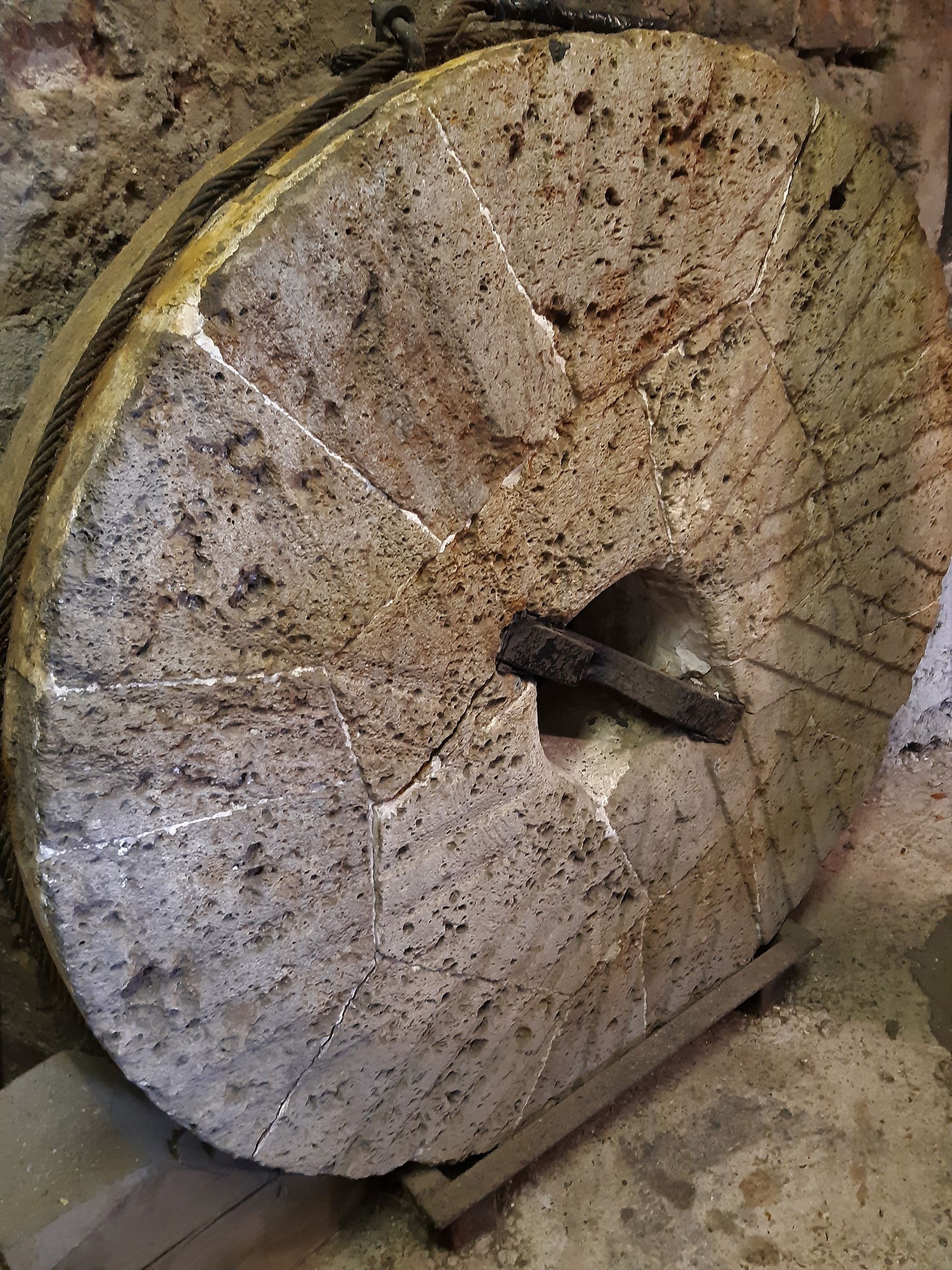
On every trip to Sussex Beacon Mill stands dark on the skyline, and there've been several times I've tried to get up there to take a closer look but have been thwarted. The last visit, though, was the time everything came together to make it possible, and it's formally ticked off my list, but like so many of these interesting places, I left feeling like there was much more to explore.


The mill isn't often open to visitors, but was during our sojourn, so we got the chance to go inside as well as admire its brooding exterior. 


The mill - a grade II listed smock-mill - was constructed in 1802 and in continuous use until 1881. It then fell in disrepair and was allegedly used by smugglers for signalling purposes before undergoing several restorations, the most recent being in the 1990s.

The Friend who was on duty at the entrance was keen to test our knowledge to make sure we'd read all the boards properly, but Never mind the weight of a bag of corn, tell us about the skeleton! I cried and so he did.

When the foundations were first dug, two workmen unearthed a skeleton complete with a sword. (Of course they did, all exhumed bodies have to be tribal chiefs with an impressive weapon, the story demands it.) (Although this isn't entirely implausible, since there are believed to be at least two Anglo-Saxon long barrows on the site.)  The men claimed they went into town for something to eat at lunchtime and when they came back, it was gone. More likely, said the Friend, that they found someone they knew who might buy it, and that's where it went. We Shall Likely Never Know.


I wanted to go for a prowl over the hill so the Offspring sat on a bench for a bit and then sheltered from the spotting rain in the cafe. 

It's been so dry and hot this summer, most of the wind-stunted flowers were a  frazzled brown, and I made a note to return earlier in the season another year. There were still a few butterflies about and lots of bumbles ... 


... white-taileds mostly, I think, but also a Common Carder bumble bee with a very high whine on milkwort (also common). 


Sadly there wasn't enough time for much more than a quick gathering of impressions.


Looking west over Rottingdean village and the Church of St Margaret, where the ashes of Edward and Georgie Burne-Jones are buried


Looking east towards Brighton


Back down on the beach - because there always has to be a sit-down on the beach with an ice cream - I gathered the day's quota of treasure:


a jackdaw wing feather from the hill


a lump of chalk also from the hill, a hagstone, and a pebble that looks quite a bit like a toffee and is pleasing to hold


Looking towards Saltdean


Monday, 30 December 2019

Three remarkable trees at the turn of the year

I was already sunk in post-electoral despondency, and the news that Iain Duncan Smith, architect of so much suffering, was going to get a knighthood in the New Year honours made me realise that comfort-watching Buffy the Vampire Slayer, good as it is, wasn't going to salve my soul anytime soon. So I decided to get some perspective by visiting a few aged trees.


It's a bit shaming to admit it had taken me so long to travel no more than a dozen miles to visit the ancient sweet chestnut tree at Tortworth in South Gloucestershire. 


Even so, I delayed our meeting a little longer by popping into the St Leonard's Church, with its elegant but strangely disproportionate tower.

The church has clearly been heavily restored and not a lot of its past remains. 


One of the two Throckmorton tombs in the South Chapel made a useful table for a nativity display.


The font is Norman, 12th century, with a 17th century cover ... 


... and there's some mediaeval glass in the traceries of a couple of windows, some of which depicts King Edward IV and the sun emblem of the House of York. 


The famous Tortworth chestnut is nearby and fenced off, presumably for the health and safety of both visitor and tree.
Written records go back to the 12th century, when the tree was a boundary marker; legend dates it to the reign of King Egbert in 800AD. 


It's difficult to measure its girth as many of its branches have rooted to become trees themselves. In fact, it looks more like woodland than a tree.


It was good to get to see it at last. 


My other two remarkable trees dictated a detour en route to the south coast. The journey was ornamented by seven red kites flying over the motorway. Always a good sign, and the first  yew tree in the churchyard of St Peter's in Tandridge, Surrey, didn't disappoint.

Unsurprisingly, the church was locked  between services. It looked interesting in an Arts and Crafts Movement sort of way and I should like to visit on a non working day some time.


The churchyard had some interesting tombs in it, though, and loads of squirrels floofing about. As for the yew, it's believed to have been struck by lightning in the mid-19th century and was declared to be in a state of rapid and terminal decay around that time ... 


... but here is it, magnificent and thriving. As far as we know, yews are the oldest living entities in Europe and Asia. This one is hollow inside and has three mighty trunks that have grown around the decayed central one that fell, probably, centuries ago. As for its age, no one really knows. Over 1000 years seems a reasonable supposition; possibly even pre-Saxon, the remnant of a Celtic tree cult. 


We didn't see the sign that says not to walk under it until we'd walked under it. (Very respectfully, of course.)


Then it was off to nearby Crowhurst for an even more venerable yew, this one in the churchyard of St George's. Which was open because there was no service being held. 


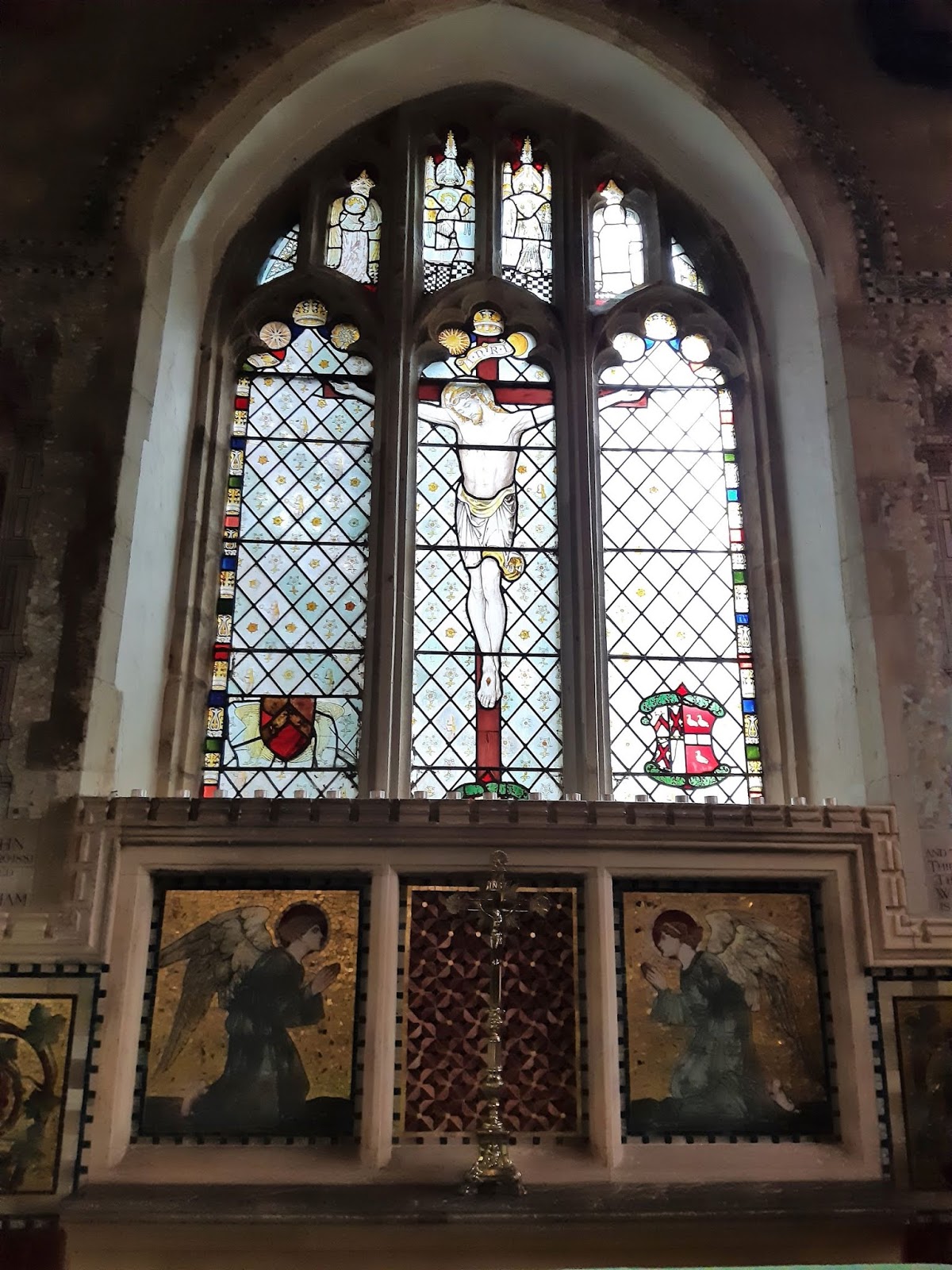
It was lovely inside, with mosaic and painted frescoes in the Pre-Raphaelite style on the east wall, providing colour and light. 


It also has a 13th century font with mediaeval graffiti ... 


... more graffiti in the porch doorway, as well as deep grooves caused by bowmen sharpening their arrow heads ... 


... and presumably a Christmas gift of beer stashed in the pulpit.


Outside, I spotted this striking headstone from the 1960s with its beautiful wheatsheaves, symbolising both the harvesting of life and resurrection ...


... and we paused to listen to a pair of extremely raucous jays having a right old barney with the magpies and the crows in the meadow over the back. 


But the yew, the yew ... ! 


Here it is, reaching out ... 


...  and thoroughly bewitching.


This is a very very old tree indeed.  In the early nineteenth century it was fitted out as a room with door, table and chairs, during which a cannon ball from the civil war was discovered embedded in its wood. 


A storm struck the tree in 1845 and brought down the 'roof'.


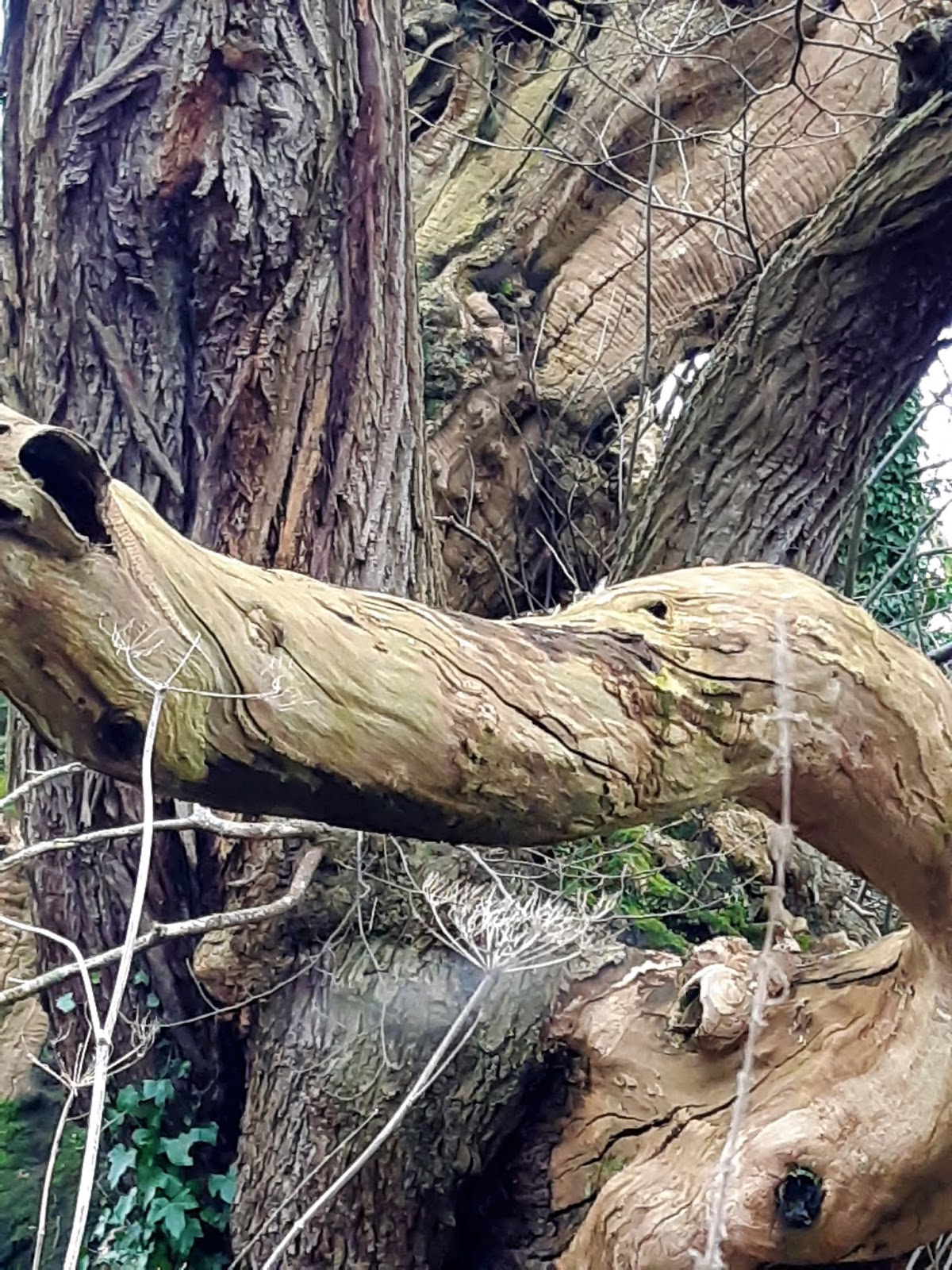
Inside, the growth of new wood on old is simultaneously architectural and grotesque.
 It's almost as if it has grown its own daemons.
As for its age ... the Parish Council claims 4000 years, but they would, wouldn't they? Again, it's impossible to know, but it does seem likely that it's at least in its second millennium.


So how do you end your pilgrimage to three timeless trees that have witnessed so much social history and probably don't care much about the preoccupations of its short-lived protagonists? 


With something that is equally unfathomable, I think.


Rock doves