About Me

My photo
Bristol , United Kingdom
Poet and poetry facilitator. Neurodishevelled. My sixth poetry collection, Love the Albatross, is available from Indigo Dreams or directly from me.
Showing posts with label St Marychurch. Show all posts

Tuesday, 20 February 2018

A eulogy for my father


Lionel Raymond Harvey
11th March 1922 - 21st January 2018


Lionel Raymond Harvey was born on 11th March 1922 at 41 Cobourg Road, Montpelier, Bristol, the second son of Graham, a railwayman and veteran of the Somme, and Ida. His elder brother, also Graham, had died the previous year at a few weeks old; his sister, Audrey, was born 18 months after him.

Before long the family moved to Herbert Street in Totterdown, and then, in 1926, to the new council estate in upper Horfield. One of Dad’s earliest memories was of moving day. His father, riding on the van, assumed he was with his mother; his mum, busy with baby Audrey, was certain he was with his father, and four-year-old Lionel was left behind at the old house, to be taken in by neighbours until his parents realised and re-crossed the city to retrieve him.

Life wasn’t always easy in Macaulay Road; in particular, money was in short supply. Dad remembered his mother hiding a jar of Shippams fish paste behind the skirting board to avoid a confrontation with his father, and he vowed at a young age never to argue about money with his future wife. Once married, he duly handed over his pay packet to my mother every Friday.

On his seventh birthday Dad was given a football, and instantly he was the most popular lad on the street. He became an agile player with swift reactions; aged 13, while working at his first job in a shoe shop down the Gloucester Road, he trapped a rat under his foot and held it there until the shop cat could be found. He and his father regularly watched Bristol Rovers play at Eastville, and his mother could work out the score by looking at their faces as they turned into Macaulay Road on their way home.

When war broke out, Lionel was working at the BAC in Filton, and although this was a reserved occupation, he enlisted in the RAF as soon as he was old enough, seeing action in Palestine, Egypt, Tripolitania and Italy.

Like many veterans, Dad didn’t talk much about his war service. He mentioned getting the  bumps in the Western Desert on his 21st birthday, and how hard it was to play football on sand dunes, but kept most of what he went through to himself. The friendships he forged during this time were renewed decades later in the 1990s, when my parents attended RAF reunions in Stratford-upon-Avon, and these gave Dad the chance to talk with people who had been there with him, the men he called his brothers, and he valued this.

Once demobbed in 1946, Lionel embarked upon a series of jobs, which included office work at Maggs department store, a spell as a Co-op insurance man, and a return to the world of aviation, working as a section leader at Rolls-Royce, responsible for ordering and despatching engine parts for Concorde.

During his free time, Dad continued to play football, as well as cricket, tennis and badminton, mainly at Eden Grove; and it was here, in 1949, that he met a sporty young woman, six years his junior, from a large family in Bishopston. My godmother, Betty Daveridge, remarked how she knew something was going on between my father and her best friend, Sylvia Hill, because as he drove their group of friends home at the end of get-togethers, he started dropping my mother off last, even though this made his route rather more scenic than necessary. My mother adds that once they became engaged, Dad sold his car. I suppose it had served its purpose, and anyhow, he had to pay for the ring.

Dad was still a huge football fan. In 1946 he’d gone AWOL from RAF St Athan to watch a derby match between Rovers and City, incurring a fortnight’s ‘jankers’ when his absence was discovered. (Sadly for Dad, the match was a nil-nil draw.) And Mum recalls that upon his return from the 1953 FA Cup Final at Wembley, he woke her at 3am to describe Stanley Matthews’ legendary cross from the right wing that resulted in the winning goal, and couldn’t understand why she wasn’t as enthusiastic about it as he was.

But of course, Mum was into rugby really, and after meeting her three older brothers who all played, Dad decided it might be wise to show an interest in their sport too. Thus began his allegiance to Bristol Rugby Club. Both Mum and Dad held season tickets until Dad was well into his 90s, and after they’d called it a day, he’d listen avidly to radio coverage of each fixture, and enjoyed trips to Ken and Hilary’s apartment to watch televised matches on Sky.

Dad also loved singing. He was a founder member of Filton Glee Club, which later became Filton Male Voice Choir, and an enthusiastic participant in the many exchange visits with the men's choir in Witzenhausen, Filton's twin town. During his final years he sang with the Filtones, last attending choir practice, here in this church, the Wednesday before his death.

Germany aside, Dad didn’t do much long distance travelling after he left the RAF, though he was often to be found with his nose in an atlas. His skill with the compass, and innate sense of direction, stood him in good stead for when he and Mum did their coast-to-coast walk, from St Bees Head to Robin Hood’s Bay, with their friends, Charles and Kathleen, whom they’d met years earlier on the beach at Shaldon in South Devon.

Dad had first discovered Shaldon, with my mother and elder sister Linda, in 1960. He would describe how he’d walked onto the beach, looked across the river Teign, and felt a strong sense of coming home. This was confirmed 35 years later when a chance sighting of some family history revealed that Dad’s great-great-grandfather, a boatman from Weston, had lived and worked in Teignmouth during the 1830s, marrying a woman from St Marychurch during his stay.

Both Linda and I recall how we were marshalled onto the beach every morning on holiday, and there we would stay until dusk, whatever the weather. That is, apart from the obligatory trip to Dartmoor – always the same route, Haytor, to Widecombe, to Dartmeet, with a detour to Princetown, before heading for Postbridge, where Dad would stand on the clapper bridge and look up the East Dart in contemplation.

‘He could be an irascible old bugger, though, couldn’t he?’ said his great friend Georges, just after his death, and yes, Dad wasn’t always easy to be around. He was a stickler for right and wrong as he saw it, refusing, for instance, to accept any corporate hospitality or even claim his expenses when he was a parish, and later district councillor, and he expected all those around him to adopt the same high standards.

Yet he wasn’t above a bit of vandalism. He could never walk past a patch of wet concrete without inscribing his and his companions’ initials in it. Linda reports that the letters LH and DH from a walk my father and I took along the sea wall at Holcombe in 1987 have survived all intervening storms, at least until her most recent inspection last summer. And whilst the Beatles were all ‘scruffy individuals’, Dad himself kept his hair long on top, earning himself the nickname ‘Curly’ and many return trips to the RAF barber on the orders of his sergeant major.  
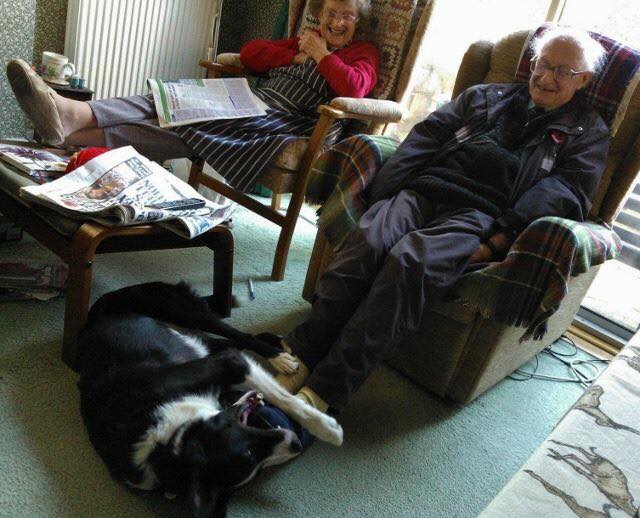
Curly was also the name his seven grandchildren knew him by, as his magnificent black and white mane gradually turned silver before thinning away altogether. He enjoyed their visits, and was latterly a devoted dog-sitter while I was at work.

Dad was well looked after by Mum for 66 years, from the day of their wedding in 1951 to his death. We are thankful he was spared a long decline and that when it came, his dying was quick and apparently painless. My enduring late memory will be of him sitting up in bed as the on-call nurse checked his temperature and blood pressure the Friday before he died. He felt horrible, he said, but nevertheless, there he was, taking his medals out of the tin he kept on the bedhead and telling her the details of each one, while she tried valiantly to sound his chest.

Occasionally Dad and I would talk about death, and I’d like to finish with a short poem by the great American poet Langston Hughes which gives beautiful shape to our conclusions:

Dear lovely Death
That taketh all things under wing—
Never to kill—
Only to change
Into some other thing
This suffering flesh,
To make it either more or less,
But not again the same—
Dear lovely Death,
Change is thy other name.


Monday, 10 August 2015

Three Go To Smugglers' Top

On a less than promising day, we adjourned to the Ferryboat Inn in Shaldon for lunch before heading up the River Teign to Ringmore.


Where is Shaldon, you ask? Why, just about here. (Measurements in miles, furlongs and poles.) (A pole - or a perch - or a rod - is a unit of length equal to 5½ yards.) (Or 16½ feet.)


As we began the long climb up Higher Ringmore Road to the lane that runs along the top of the ridge, our socialist spirits were cheered by this welcome sight. 


OK, so it's probably more to do with local geography than a celebration of the fact that there is at least one politician in the Labour Party with principles, but we continued with a spring in our steps.  


On top of the ridge, there were views - still pretty saturnine, it has to be said, but far-reaching and impressive. Here's Teignmouth, with a smudgy looking Exmouth in the distance ... 


... and the view back along the lane, with Dartmoor lowering on the horizon.    


And the hedges were full of thyme and honeysuckle and lots and lots of butterflies because this is Butterfly Lane.  There was no muddy water making it impassable either, presumably because the kids who used to ride their quad bikes along here have grown up and moved away to an area with marginally more affordable housing.  Or the council has sorted out the drainage.  


There was this young dead bunny too, which actually wasn't even dead yet, though not far off. At first we wondered if it had been shot, as we'd heard firing from the fields shortly before, but it seemed to have sustained injuries to its ears, so maybe we'd scared off a predator.  I remembered the last time I'd walked along the lane - before I'd been forced to turn back because of the flooding - I'd seen a stoat skedaddle across the track, and that seemed a plausible explanation.  

It was horrible to see it scrabbling on its side in the dust, and so very hard to walk on and let nature take it course. We hoped a kindly or at least hungry predator would return soon and finish the job.  

Looking back up river to the moor. 


The lane started to climb again as we approached its end, and there were views down the coast to St Marychurch, whence hailed my great-great-grandmother, and Torquay.  And the sun came out. 
After dicing with death for a couple of hundred yards on the Torquay Road, we turned onto the coast path at this very excitingly named house.  
Then there was a final bit of risky living - at least as far as my partner is concerned - as we skirted a herd of unconcerned cows and made our way down the extremely steep path towards the Ness at Shaldon.  My home from home.   


Friday, 15 May 2015

Inspiration : The Poet And The Boatman

I was recently approached by Neil Howell, who keeps a blog called Teignmouth in Verse. He'd come across my poem The Poet And The Boatman, about John Keats' stay in South Devon during 1818.  I gave permission for him to post it, found myself explaining to ex-pat actor and Romantics aficionado Ian Frost how I came to write it, and decided the story might make another post in my Inspiration series.  

My immediate family's connection with Teignmouth and Shaldon on the South Devon coast goes back many years.  My parents first 'discovered' Shaldon the year before I was born. My father said he walked onto the beach and had the sensation he had 'come home' - quite odd, really, since he is not at all given to airy-fairiness, as he would doubtless regard it.  They returned year after year with my elder sister and me. 


At first we stayed in Chez Nous B&B on The Strand with Mr and Mrs Cordon and their Jack Russell terrier, Jo-Jo.  (The house is now a bastion of UKIP, alas.)  And sometimes we stayed in the shabby grandeur of Manor House, two doors up, or the flat above the Clipper cafe or, more often, one of the caravans or chalets at the site by the bridge which now has mock-Georgian cottages built on it. When I was about 11 my parents bought a caravan at Smugglers Caravan Park in Holcombe and there we have holidayed ever since. (Obviously not still with my mum and dad - I grew up and had kids of my own, and now it's mainly just me and my partner and my border collie, Ted.) 

When I was about seven, I remember my father pointing out a yellowy house across the estuary in Teignmouth,  'That's Keats' House,' he said. 'Who's Keats?' I asked. 'A poet who stayed here,' my father answered cryptically.  


Any mention of poets, authors or artists filled me with great excitement as a child and I would walk very slowly past the house whenever I saw it, in case I glimpsed a shadow or a ghost in a billowing white shirt.  Although once back in Bristol, I would have trouble remembering who exactly had lived there - was it Keats or Yeats? Both, I knew, were poets, but apart from being dead, I knew nothing about them and had no idea what distinguished one from the other.  Eventually the idea of John Keats coalesced in my mind and when, as a teenager, I first read 'La Belle Dame Sans Merci', it was with the sense that we somehow had a connection.

Anyhow, about 20 years ago, my aunt who is married to one of my mother's many brothers but is actually a blood relative of my father (we'm a bit like that in Bristol, mind) received some documents from a cousin of hers who is into genealogy, and she forwarded to my father the information pertaining to the Harveys. In it we discovered that my great-great-great grandfather, James Harvey, a Somerset man from Weston-Super-Mare, worked as a boatman all around the peninsula in the 1820s and 1830s, marrying a woman from St Marychurch on the way and settling for a couple of years in Teignmouth, where two of their children were born.  It was, indeed, 'home'. I was wildly pleased by this, partly because of my love for Devon in general and the River Teign from source to sea in particular, but also because of the Keats connection.  I harboured a brief fantasy that James Harvey might have rowed John across the river to Shaldon or maybe my great-great-great grandmother laundered his shirts or served him a beer in a pub or even just greeted him in the street one morning.  Of course I soon discovered that this could never have happened as they didn't coincide in time, Keats having left Teignmouth in 1818, perhaps when it was clear that the sea air was not benefitting his brother, Tom, who was to die of tuberculosis just a few months later. 

I had it in mind to write a poem about this missed meeting - between Keats, James Harvey the boatman, and me - for some years.  When I finally found my way in, I decided not to be explicit about who the boatman was, mainly because his exact identity is really only of interest to me. In fact, people tend to think he might be Charon, which never occurred to me when I wrote it, fixed as I was on my ancestor. 

As for the poet, I didn't want it to be immediately obvious who he was either, although most people with an interest in poetry would realise within the first two lines.  Teignmouth has the reputation of being a rather stolid town - certainly Keats' skinny-dipping met with considerable disapproval - and it doesn't have a huge number of literary associations.  And even if you haven't rumbled who he is by then, well, the foreshadowing in the references to blood and drowning soon make it clear.  


The Poet And The Boatman

Tidal here and salt
the final turn of Teign
before its fretful merging with the sea
creates a harbour in the lee of land,
this curved blood-coloured beach.

Through mist that lifts like linen wraiths
I glimpse the poet stripping off
his white ballooning shirt and britches,
bathing in a manner
far from gentlemanly

the water’s cold, he’ll catch a chill

while over here a boatman’s sanding smooth
a newly mended hull. 
He’ll check the caulk is watertight
before he ventures out to rescue souls
condemned to watery death.

Both men are bright-faced,
close in age,
yet they’ll never share a jar
for by the time the boatman’s posted here,
John Keats is twelve years dead.

no one could have saved the poet
from drowning in his blood

Instead the boatman heads for breakfast,
and John is gone with a flap of his red-stained shirt
to flirt with the sleep-soft girls
stirring in their beds
above the bonnet shop.


© Deborah Harvey 2014


'The Poet And The Boatman' is published in my 2014 collection, Map Reading for Beginners, published by Indigo Dreams and available from their website. (Or from Amazon if you must, or all good independent bookshops.)


Wednesday, 6 June 2012

The Poet and the Boatman

Another poem takes its (very modest) place in the world, having won second prize in this year's Chipping Sodbury Poetry Competition and earning me a discretionary twenty quid, which I shall spend on petrol for a jaunt somewhere with Ted.

So here it is, flushed with success (rather than tuberculosis).  


(Incidentally, the Boatman was James Harvey, my great-great-great-great-I-can't-remember-how-many-exactly-greats-grandfather, who travelled around the south-western peninsula and lived briefly in Teignmouth in the very early 1830s, having married a woman from just along the coast at St Marychurch.  He would never have met Keats, having moved there some fourteen years after the poet's sojourn.)


                  The Poet and the Boatman


                  Tidal here, and salt - 
                  the final turn of Teign
                  before its fretful merging with the sea
                  creates a harbour in the lee of land,
                  this curved blood-coloured beach.

                  Through mist that lifts like linen wraiths

                  I glimpse the poet stripping off
                  his white ballooning shirt and britches,
                  bathing in a manner 
                  far from gentlemanly

                  The water's cold, 

                  he'll catch a chill

                 
while over here a boatman's sanding smooth

                  a newly mended hull.
                  He'll check the caulk is watertight
                  before he ventures out to rescue souls
                  condemned to whelming death.

                  Both men are bright-faced,

                  close in age
                  yet they'll never share a jar
                  for by the time the boatman's posted here,
                  John Keats is twelve years dead.

                  No one could have saved the poet

                  from drowning in his blood

                 
Instead the boatman heads for breakfast

                  and John is gone with a flap of his red-stained shirt
                  to flirt with the sleep-soft girls
                  stirring in their beds
                  above the bonnet shop.


©Deborah Harvey 2009, 2012


In Spring 1818, Keats spent three months in Teignmouth on the South Devon coast in the vain hope that the temperate climate and sea air would cure his brother's consumption.