Son the Elder was roboteering just outside Oxford and needed chauffeuring, so the Northerner and Cwtch the Collie joined us, on our trip to visit the places we failed to see last November, when we were making the same journey and my car broke down en route.
About Me
- Deborah Harvey Poetry
- Bristol , United Kingdom
- Poet and poetry facilitator. Neurodishevelled. My sixth poetry collection, Love the Albatross, is available from Indigo Dreams or directly from me.
Showing posts with label Warwickshire. Show all posts
Sunday, 19 May 2024
All the birds of Oxfordshire and Gloucestershire (and Warwickshire)
After dropping my son off in Botley, we headed for St Edward's in Stow-on-the-Wold, mainly to see the famous door in the North Porch, which is flanked by two three-hundred-year-old yews and said to have inspired Tolkien when he was writing about the Doors of Durin in 'The Fellowship of the Ring'.
I'd hoped to linger and take some photos of the Northerner here because he loves 'The Lord of the Rings', and maybe get him to take a possible author photo of me for my forthcoming poetry collection, but there was a constant stream of visitors rounding the corner to pay homage to The Door, so we didn't linger.
Inside the church the things that interested me most were the remaining traces of mediaeval paintwork on the south side of the sanctuary ...
... and a splendid ledgerstone to the sacred memory of Sir Hastings Keyt, a Royalist who died, aged 23, in 1645, during the last battle of the first Civil War just outside Stow-on-the-Wold.
I particularly like the detail of the skulls.
In the churchyard there's a memorial to the battle itself, which saw 1000 Royalists held prisoner in the church ...
The station fell victim to the infamous Dr Beeching's axe in 1966 and is no longer standing, but the railway sign is ingeniously displayed in the local bus shelter, along with a plaque inscribed with the poem, which we read aloud, of course, in homage.
After our similarly fleeting stop, we headed for the Rollright Stones, which stand right on the Warwickshire/Oxfordshire border, not that the border existed when they were set up from the 4th to the 2nd millennium BC.
The earliest of the stones are believed to be the Whispering Knights - actually the remains of an early or middle neolithic dolmen.
the Clootie tree by the King's Men
The most 'modern' of the Rollright Stones is the King himself, just over the road in Warwickshire and a sinuous curved shape thanks to the tradition earlier visitors and drovers had of chipping off parts of the stone as good luck charms.
'Seven long strides shalt thou take
and if Long
Compton thou canst see,
King of England thou shalt be'
said the witch in the Early Modern folk tale attached to the site, and on the King's seventh stride a mound rose up
blocking the view, and the witch turned them all to stone: the king becoming the King Stone; his army the King’s Men; and his knights the Whispering Knights, forever plotting treachery.
daisies and corn speedwell; ground ivy; harlequin ladybird; hairy chervil and red campion; speedwell and stitchwort; red and white campion; butterbur leaves; hen pheasant feathers
Having wanted to see the door of the church in Stow, and the Adlestrop railway sign, and the Rollright Stones ever since I lived in Banbury 35 years ago, I was in a very buoyant mood as we headed for Cumnor, the Northerner's choice of destination, having studied Matthew Arnold's 'The Scholar Gypsy' for A-level, but having had a necessarily swift drink in a truly awful, unwelcoming pub and failed to find the Cumnor Hills, we soon moved on to the nearby village of Iffley. This has a church I was keen to visit, being Romanesque in style and dating from the 1160s.
Beakhead ornamentation on the West Door
white and blue forget-me-nots
This sculpture in the churchyard reminds me of work by Peter Randall-Page but I haven't been able to find out who carved it.
The first thing I noticed as I stepped inside the church was the 12th century font in the baptistry, with its mismatched leg, the result of an ancient repair job, and its striking lid that dates from 2014 ...
The Nativity window was designed by John Piper and made by David Wasley, and was installed in 1995 as a gift from Piper's widow, Myfanwy Piper.
Crow: In hac nocte
Owl: Ubi? Ubi?
Lamb: Bethlem! Bethlem!
looking up through the nave, tower and chancel to the altar
The sumptuously carved stone was reminding me of Bristol Cathedral Chapter House, which is probably my favourite space in all of Bristol, and when I got home, I checked the date and discovered it too dates from 1160.
I really love you, I do ... [hic]
Sunday, 17 September 2023
Ay, now am I in Arden
All I've ever really wanted, since I was a child, is a house with a garden that has a high wall around it and a door in the wall. Not too much to ask, you'd think.
Oh, and windows with stone mullions, and a window seat. And crooked walls. Though the fact I've never lived, even temporarily, in a house with just one of these features makes me suspect it's almost certainly an unachievable dream, especially this late in the day.
And now, to make matters worse, I want a moat, for which I blame Baddesley Clinton in Warwickshire, which I visited last weekend. Thanks, Baddes, for zapping that dream even further out of reach.
Never mind. The real reason for my third foray to the Midlands in two months was to see Angela, friend from my undergraduate days, but having left Bristol early, I had time to visit this beautiful 15th century manor house, which I'd wanted to see ever since I first heard about it.
As the house didn't open till 11am, I started with a wander around the gardens and grounds.
Look at this ancient vine planted outside the glasshouse but growing through the window and trained over the ceiling.
Common Carder bumble bee
buff-tailed bumblebee on cardoon
three buff-tailed bumbles on cardoon
sheep grazing in the parkland
a rotten apple
There are several ponds of varying size, most containing quantities of duckweed, through which the ducks leave sinister black trails.
On the whole I prefer wild flowers to garden flowers, but every now and then, I fall for something spectacular, like these dahlias - I think they're called Black Narcissus.
Inside the house, my eye was caught and caught again by the stained glass, most of which was installed by Henry Ferrers the Antiquary and dates from the 1600s.
In the kitchen there was the usual vintage kitchenalia, the usual fake comestibles and the usual priest hole (one of three). This one, the actual old garderobe shaft, leads to a narrow sewage channel, only four feet high, where in 1591, following a gathering of all the Jesuit priests and novices in the country, five remaining Jesuit priests, two
novices and three Jesuit servants crouched for four hours while armed men pounded on walls above them, overturned furniture and tore off panelling in search of them.
That they weren't discovered points to the ineptitude of the searchers - local thugs, apparently, who'd heard a rumour of the gathering and were after the reward money.
Unbelievably, this colossal stone chimneypiece was once located upstairs, before being brought back down and installed in the Great Hall.
There's something so pleasing about ancient oak furniture and blue and white pottery
I'm not going to post photos of bedrooms with four-poster beds and artfully placed teasels so that punters don't sit on them; I'll stick with some other, more interesting rooms, such as this chapel. Before the Reformation, the Ferrers family, who gained ownership of Baddesley Clinton through marriage in 1517, worshipped in St Michael's, the mediaeval parish church close to the house - more about there later - but their loyalty to the Catholic faith meant they subsequently had to worship in private, and so they offered Mass in their domestic chapel. This version of it was recreated in the 1940s, the original chapel having previously fallen out of use and been used as a lumber room.
This is the Great Parlour, which was used as a studio in the second half of the 19th century, when the house was inhabited by 'The Quartet'. There's an interesting story attached to this group of people, namely, that in 1859 the wealthy novelist Edward Dering asked fellow-writer Lady Georgiana Chatterton for her niece, Rebecca Orpen's, hand in marriage. Lady Chatterton was hard-of-hearing and thought he was asking her to marry him, so accepted the proposal herself, despite being twenty years older than him. Edward, being too gallant to disabuse her, married her. Ten years later, they moved to Baddesley Clinton to live with Rebecca and her husband, Marmion Edward Ferrers, who owned it. Here they immersed themselves in the painting, writing, music, poetry and restoration of the house. Lady Chatterton died at the age of 70 in 1876, followed by Marmion in 1884. After a year of living together in the house with a Roman Catholic priest as chaperone, Edward finally got to marry his Rebecca, when they were 59 and 55 respectively. They had seven years together before Edward died in 1892, leaving Rebecca to live on for another 31 years.
In the library next to the studio there's a blood stain on the floor by the fireplace; allegedly, the blood of a priest murdered by Nicholas Brome, the owner of the house in the late 15th century. The story goes that he drew his sword and killed the priest in 1485 when he came home and found him 'chockinge his wife under ye chinne'.
Except wouldn't there be more blood than that? I suggested to the NT volunteer stationed in the library that somebody was having somebody else on, and that was exactly the case: it was those naughty writers of the Quartet - 'you know what writers are like, they love a good story' - who spilled pig's blood on the floorboards for the entertainment of visitors. So while the murder really did happen, the evidence of it is fake - in fact, the part of the building housing the library wasn't even built until a century later.
Choughs featuring on a coat-of-arms
The courtyard
By now I was running a little late for my assignment with Angela, so I almost ran the several hundred yards up the lane to the Church of St Michael. The current building dates from at least 1305, but there's believed to have been a church on that site two to three centuries earlier. Until the 19th century, it was dedicated to St James.
The painted table tomb of Sir Edward Ferrer, who died in 1535
I love the lectern with its simple etched decoration.
It's in the church that there's a final encounter with Nicholas Brome, who killed not one but two people during his life, having seen fit to avenge his father's murder by killing his assailant in 1471, 14 years before the murder of the priest. Being upper class, he got away with a fine for the first murder, and was pardoned by the Pope for the second, with the proviso that he renovated and extended the church.
As part of his penance, he arranged to have his body buried vertically in the doorway of the church, so that people entering it would walk on his head. Hence the marker stone under the mat.
And on to Angela in Coventry, where, after lunch at Fargo Village, we repaired to Charterhouse for ice cream by the River Sherbourne and a fine chin-wag, catching up on memories from 40 years ago and everything that's happened since we last saw each other. (Safer than a chinne-chock any day.)
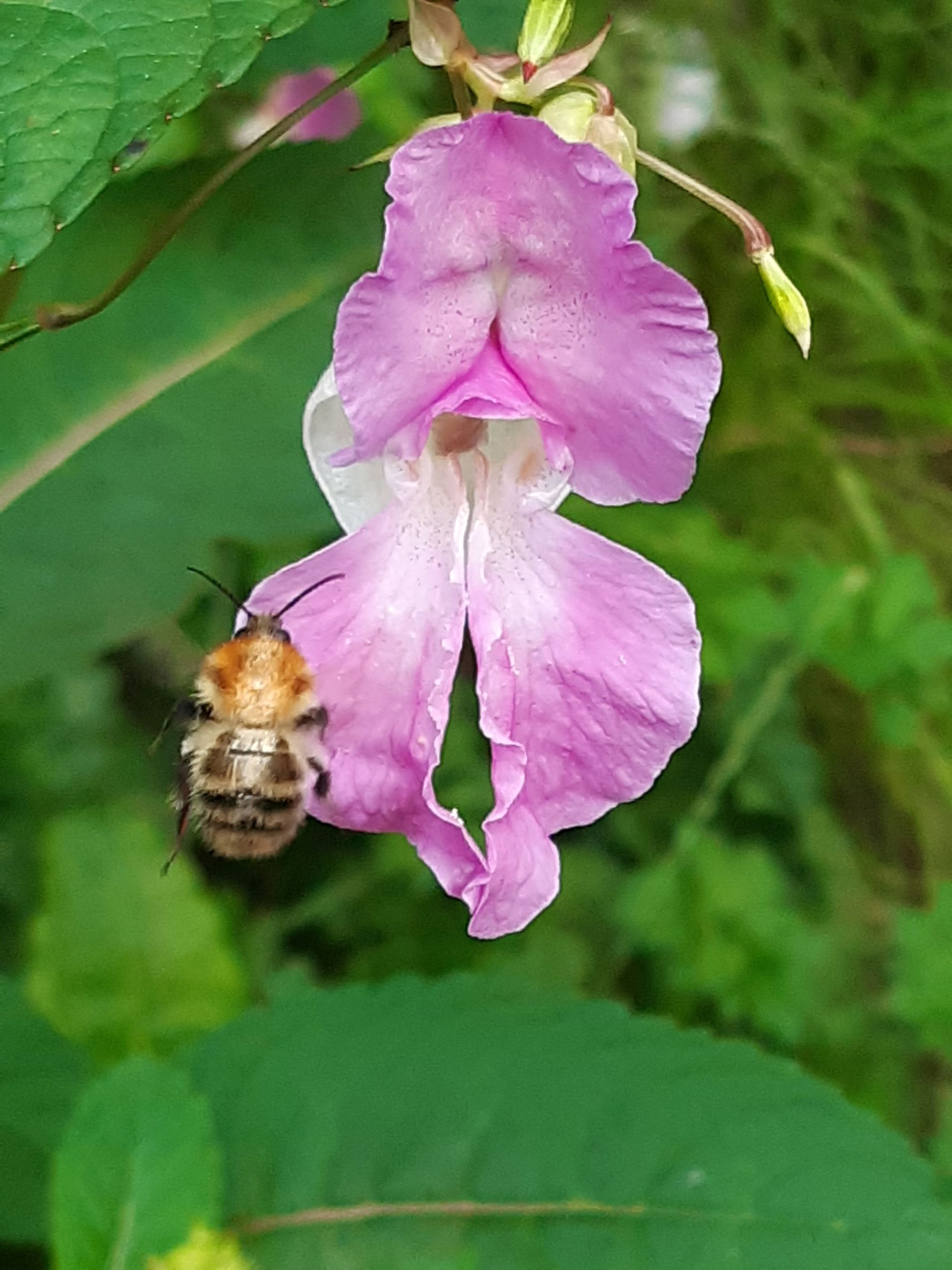
Himalayan Balsam with Common Carder bumble ...
... the bum of a tree bumblebee ...
... and the tree bumble itself
Will be up that way again soon.
Subscribe to:
Posts (Atom)


.jpg)