About Me

My photo
Bristol , United Kingdom
Poet and poetry facilitator. Neurodishevelled. My sixth poetry collection, Love the Albatross, is available from Indigo Dreams or directly from me.
Showing posts with label Winchester Cathedral. Show all posts

Thursday, 6 September 2012

Murder in the Cathedral

Last November I made my first visit to Canterbury and met up with my niece, Ruth, for a tour.  We had lunch first.  Then, as we were heading to the Cathedral, I had a call from Son the Elder, whom I'd deposited in Maidstone to watch a couple of sessions of Robot Wars.  He was bored.  Could I come and pick him up after the first session, please?

Thus, our visit to the Cathedral was somewhat rushed.  Also, I had it in my head that I would get back there this year, so didn't write about it (apart from the amazing graffiti with serifs there).  However, a return trip now seems somewhat more remote that I'd anticipated, so I shall at least post some photos before I forget why I took them.  


As well as ancient graffiti, I have a penchant for  worn flights of steps.  This isn't quite as impressive as the one leading to the Chapter House in Wells Cathedral, but I liked the way the light was catching the edges.  All those feet wot have trod up it, blah blah blah ... 
I'm only picking out a few things, partly because Ruth popped my guide book into her bag at one point because my hands were full and I never did get it off her.

This is a detail from the exquisite 1480 mural of the legend of St Eustace, showing the Roman General Placidus (Eustace) on his knees before a stag, between whose antlers he can see a vision of the crucified Christ.  Various events in the middle section of painting show Eustace's new found Christian faith being tested. At the top, Eustace, his wife and children are roasted to death inside a bronze statue of a bull on the orders of Emperor Hadrian (AD118) for failing to make a pagan sacrifice.  Which seems a bit harsh.  

I loved this stalwart, double-chinned cherub and could easily imagine it making jam when the Cathedral is closed to take to the next meeting of the WI.  


Who'd have thought that The Walt Disney Company moonlighted as stained glass window artists?


More to my liking was this window by Harry Stammers. 


There was, of course, all the wonderful soaringness you need in a mighty mediaeval Cathedral.


This vista lifted my spirits all the way up there with it also.
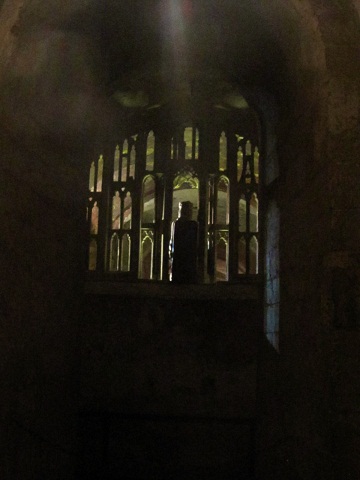

But my overall favourite part was the 11th century  Crypt, where for some undisclosed reason, you're not allowed to take photos (which meant that I had to sneak a few, obviously.)


This is a wonderfully delicate roof painting, ill-served by me and my camera. 


Not to be outdone by Winchester Cathedral, Canterbury has commissioned a sculpture, entitled Transport, by Antony Gormley for its Crypt.  Whilst it lacks the atmosphere of the stunning flooded Crypt of Winchester, where the figure interacts with, and is enhanced by, its watery surroundings, I still love this recumbent  floating body made from ancient nails replaced when the Cathedral roof was repaired.  


It's more a defined space than a solid, floating above the site of St Thomas Becket's first tomb, where he lay from the date of his murder in 1170 until 1220, when his bones were removed to a shrine in the newly completed Trinity Chapel.     


Talking of which, here's the eternal flame burning at the site of the shrine, which was destroyed, along with sainted remains, on the orders of Good King Psychopath in 1538.  


Time really was running out and I was feeling anxious about not having left to drive back to Maidstone, except that I was really very very anxious, to the point where it was difficult to breathe and then I turned and looked up and saw in front of me a small altar surmounted by a sculpture of murderous swords.  

I hadn't realised until then that Becket had been killed not where the flame was, but here, near the stairs into the Crypt.


'The wicked knight leapt suddenly upon him, cutting off the top of the crown which the unction of sacred chrism had dedicated to God.  Next he received a second blow on the head, but still he stood firm and immovable.  At the third blow he fell on his knees and elbows, offering himself a living sacrifice, and saying in a low voice, 'For the name of Jesus and the protection of the Church, I am ready to embrace death.'  But the third knight inflicted a terrible wound as he lay prostrate.  By this stroke, the crown of his head was separated from the head in such a way that the blood white with brain, and the brain non less red from the blood, dyed the floor of the Cathedral.  The same clerk who had entered with the knights place his foot on the neck of the holy priest and precious martyr, and, horrible to elate, scattered the brains and blood about the pavements, crying to the others, "Let us away, knights; this fellow will arise no more."'       


Edward Grim


Sunday, 15 July 2012

Beauty Things in Winchester

It was off to Winchester yesterday with Pameli Benham, who was going to see a friend perform in a play at the Chesil Theatre.  Meanwhile, I had designs on the Cathedral, having spent so long in the pub and Christmas Market during my only other visit to Winchester that by the time I got round to a bit of culture, it was too dark to see anything.  I also wanted to see the City Mill and take a wander along the river in the footsteps of Keats, who sojourned there in 1819 following his brother Thomas's death, and was inspired to write Ode to Autumn.     So after a toothsome lunch in The Corner House, Pameli and I went our separate ways and I made a beeline for The Close.

The usual stunning soaring stuff inside, but like every other Cathedral or Church, Winchester has its own particular points of interest, almost all of which I'd missed the last time, the
first being Jane Austen's grave,
memorial and commemorative window. 

A skitter past the lavishly decorated font of c1150, and I encountered the Ephiphany Chapel, which was always going to be right up my alley, boasting four Morris & Co windows designed by Edward Burne-Jones and a beautiful Agnus Dei by Eric Gill.


The next absolute glory was the medieval wall paintings in the Holy Sepulchre Chapel.  Dating from the 12th century, they were covered over during one of our several Cultural Revolutions and only rediscovered in the 1960s ...  


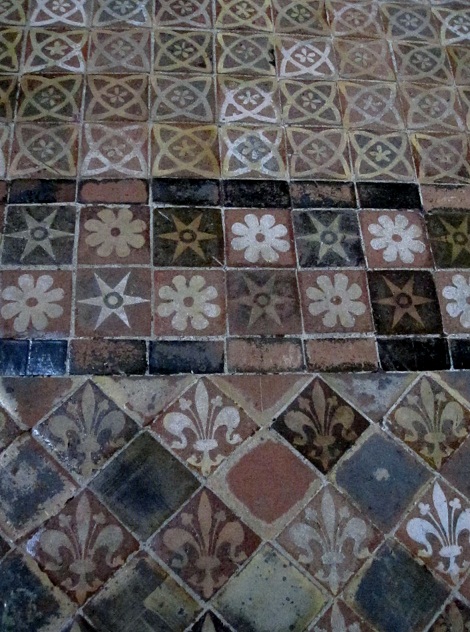
... closely followed by the huge expanse of 13th century floor tiles, over which pilgrims would cross on their knees ...


... to visit the shrine of St Swithun.  (It was tempting to offer up a prayer or two for fine weather, it being St Swithun's Day the following day - and it has been fine, but as I forbore to slither across the tiles on my knees, I'm not holding my breath for forty days of non rain.)


There were ancient tombs and memento mori aplenty and exuberant misericords in the choir, although the huge stone screen was partly covered in scaffolding and it was difficult to appreciate it fully.  Oh and the enormous Norman pillars were smothered in graffiti with serifs, one of my joys in life.  Below is a set of initials from 1582.  

The Cathedral was closing to the public earlier than usual because there was a special service taking place, but I made sure I had time to pop down to the crypt and I was so glad I did.  Despite the prodigious quantities of rain we have had lately, I wasn't sure it would be flooded, but it was and I was pleased because it meant that Antony Gormley's sculpture, Sound II, was in its element - literally - and a heart-stoppingly beautiful and tranquil sight.   


The Riven Itchen was fairly high and, being a chalk stream, running fast through the ancient city and under the City Mill.  It felt strange to stand in the room above the mill race and feel the floor trembling.


There was no time to wander in the company of Keats down to the Hospital of St Cross and Almshouse of Noble Poverty, but that's fine because it means I shall have to return some time. Maybe in autumn, perhaps ...