About Me

My photo
Bristol , United Kingdom
Poet and poetry facilitator. Neurodishevelled. My sixth poetry collection, Love the Albatross, is available from Indigo Dreams or directly from me.
Showing posts with label Bristol City Museum. Show all posts

Tuesday, 3 April 2018

The Vanity of Small Differences: Grayson Perry at Bristol City Museum

And so to Bristol City Museum to see (another) Grayson Perry exhibition, The Vanity of Small Differences.

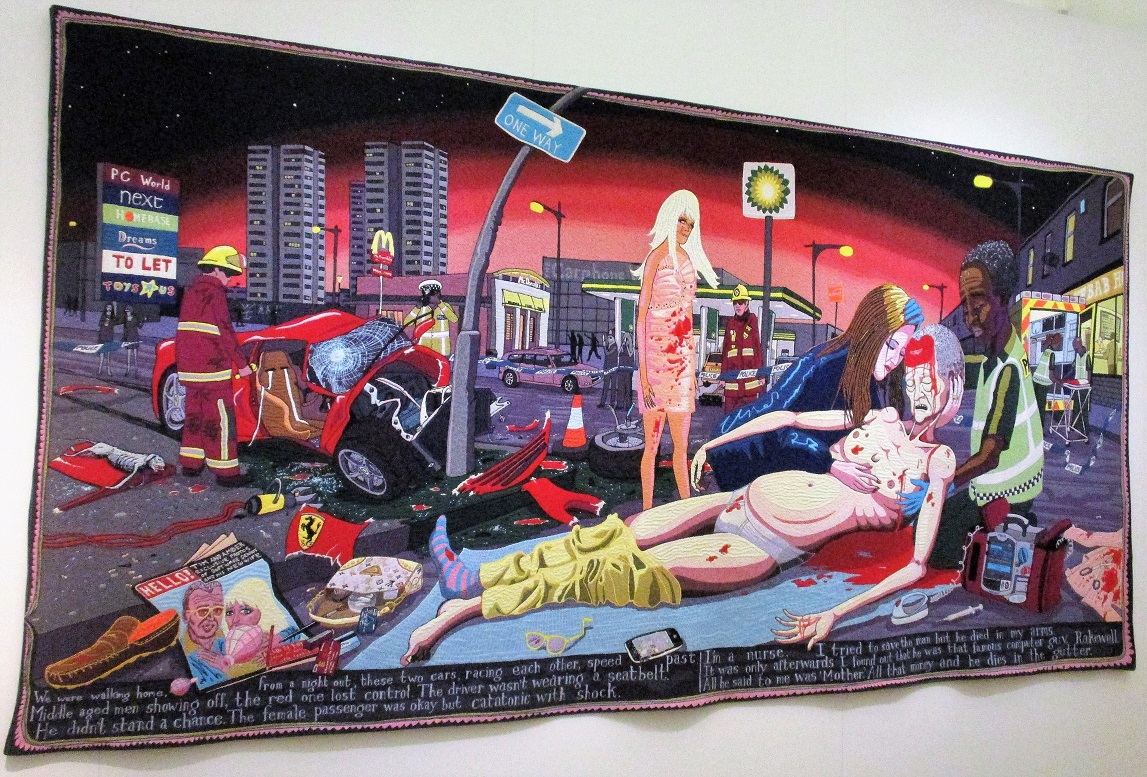
The set of six tapestries explores one of his favourite topics, class, through the story of working class lad, Tim Rakewell, who leaves his working class Sunderland home, goes to university, marries a middle class girl whose father mocks his accent, makes shedloads of money developing apps, buys a stately home, and dies crashing his Ferrari while showing off to his new trophy wife. The exhibition is augmented by the original 'Rake's Progress' print series by William Hogarth and David Hockney, as well as some 18th century ceramics from the museum's collection, for added context.  


The Adoration of the Cage-Fighters


The Agony in the Car Park


The Expulsion from Number 8 Eden Close


The Annunciation of the Virgin Deal


The Upper Class at Bay (or an endangered species)


#Lamentation


Like many people, class makes me uncomfortable. The daughter of working class Tories, I was sent to a direct grant girls' school, which my parents felt would give me a 'good' education. I encountered a degree of prejudice there, from some members of staff and the parents of pupils (although not so much from the pupils themselves). I never fitted in, but then I found I didn't fit in at home any more either. I emerged from my schooling a socialist, much to the dismay of my parents.


Here's one of those mothers. 


And I know this well-appointed room too because I had breakfast in it one sunny morning 40-odd years ago. The father of the family asked me if I wanted margarine or butter on my toast, and I didn't know what the right answer was. We had margarine at home, though, so I guessed butter would probably be the more acceptable response. W
rong!

'Oh well, if you want to die of coronary arterial disease, that's your look-out,' he said, shoving the butter dish in my direction. 

I looked up 'coronary arterial disease' later.  


So I don't like to think of book-lined rooms as being a sign of membership of the middle classes. 


Or these lovely Penguin mugs. (We've got two.)


Or William Morris - for god's sake, he was a founding father of socialism.


Or even protest itself. 

 Does it matter? Is this all vanity, as the name of the exhibition suggests? 


Sometimes art imitates life. During a pause in the rolling film feature before it restarted, a woman came through the open door and rushed towards me. 

'It's the poet, Debbie Harvey! I've heard so much about you, I've always wanted to meet you!'

I clocked the Debbie - not my writing name. But I'd never seen her before in my life. Or had I? I'm rubbish at faces, and even worse at faces out of context. 


Then relief. My oldest friend was right behind her. 

We hugged and kissed and laughed at our chance meeting. The opening titles started to play. Instantly a woman behind us said, very loudly, 'Would you please go outside if you want to talk. Some of us came in to watch.'

And there we were, right back in school in our handknitted cardigans, not knowing what lasagne or salami was and bemused by peers whose homes were so warm they could wear t-shirts in January. I don't think you ever really leave where you start out. 


Friday, 8 December 2017

Grayson Perry - The Most Popular Art Exhibition Ever! - Arnolfini, Bristol

One of my favourite pieces of art ever is God Please Keep My Children Safe by Grayson Perry, which I saw at the Love exhibition at Bristol City Museum back in 2008. More than any other artwork I've encountered, it epitomises for me that obsessional and terrific  love with which your life is weighted the instant you feel your baby shift inside you. (I don't mean terrific in the sense of 'mahvellous, dahling'; I mean 'Causing You Terror'. Because in that instant you know that your life is utterly bound up, one way or another, with this new one for the rest of its duration.) 

Suffice to say, I've been really looking forward to seeing the most recent exhibition of Grayson Perry's work in Bristol - The Most Popular Art Exhibition Ever! - at the Arnolfini. If I were still writing my arts column for the local paper, I'd have been down there to see it a lot earlier in its run, but I'm not and I'm glad, too, since the note to one of the exhibits - Puff Piece - says that GP can't bear to read any of the reviews of his shows these days, as the good ones affect him just as much as the negative ones. (Not that he would have come across said local paper, of course, but even so.) 

Anyway, I'm just going to post photos to remind me of my favourite bits, and of the fun I had watching other visitors to the exhibition react to the pieces on display. 


Battle of Britain


Battle of Britain (detail)


Kenilworth AM1


Matching Pair 

the Remain pot 


the Leave pot 


Marriage Shrine


(The outside trying to break  in. This is through the gallery window, not an exhibit.)


Alan Measles and Claire Visit the Rust Belt

Jeremy Corbyn holding Claire's hand while Theresa May and Boris Johnson look on 


Trump kissing Alan's hand as Melania Trump and Nigel Farage look on


The Digmoor Tapestry


(More obtrusive outdoor scenery through the windows)


Red Carpet


Our Mother


Puff Piece (detail)


Luxury Brands for Social Justice


'rich people deserve equal rights too!' ... 'war and poverty are bad, I learnt that at university' ... 'super expensive knick-knacks against facism' ... 'all my ideas are recycled' ... 'liberal values sold here' ... 'this art makes me a better person' ... 'I've read all the academic research about empathy' ... 'remind me what it it we're protesting about' ... 'let them eat conceptual art' ... 'I'm off to buy a very serious piece of political art' ... 'poor places are so much more authentic' 


Animal Spirit and Object in Foreground

Death of a Working Hero (detail)


Shadow Boxing (detail)


Reclining Artist


Long Pig


What I like best about GP's work is its layered quality, which is most evident in the pottery and tapestries. There is always so much more going on beneath the surface, and the longer you look, the deeper you see. It's something I always try to do in my poems, and I left the exhibition more determined than ever to achieve that.

Grump of the Day was that the perspex boxes protecting the pottery and sculptures, whilst necessary, were horribly smeary and in need of a good clean. 

Final Joy of the Day was the discovery that having waited years for one to come along, a second Grayson Perry exhibition, featuring six tapestries inspired by Hogarth's The Rake's Progress, will open at Bristol City Museum on 31st March 2018. 

Saturday, 31 December 2016

Warrior Treasures: Saxon Gold from the Staffordshire Hoard at Bristol City Museum

It would be a physical impossibility for me to walk past an exhibition containing the word Hoard and featuring items from the largest stash of Anglo-Saxon gold ever found. How odd, then, to find myself in a space inhabited - while I was there, at least - only by men. I suppose the word Warrior might put many women off, but they're missing some perfect, precise craftwork that would put the majority of stuff on Pinterest or Etsy to shame. Like this:

A Seax hilt plate 

A Seax is a type of single-edged dagger. The pattern on this hilt plate is of running animals, each holding the hind leg of the one in front in its mouth. 

If, like me, your knowledge of the Dark Ages is at best sketchy, there's lots of useful information about the various parts of the sword, and a potted history, from the departure of the Romans in 410AD to the invasion of the Normans, which helps put the exhibits in context.  (The hoard is believed to have been buried approximately midway through this period, around 1300 years ago.) But it's the timeless skill of the goldsmiths that is so memorable - the finest of work wrought without aid of magnification, electric light or sophisticated tools. It's fascinating and breathtaking, and reminded me of the examples of embroidery worked by Bess of Hardwick's servants, on show at Hardwick Hall, only older and goldier.

As you can see, my photos aren't very good on account of the very small size of the exhibits and the darkness necessary to show them to full advantage. There's plenty of better ones on the Staffordshire Hoard website

A bird of prey with double spiral filigree decoration 
What I found most affecting is that almost all the pieces are in a damaged or fragmentary state. They're the spoils of war, ripped from the weapons of dead or dying men and buried for later retrieval - although probably not as late as 5th July 2009, which is when they were discovered by heroic metal detectorist, Terry Herbert. The detail of each design depicts the original owner's status, wealth, family and even his religious beliefs - knowledge lost to us for ever.

Anyway, I highly recommend this exhibition even if you don't watch Game of Thrones. It runs until 23rd April, but the presbyopic attendee is going to need their reading glasses to get the full benefit of what's on display.  


Sunday, 17 January 2016

Death: The Human Experience Bristol City Museum

So, I finally made it there and this is a review I wrote.

In a week which saw the death of not just the most influential musician and cultural icon of the last 45 years, but also one of our greatest, best-loved actors, it felt like an appropriate time to visit the current exhibition at Bristol City Museum, entitled Death: The Human Experience.


This comprehensive exhibition features five sections based on key human experiences of death - symbols of death; stages of death; attitudes to death; human remains; and science and ethics – and includes hundreds of objects and images relating to each aspect from different cultures around the world.  These range from the familiarity of a stuffed crow, a wreath of lilies, and a porcelain mortuary table from the former Bristol General Hospital, to a reconstruction of a mediaeval plague doctor’s mask, a Ghanaian fantasy coffin in the shape of a rather fearsome-looking tiger, a 1900 watercolour copy by archaeologist Adela Breton of a Mayan temple wall painting featuring human sacrifice, and mummified body parts.


These are presented alongside interactive features, such as the (variable) point at which one might be considered dead, and a series of quotes, including Mark Twain’s rather jaunty assertion, ‘I do not fear death. I had been dead for billions and billions of years before I was born, and had not suffered the slightest inconvenience from it.’

Rather surprisingly, given the breadth of objects on display, the item that had the most effect on me was the first I saw: an X-ray of a (living) skull by Mariele Neudecker, entitled Truth is an Overrated Virtue, which was startling in its fragility. 


I was also intrigued by another exhibit, entitled An Affidavit Certificate, dated April 21st, 1707, Proving that Thomas Mathew was Buried in Wool, which shows the said Bristolian Thomas's burial preference, as follows:

'These are to certifie that the body of Thomas Matthews lately de interred in the parifhe of St Nicolas was not put in, wrapt, wound up or in any shurt, shift, sheet or shroud, made or mingled with flax, hemp, silk, hair, gold, silver or other then what is made of sheeps woll only, or in any coffin lined or faced with any cloth stuff or any other thing what so ever made or mingled with flax, hemp, silk, hair, gold or silver or any other material but sheeps woll only The truth where of attefted by ………… as well by their hands and seals herunto selt and subfcribed as by their refpective oaths taken before me.. one of.... majifties Iuftices of the peace for the.. a fore faid
As witness my hand the 21st day of the April in the 6th year of the reign of the.... over England and c....'


The only minor criticism I have is the tone of some of the information boards which, in their exhortation to visitors to reflect upon their own journey to death, come across as slightly patronising at times.  As it is, I left with an enhanced grasp of the sheer normality of death as the end to which we are all progressing, which shapes our lives and gives them meaning.


The entrance fee for Death: The Human Experience, which runs until 13th March, has been waived, with visitors being encouraged instead to pay what they think it is worth. I hope very much that the museum makes some money out of this excellent and well-attended exhibition. 


All photos ©Bristol City Museum website