
Well, not cavorting really. I was there to visit a friend of very long standing, who's been poorly lately. First, though, a flying to visit to Coventry Cathedral, which, I'm ashamed to say, I'd never visited before.
Everyone says not to approach the new Cathedral until you've explored the ruins of the old. So I did, at length.

I'd guessed it would be a chastening experience, and possibly also a reminder of the bombsites of my childhood, Bristol having been blitzed heavily too (although not to the point where a new word was coined to describe what happened - koventrieren, to completely destroy). Even so, I wasn't prepared to feel as tearful as I did within two minutes of entering, when I saw the (replica of the) charred cross that was made from two fallen roof beams the day after the old cathedral's destruction, with Father Forgive inscribed on the wall behind it.

Everywhere there's evidence of that night's murderous destruction ...
.jpg)
.jpg)

... but also of peace and reconciliation, most notably in the artworks that link the city with Dresden and Hiroshima, Berlin and Belfast.

Jacob Epstein's Ecce Homo

The only memorial to have survived the fire-bombing is that of Bishop Yeatman-Briggs, who died in 1922. The band of his mitre is embellished with three fylfot crosses, otherwise known as swastikas - but which had yet to acquire their unfortunate - and in this instance, ironic - connection with fascism.

Work on the new cathedral started in 1954, with Basil Spence appointed architect, and lasted eight years, the new Cathedral opening in 1962. The first thing you notice as you walk in is the vast Baptistery window, designed by John Piper and made by Patrick Reyntiens, who also worked on Liverpool Metropolitan Cathedral together. Their work here is no less stunning.
A guide came over and asked if I had any questions, but all I managed was some hand-waving, indicating much emotion.

The stone in front of the window is a sandstone boulder from Bethlehem, carved to serve as a font.

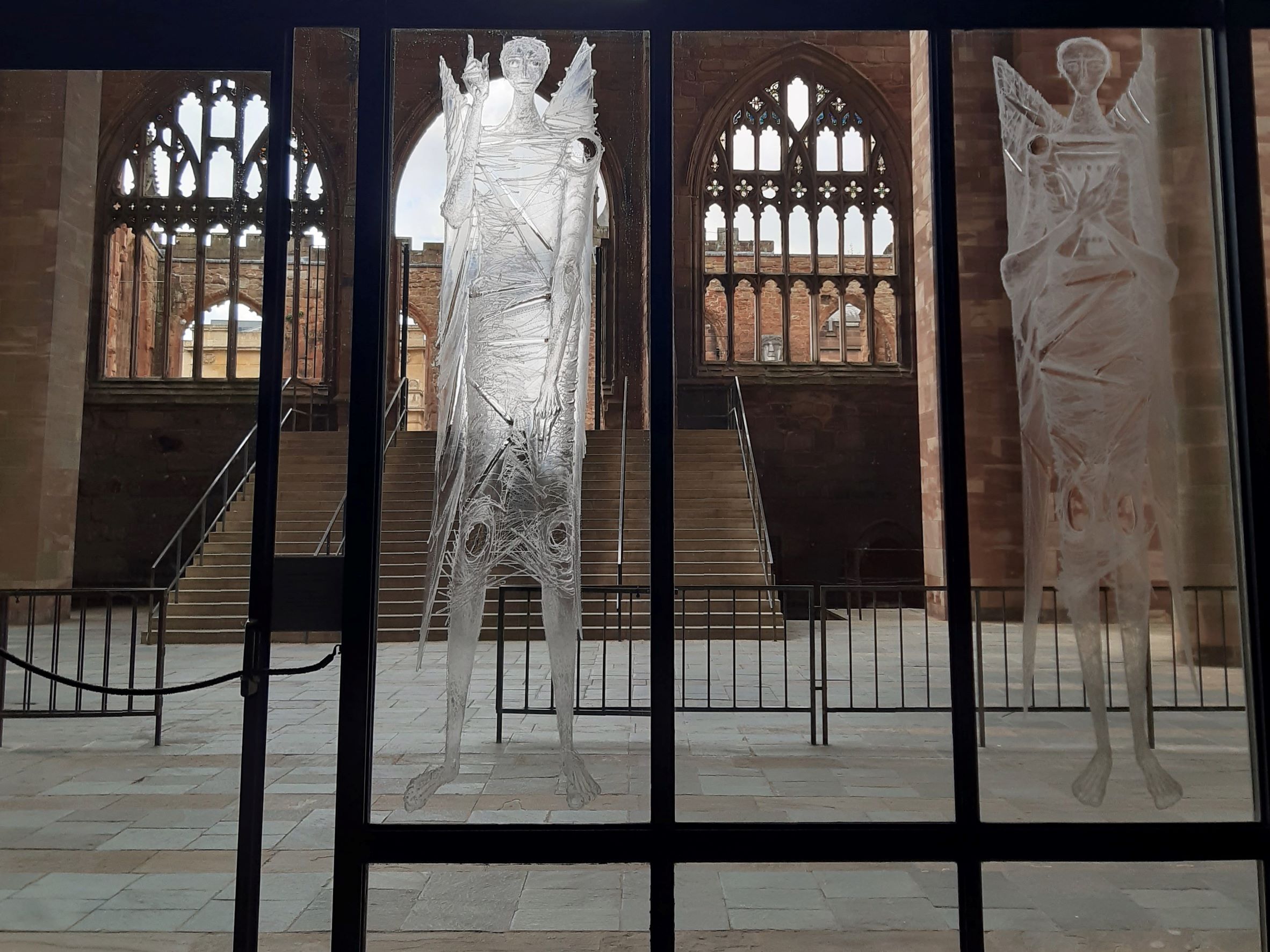
It was only at this point that I turned to really look at the West Screen, through which the new cathedral is entered (though it's only the West Screen liturgically speaking, being on the actual south side of the building on account of its positioning at right angles to the ruined original). It's just as stunning as the window, once you notice it. I've never really held with the notion of saintly saints, and angels whose mission it is to help you find a parking space, and the saints and angels here, designed and engraved by New Zealander John Hutton, are really quite as focussed and scary as I've always thought they must be. At first they made me think of the illustrations of my favourite book illustrator, Charles Keeping, and then the White Walkers from Game of Thrones, and I remembered seeing more angels of their ilk in Guildford Cathedral (also Hutton's work).



The back of Jacob Epstein's Heroic Torso
The other windows angled the length of the nave only come into view as you walk down it and are equally beautiful, rising to a height of 25 metres. They were designed by students and a tutor at the Royal School of Art. It's difficult to do them justice with a camera phone.


The liturgical east end of the nave - which is the actual north end of the building - is graced with a tapestry of Christ in Glory in the Tetramorph, designed by Graham Sutherland.


The tiny cross you might just make out at the centre of the High Altar cross is made from mediaeval nails that were found scattered over the floor of the ruins after the bombing. This is the first of many such crosses made of nails and distributed around the world in the aftermath of the war, as symbols of hope and reconciliation.
Oh and while we're down here, look at this organ. (This is just one side of it.) I think there was a lunchtime recital scheduled the morning I was there, so maybe I was lucky and heard the rehearsal; anyhow, the playing was beautiful and added hugely to the atmosphere of the place.

The tetramorphs turn up again in one of the side chapels, the Chapel of Unity...

... which also has amazing stained glass windows.


... this moment of great beauty in the Chapel of Christ the Servant (or Chapel of Industry) ...

... and in the crypt a glimpse of a silver Altar Cross and candlesticks made by Arts and Crafts silversmith Omar Ramsden, which were rescued from the burning cathedral on the night of its destruction.

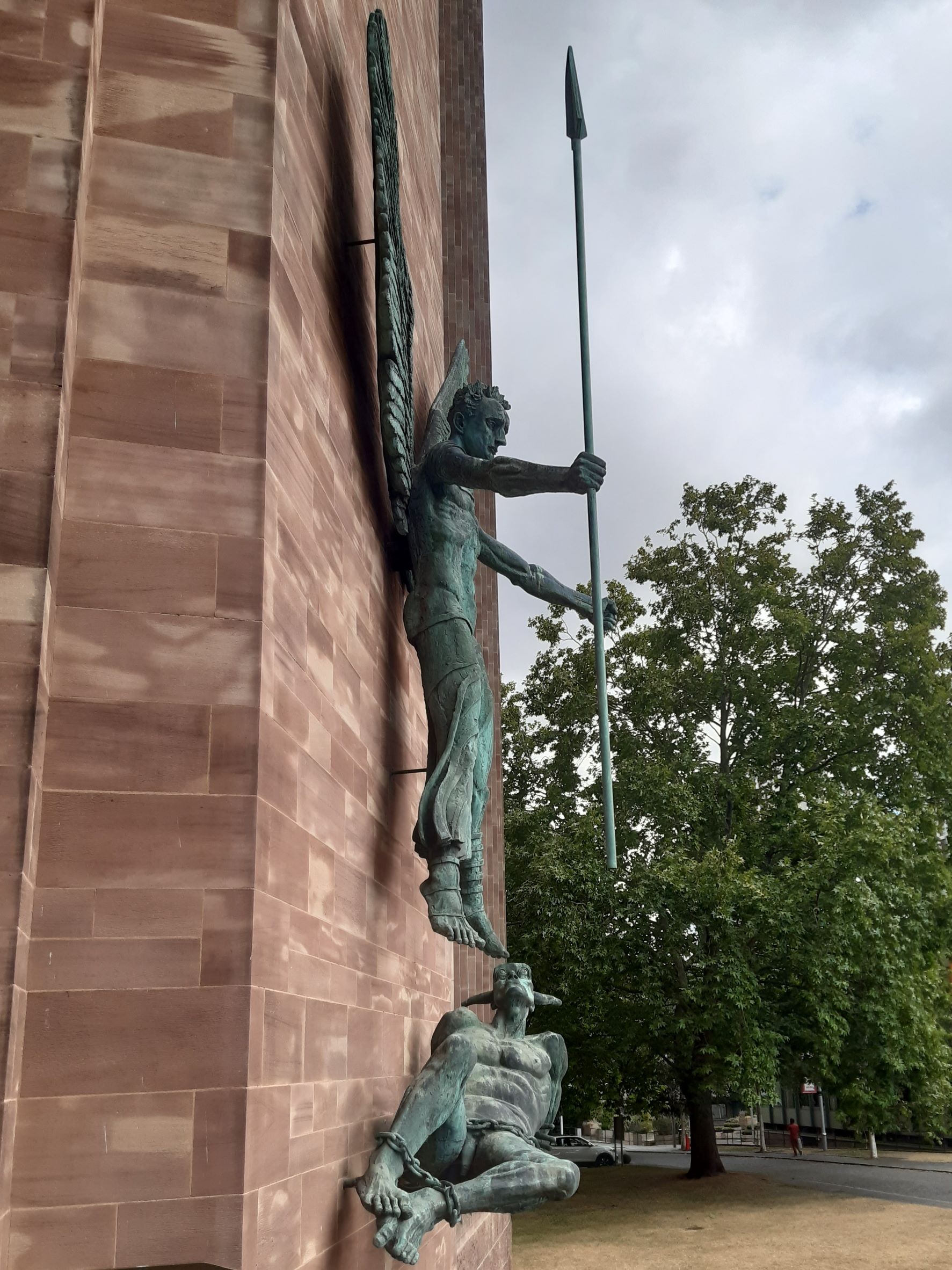
Epstein's St Michael's Victory over the Devil


I did see all this in my wanderings, however.

22 Bayley Lane - The Cottage - built in the early 16th century

The Golden Cross Inn, built in 1583 and still a pub, having been much frequented by local lad and celebrated poet, Philip Larkin
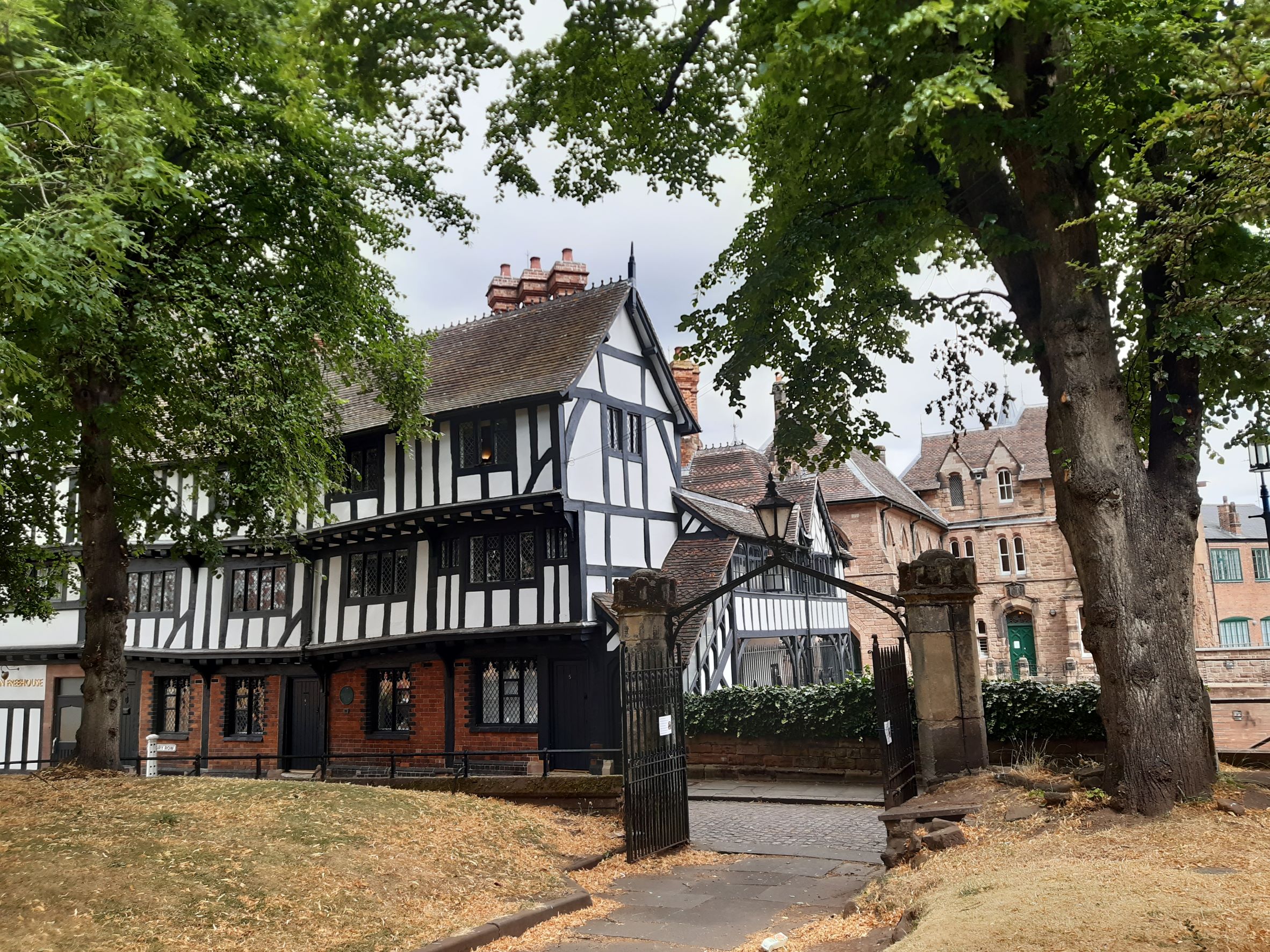
3 - 5 Priory Row - the Lychgate Cottages

'Man's Struggle' by Walter Ritchie, whose sculptures also adorn Bristol Eye Hospital

The Art Deco Ellen Terry Arts and Media building, named in honour of another famous local
Then off to suburbia - only a mile from the city centre - to see Angela in her fabulous cave of a home. Angela has worked all her life in the vintage clothing industry and her flat is stuffed with so many wonders, they'd require a blogpost of their own to do them justice.

I'll just mention this chair accommodating my bottom, one of four with a matching table, that used to be sat on by Robert Plant's bottom. Another holy moment in a day crammed with them.


