About Me

My photo
Bristol , United Kingdom
Poet and poetry facilitator. Neurodishevelled. My sixth poetry collection, Love the Albatross, is available from Indigo Dreams or directly from me.
Showing posts with label Coventry. Show all posts

Friday, 22 December 2023

Blinking in the light

Somewhere in one of the boxes of photos under my bed, there must be a picture of my friend, Angela Prior-Kimball, and me together, when we first knew each other at Lancaster University in the early 80s, but for a reason that has nothing to do with our friendship, I still haven't mustered the inclination to unearth them.  So here we are not together, Angela having taken the second photo, of which I was completely oblivious, at the 1983 graduation ball. 


On the face of it, our friendship was somewhat unlikely. Angela was ebullient, with a can-do attitude - to the last, as it turned out. She was good at tennis - her nickname at the time was Angela Prior-Lloyd-Bum (Lloyd after the then Chris Evert Lloyd) - and even then she had a fascination with fashion, and impressive boundaries. I, on the other hand, was bookish, definitely not sporty or fashionable, and riddled with insecurities. 

One episode I remember - which Angela had forgotten, although she appreciated it when I told her the last time I saw her - involved a rabbit fur coat my father had given me, which had been given to him by a former client from when he'd sold insurance. Of course, I wouldn't dream of wearing fur now, but this was the winter of 1981/2 , which was so cold it has its own Wikipedia entry, and I was steadily freezing to death in the west end of Morecambe, in a mouldy attic which was painted the colour of the inside of a Ladyshave box (as another friend memorably described it), so I suppressed a vague feeling of disquiet, and wore it. Until, that is, the night I bundled it into an alcove in what was then Lonsdale College bar, only for it to be gone when I came to catch the bus back to the Battery. 

Any relief I felt at not wearing rabbit skin over my own any more was swamped by anxiety at what my father might say when he found out I'd let the damn thing get stolen. I still wasn't fully reconciled to its loss when Angela turned up unexpectedly in my flat a few nights later and asked if I'd had any news of its whereabouts. I immediately launched into a description of where I'd looked, who'd been in the bar at the time, various false sightings, etc, only for her to start laughing and call me a silly moo because in my consternation, I hadn't noticed that it was draped around her shoulders. The landlord, it turned out, had put it behind the bar so that it wouldn't get nicked, but hadn't been there when I was looking for it, and had forgotten to tell me subsequently. Angela, though, like the Vintage Queen she was to become, had ferreted it out. 

Being a language student, I graduated a year later than Angela, in 1984, by which time she'd started her business, Heaven Vintage, and was rumoured to be managing a pop group. Within a few years I had multiple babies and she was appearing on The Clothes Show; then, by the mid 1990s, she was living in Miami and it seemed our paths had diverged for good ...

... though elsewhere, computer programmers were dreaming of a phenomenon called social media, and by 2011,  we'd re-forged our connection to the point where I dedicated a poem in Communion, my first poetry collection, to her. 

Even so, that might have been the extent of our rekindled friendship, were it not for a chance encounter in Stratford-upon-Avon in 2014. I was hurrying to the Royal Shakespeare Theatre to see Henry IV Part I with my partner; Angela was sitting in the sun with a friend on the corner of Sheep Street and High Street, and true to form, spotted me as I passed by, quite unaware, and shouted my name. 'I recognised you by your walk!' she declared, somewhat disconcertingly. 


After that, we kept in closer touch. My last two trips to see her in Coventry came after her diagnosis of Stage 4 ovarian cancer almost exactly two years ago. The first included a visit to the Cave of Wonders that was her flat on Blondvil Street, which address suited her to the ground.


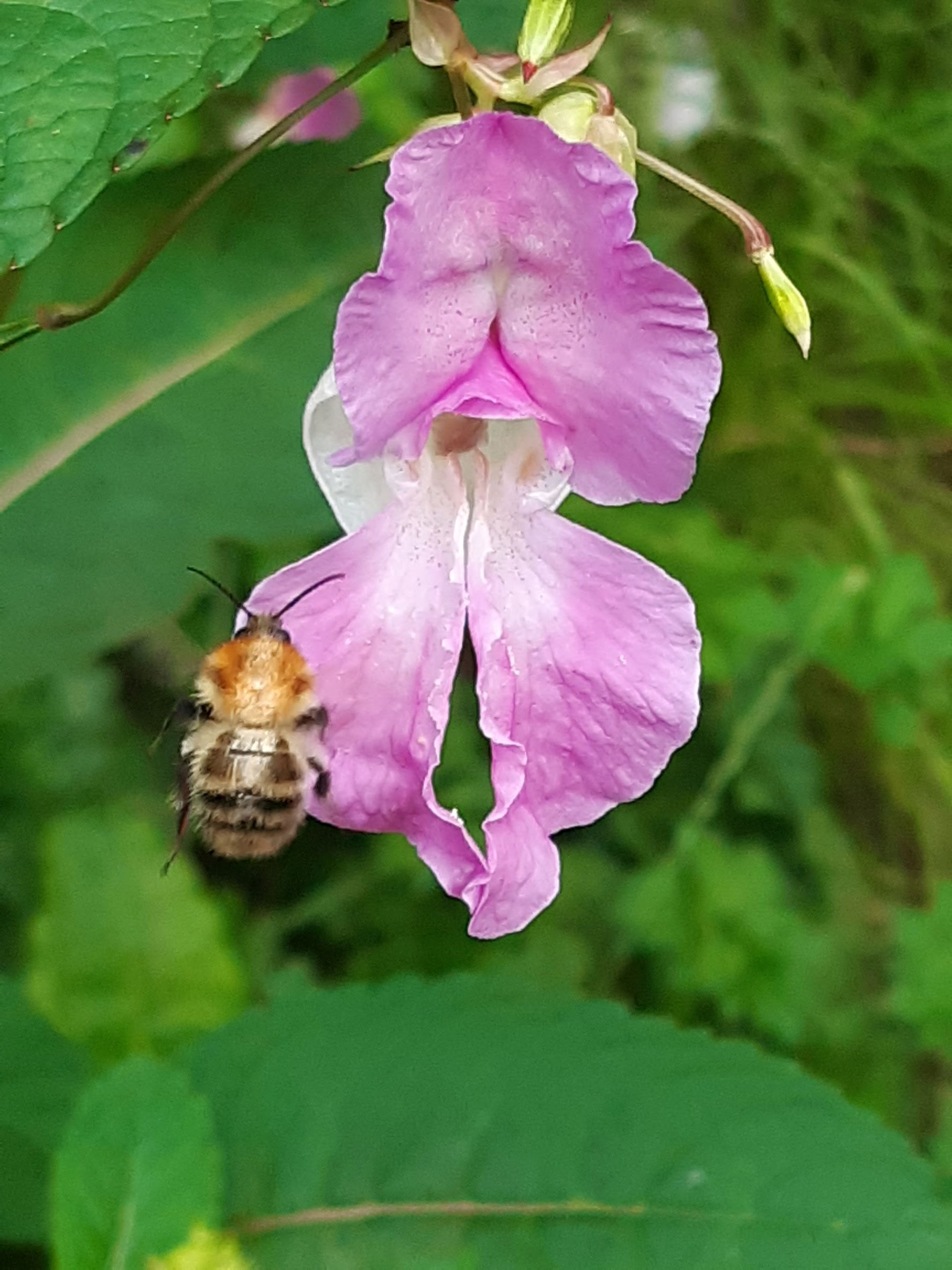
On my second visit this September we sat in the sun by the River Sherbourne at Charterhouse, watching the bees in the Himalayan Balsam and eating ice cream. Angela was as indefatigable as ever, planning a huge vintage fair to raise money for a new treatment that isn't available on the NHS. As I was hoping to go, I thought there was every chance I'd see her again, but a dose of Covid (mine) and Angela's cancer colluded, and although the fair happened in November, another visit wasn't to be. 

So it goes. Solstice feels like a good time to write this. The year has turned, and we're all heading towards the light; it's just that my dear determined friend has beaten us to it. 


Sunday, 17 September 2023

Ay, now am I in Arden

All I've ever really wanted, since I was a child, is a house with a garden that has a high wall around it and a door in the wall. Not too much to ask, you'd think. 

Oh, and windows with stone mullions, and a window seat. And crooked walls. Though the fact I've never lived, even temporarily, in a house with just one of these features makes me suspect it's almost certainly an unachievable dream, especially this late in the day. 


And now, to make matters worse, I want a moat, for which I blame Baddesley Clinton in Warwickshire, which I visited last weekend. Thanks, Baddes, for zapping that dream even further out of reach. 


Never mind. The real reason for my third foray to the Midlands in two months was to see Angela, friend from my undergraduate days, but having left Bristol early, I had time to visit this beautiful 15th century manor house, which I'd wanted to see ever since I first heard about it. 

As the house didn't open till 11am, I started with a wander around the gardens and grounds.


Look at this ancient vine planted outside the glasshouse but growing through the window and trained over the ceiling. 


Common Carder bumble bee


buff-tailed bumblebee on cardoon


three buff-tailed bumbles on cardoon


sheep grazing in the parkland


a rotten apple


There are several ponds of varying size, most containing quantities of duckweed, through which the ducks leave sinister black trails.


On the whole I prefer wild flowers to garden flowers, but every now and then, I fall for something spectacular, like these dahlias - I think they're called Black Narcissus. 

Inside the house, my eye was caught and caught again by the stained glass, most of which was installed by Henry Ferrers the Antiquary and dates from the 1600s.


In the kitchen there was the usual vintage kitchenalia, the usual fake comestibles and the usual priest hole (one of three). This one, the actual old garderobe shaft, leads to a narrow sewage channel, only four feet high, where in 1591, following a gathering of all the Jesuit priests and novices in the country, five remaining Jesuit priests, two novices and three Jesuit servants crouched for four hours while armed men pounded on walls above them, overturned furniture and tore off panelling in  search of them.

That they weren't discovered points to the ineptitude of the searchers - local thugs, apparently, who'd heard a rumour of the gathering and were after the reward money. 


Unbelievably, this colossal stone chimneypiece was once located upstairs, before being brought back down and installed in the Great Hall.


There's something so pleasing about ancient oak furniture and blue and white pottery


I'm not going to post photos of bedrooms with four-poster beds and artfully placed teasels so that punters don't sit on them; I'll stick with some other, more interesting rooms, such as this chapel. Before the Reformation, the Ferrers family, who gained ownership of Baddesley Clinton through marriage in 1517, worshipped in St Michael's, the mediaeval parish church close to the house - more about there later - but their loyalty to the Catholic faith meant they subsequently had to worship in private, and so they offered Mass in their domestic chapel. This version of it was recreated in the 1940s, the original chapel having previously fallen out of use and been used as a lumber room.


This is the Great Parlour, which was used as a studio in the second half of the 19th century, when the house was inhabited by 'The Quartet'. There's an interesting story attached to this group of people, namely, that in 1859 the wealthy novelist Edward Dering asked fellow-writer Lady Georgiana Chatterton for her niece, Rebecca Orpen's, hand in marriage. Lady Chatterton was hard-of-hearing and thought he was asking her to marry him, so accepted the proposal herself, despite being twenty years older than him. Edward, being too gallant to disabuse her, married her. Ten years later, they moved to Baddesley Clinton to live with Rebecca and her husband, Marmion Edward Ferrers, who owned it. Here they immersed themselves in the painting, writing, music, poetry and restoration of the house. Lady Chatterton died at the age of 70 in 1876, followed by Marmion in 1884. After a year of living together in the house with a Roman Catholic priest as chaperone, Edward finally got to marry his Rebecca, when they were 59 and 55 respectively. They had seven years together before Edward died in 1892, leaving Rebecca to live on for another 31 years.


In the library next to the studio there's a blood stain on the floor by the fireplace; allegedly, the blood of a priest murdered by Nicholas Brome, the owner of the house in the late 15th century. The story goes that he drew his sword and killed the priest in 1485  when he came home and found him 'chockinge his wife under ye chinne'. 

Except wouldn't there be more blood than that? I suggested to the NT volunteer stationed in the library that somebody was having somebody else on, and that was exactly the case: it was those naughty writers of the Quartet - 'you know what writers are like, they love a good story' - who spilled pig's blood on the floorboards for the entertainment of visitors. So while the murder really did happen, the evidence of it is fake - in fact, the part of the building housing the library wasn't even built until a century later.


Choughs featuring on a coat-of-arms


The courtyard


By now I was running a little late for my assignment with Angela, so I almost ran the several hundred yards up the lane to the Church of St Michael. The current building dates from at least 1305, but there's believed to have been a church on that site two to three centuries earlier. Until the 19th century, it was dedicated to St James.  


The painted table tomb of Sir Edward Ferrer, who died in 1535


I love the lectern with its simple etched decoration.

It's in the church that there's a final encounter with Nicholas Brome, who killed not one but two people during his life, having seen fit to avenge his father's murder by killing his assailant in 1471, 14 years before the murder of the priest. Being upper class, he got away with a fine for the first murder, and was pardoned by the Pope for the second, with the proviso that he renovated and extended the church. 
As part of his penance, he arranged to have his body buried vertically in the doorway of the church, so that people entering it would walk on his head. Hence the marker stone under the mat. 


And on to Angela in Coventry, where, after lunch at Fargo Village, we repaired to Charterhouse for ice cream by the River Sherbourne and a fine chin-wag, catching up on memories from 40 years ago and everything that's happened since we last saw each other. (Safer than a chinne-chock any day.)


Himalayan Balsam with Common Carder bumble ... 


... the bum of a tree bumblebee ...


... and the tree bumble itself 

Will be up that way again soon. 


Wednesday, 27 July 2022

Cavorting in Coventry

Well, not cavorting really. I was there to visit a friend of very long standing, who's been poorly lately. First, though, a flying to visit to Coventry Cathedral, which, I'm ashamed to say, I'd never visited before. 

Everyone says not to approach the new Cathedral until you've explored the ruins of the old. So I did, at length.


I'd guessed it would be a chastening experience, and possibly also a reminder of the bombsites of my childhood, Bristol having been blitzed heavily too (although not to the point where a new word was coined to describe what happened - koventrieren, to completely destroy). Even so, I wasn't prepared to feel as tearful as I did within two minutes of entering, when I saw the (replica of the) charred cross that was made from two fallen roof beams the day after the old cathedral's destruction, with Father Forgive inscribed on the wall behind it.


Everywhere there's evidence of that night's murderous destruction ...


... but also of peace and reconciliation, most notably in the artworks that link the city with Dresden and Hiroshima, Berlin and Belfast.


Jacob Epstein's Ecce Homo


The only memorial to have survived the fire-bombing is that of Bishop Yeatman-Briggs, who died in 1922. The band of his mitre is embellished with three fylfot crosses, otherwise known as swastikas - but which had yet to acquire their unfortunate - and in this instance, ironic - connection with fascism.  


Work on the new cathedral started in 1954, with Basil Spence appointed architect, and lasted eight years, the new Cathedral opening in 1962. The first thing you notice as you walk in is the vast Baptistery window, designed by John Piper and made by Patrick Reyntiens, who also worked on Liverpool Metropolitan Cathedral together. Their work here is no less stunning. 

A guide came over and asked if I had any questions, but all I managed was some hand-waving, indicating much emotion.   


The stone in front of the window is a sandstone boulder from Bethlehem, carved to serve as a font.


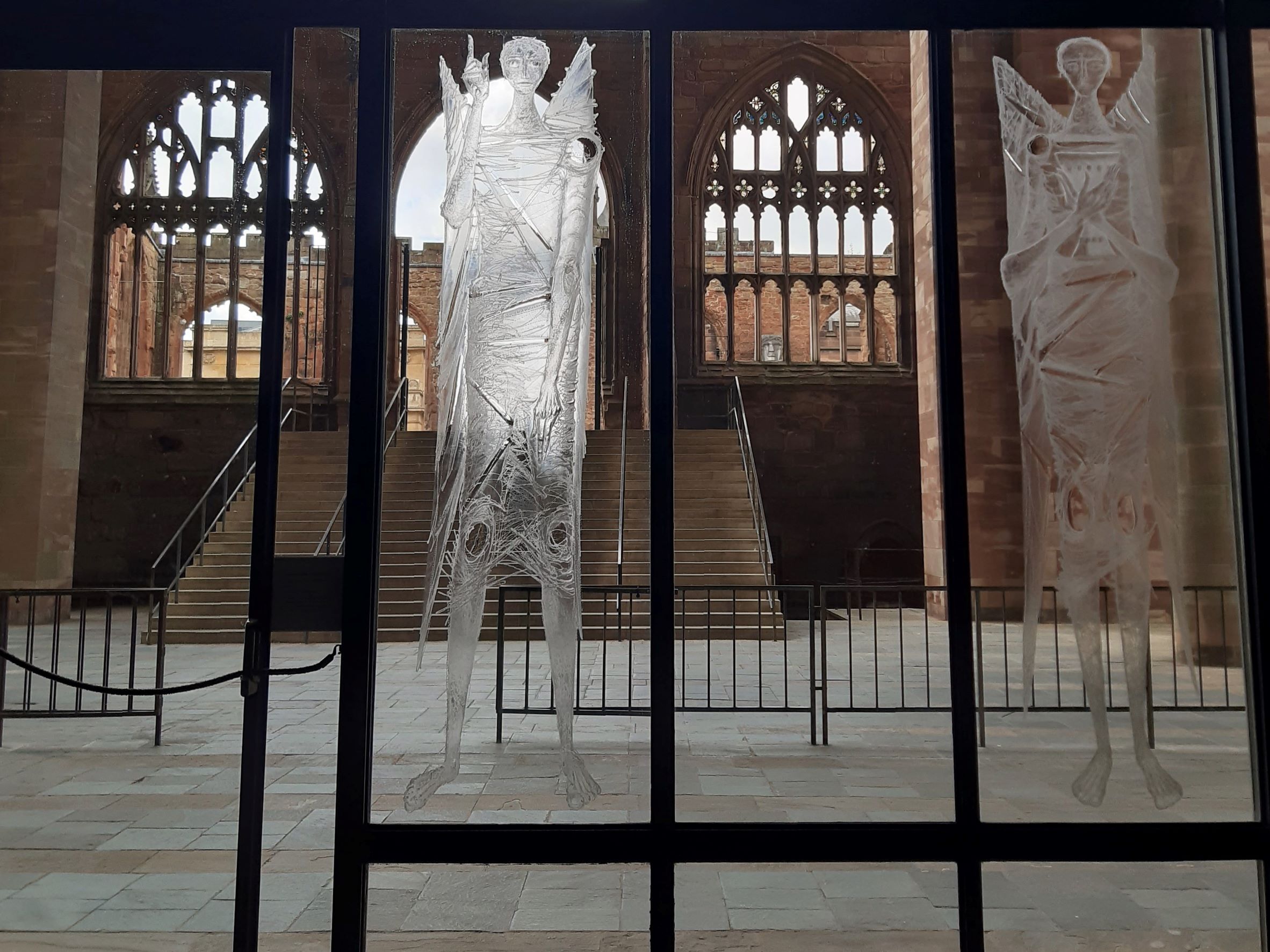
It was only at this point that I turned to really look at the West Screen, through which the new cathedral is entered (though it's only the West Screen liturgically speaking, being on the actual south side of the building on account of its positioning at right angles to the ruined original). It's just as stunning as the window, once you notice it. I've never really held with the notion of saintly saints, and angels whose mission it is to help you find a parking space, and the saints and angels here, designed and engraved by New Zealander John Hutton, are really quite as focussed and scary as I've always thought they must be. At first they made me think of the illustrations of my favourite book illustrator, Charles Keeping, and then the White Walkers from Game of Thrones, and I remembered seeing more angels of their ilk in Guildford Cathedral (also Hutton's work). 


The back of Jacob Epstein's Heroic Torso

The other windows angled the length of the nave only come into view as you walk down it and are equally beautiful, rising to a height of 25 metres. They were designed by students and a tutor at the Royal School of Art.  It's difficult to do them justice with a camera phone.


The liturgical east end of the nave - which is the actual north end of the building - is graced with a tapestry of Christ in Glory in the Tetramorph, designed by Graham Sutherland. 


The tiny cross you might just make out at the centre of the High Altar cross is made from mediaeval nails that were found scattered over the floor of the ruins after the bombing. This is the first of many such crosses made of nails and distributed around the world in the aftermath of the war, as symbols of hope and reconciliation.

Oh and while we're down here, look at this organ. (This is just one side of it.) I think there was a lunchtime recital scheduled the morning I was there, so maybe I was lucky and heard the rehearsal; anyhow, the playing was beautiful and added hugely to the atmosphere of the place. 


The tetramorphs turn up again in one of the side chapels, the Chapel of Unity...


 ... which also has amazing stained glass windows. 


By now I realised I'd spent so long fanning myself with my guidebook in order to bring me back to myself that I was running short on time. A quick dash around the liturgical eastern end brought 
an encounter with the original Charred Cross, now installed inside for its protection ...


... this moment of great beauty in the Chapel of Christ the Servant (or Chapel of Industry) ... 


... and in the crypt a glimpse of a silver Altar Cross and candlesticks made by Arts and Crafts silversmith Omar Ramsden, which were rescued from the burning cathedral on the night of its destruction.  


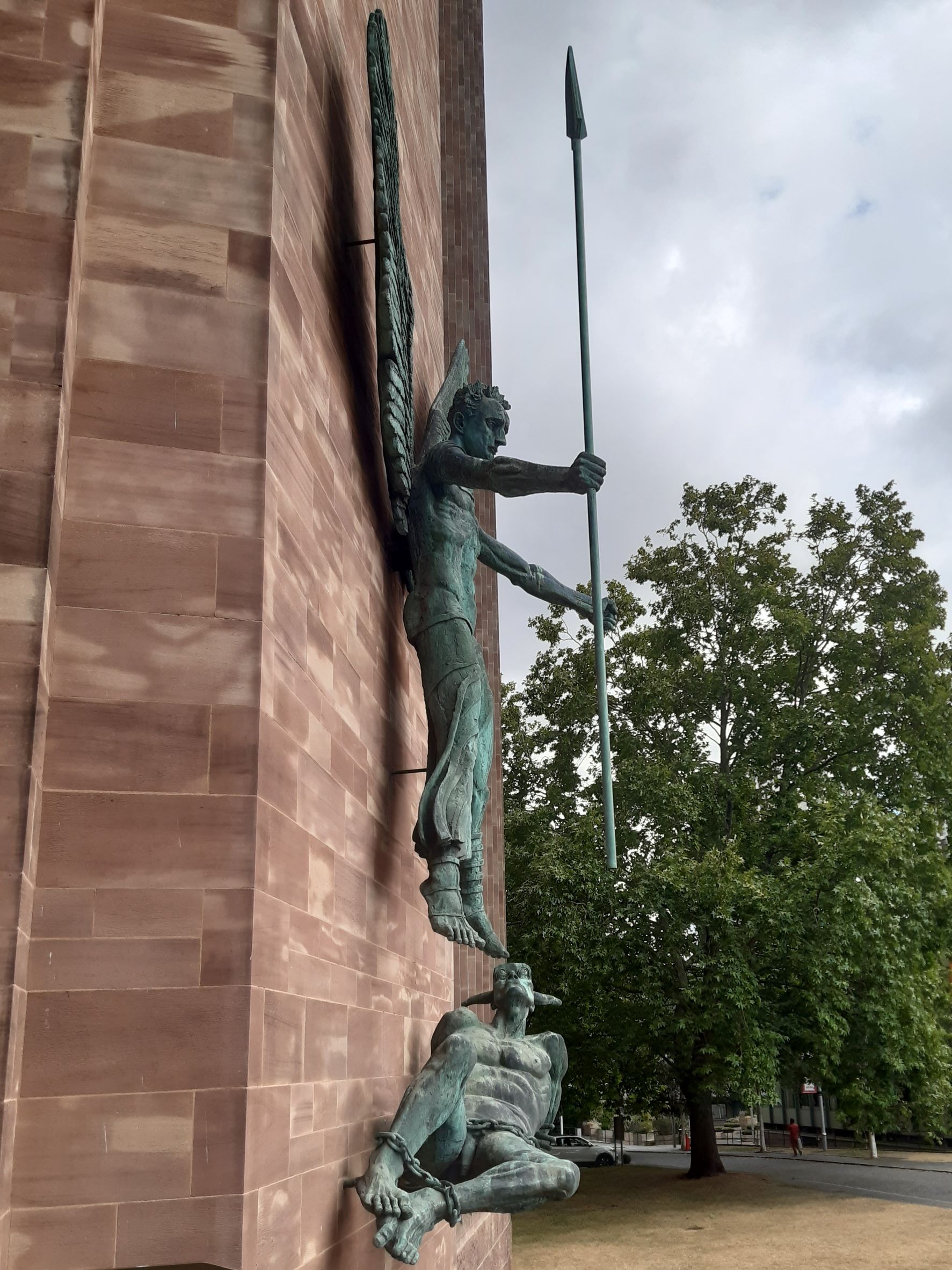
Epstein's St Michael's Victory over the Devil


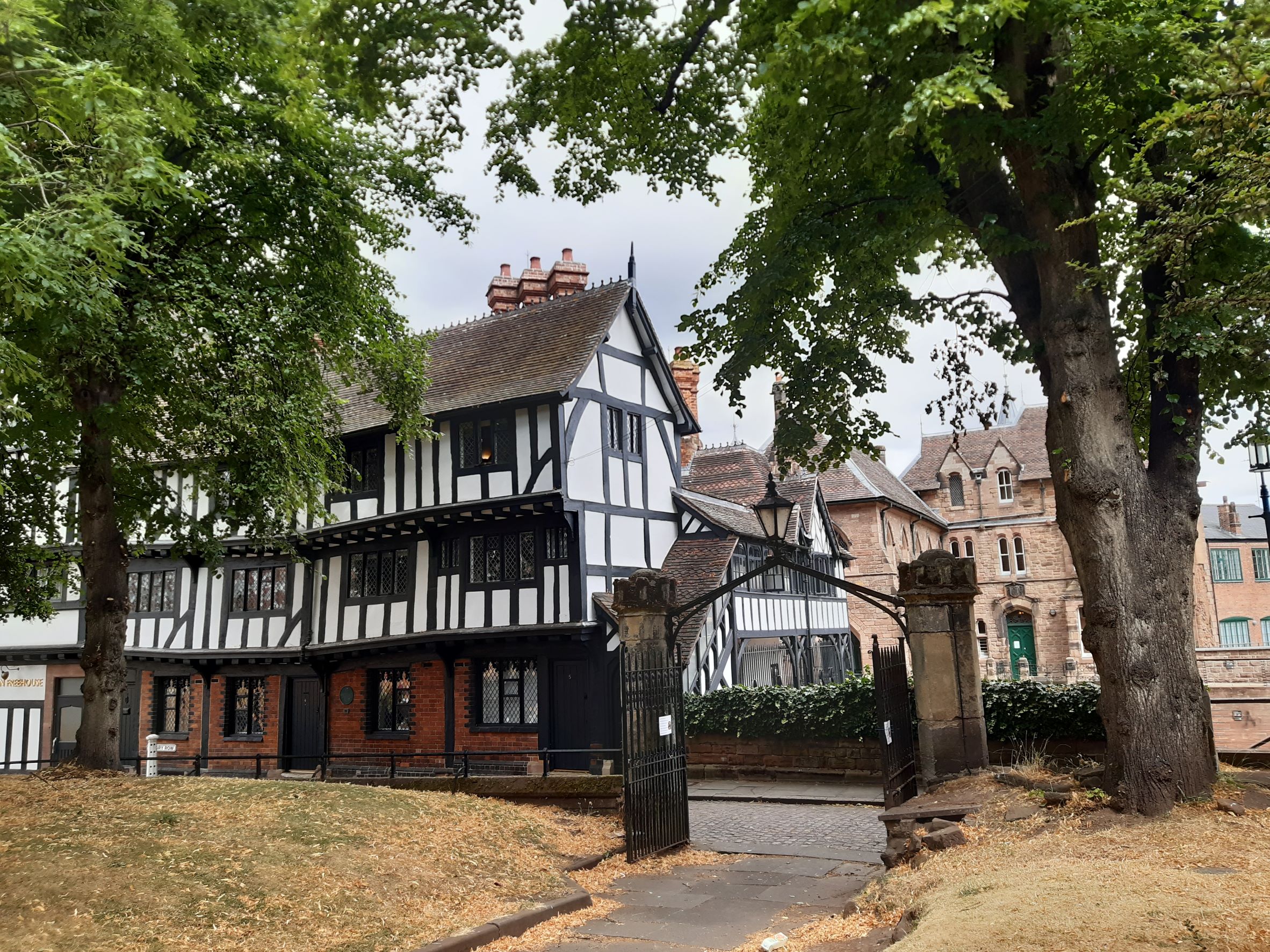
Despite the massive destruction visited on Coventry, there are still a few mediaeval buildings about. I was hoping to see the Coventry Doom in nearby Holy Trinity Church but it was locked, which meant I wasn't going to be as late going to see my friend, Angela, as I'd feared, hooray! Except that I promptly got lost, despite the combined efforts of Google and the map I'd printed to get me back to the car park. 

I did see all this in my wanderings, however. 


22 Bayley Lane - The Cottage - built in the early 16th century


The Golden Cross Inn, built in 1583 and still a pub, having been much frequented by local lad and celebrated poet, Philip Larkin


3 - 5 Priory Row - the Lychgate Cottages


'Man's Struggle' by Walter Ritchie, whose sculptures also adorn Bristol Eye Hospital


The Art Deco Ellen Terry Arts and Media building, named in honour of another famous local

Then off to suburbia - only a mile from the city centre - to see Angela in her fabulous cave of a home. Angela has worked all her life in the vintage clothing industry and her flat is stuffed with so many wonders, they'd require a blogpost of their own to do them justice.   


I'll just mention this chair accommodating my bottom, one of four with a matching table, that used to be sat on by Robert Plant's bottom. Another holy moment in a day crammed with them.