
 Last November I made my first visit to Canterbury and met up with my niece, Ruth, for a tour. We had lunch first. Then, as we were heading to the Cathedral, I had a call from Son the Elder, whom I'd deposited in Maidstone to watch a couple of sessions of Robot Wars. He was bored. Could I come and pick him up after the first session, please?
Thus, our visit to the Cathedral was somewhat rushed. Also, I had it in my head that I would get back there this year, so didn't write about it (apart from the amazing graffiti with serifs there). However, a return trip now seems somewhat more remote that I'd anticipated, so I shall at least post some photos before I forget why I took them.


This is a detail from the exquisite 1480 mural of the legend of St Eustace, showing the Roman General Placidus (Eustace) on his knees before a stag, between whose antlers he can see a vision of the crucified Christ. Various events in the middle section of painting show Eustace's new found Christian faith being tested. At the top, Eustace, his wife and children are roasted to death inside a bronze statue of a bull on the orders of Emperor Hadrian (AD118) for failing to make a pagan sacrifice. Which seems a bit harsh.

I loved this stalwart, double-chinned cherub and could easily imagine it making jam when the Cathedral is closed to take to the next meeting of the WI.

Who'd have thought that The Walt Disney Company moonlighted as stained glass window artists?

More to my liking was this window by Harry Stammers.


This vista lifted my spirits all the way up there with it also.
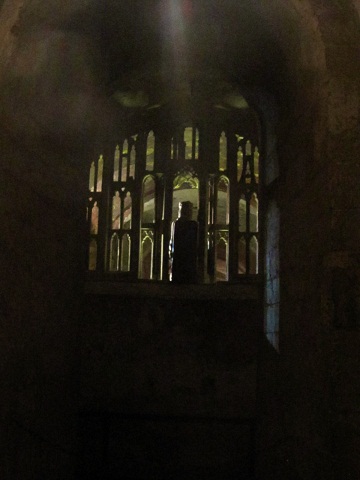
But my overall favourite part was the 11th century Crypt, where for some undisclosed reason, you're not allowed to take photos (which meant that I had to sneak a few, obviously.)

This is a wonderfully delicate roof painting, ill-served by me and my camera.

Not to be outdone by Winchester Cathedral, Canterbury has commissioned a sculpture, entitled Transport, by Antony Gormley for its Crypt. Whilst it lacks the atmosphere of the stunning flooded Crypt of Winchester, where the figure interacts with, and is enhanced by, its watery surroundings, I still love this recumbent floating body made from ancient nails replaced when the Cathedral roof was repaired.

It's more a defined space than a solid, floating above the site of St Thomas Becket's first tomb, where he lay from the date of his murder in 1170 until 1220, when his bones were removed to a shrine in the newly completed Trinity Chapel.

I hadn't realised until then that Becket had been killed not where the flame was, but here, near the stairs into the Crypt.

'The wicked knight leapt suddenly upon him, cutting off the top of the crown which the unction of sacred chrism had dedicated to God. Next he received a second blow on the head, but still he stood firm and immovable. At the third blow he fell on his knees and elbows, offering himself a living sacrifice, and saying in a low voice, 'For the name of Jesus and the protection of the Church, I am ready to embrace death.' But the third knight inflicted a terrible wound as he lay prostrate. By this stroke, the crown of his head was separated from the head in such a way that the blood white with brain, and the brain non less red from the blood, dyed the floor of the Cathedral. The same clerk who had entered with the knights place his foot on the neck of the holy priest and precious martyr, and, horrible to elate, scattered the brains and blood about the pavements, crying to the others, "Let us away, knights; this fellow will arise no more."'
Edward Grim

