About Me

My photo
Bristol , United Kingdom
Poet and poetry facilitator. Neurodishevelled. My sixth poetry collection, Love the Albatross, is available from Indigo Dreams or directly from me.
Showing posts with label Culbone. Show all posts

Monday, 25 April 2016

Into the Black Mountains Part II : Capel-y-ffin and St Martin's, Cwmyoy

I last visited Capel-y-ffin - well, a little less than 50  years ago, and being very young, remember little other than my parents telling me, maybe as a sop, that there were artists there. It worked. I spent the whole trip with my eyes on stalks, on the lookout for anyone sufficiently exotic-looking to pass as a painter or maybe even a writer, as if I might somehow bask in their Ready-Brek glow as they passed. Much later, I learnt that Eric Gill and his entourage had lived in the monastery there 40 years earlier, and that the poet and artist David Jones had been a frequent visitor.  But I saw no one who might have fitted the bill that day.

I'm not even sure which hill we climbed, though this one looks familiar.  If it is the one, I suspect the fact I remember being told it didn't have a name might well be because it's called Lord Hereford's Knob.  

The chapel of St Mary the Virgin, in the shadow of said Knob,  is delightful, and its diminutive size reminded me of Culbone Church on Exmoor.  

The Rev Francis Kilvert described it as 'owlish', which makes Dru's discovery of owl pellets in the churchyard fitting. 


'I shall lift up mine eyes unto the hills from when cometh my help'

A copy of David Jones' Sanctus Christus de Capel-y-Ffin


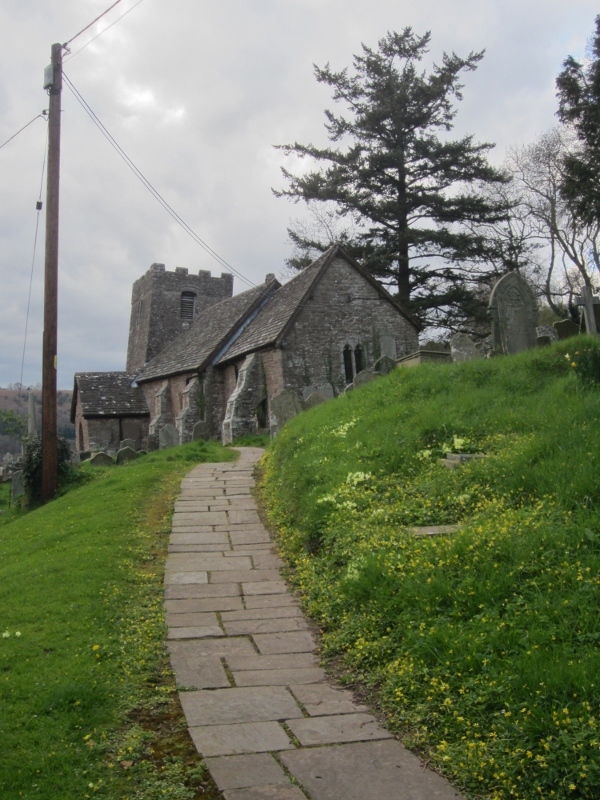
Leaving Capel-y-ffin, we headed back down the valley. Up on a hill to our left, I glimpsed a church that looked as if it were melting into the ground. Dru explained that the whole village of Cwmyoy was built on a hillside subject to slippage, so in a way it is. 


I don't think I've ever seen so many toppling graves before. 


The tower of Pisa is 4.7 degrees out of alignment; the tower of St Martin's 5.2 degrees.   

As for inside, Dru's assertion that there wasn't a straight line in the place turned out to be true. 


I started to wonder if the only thing keeping the windows in place was the ivy. 


Back outside, we came across a tastefully lettered headstone to one Arthur Denys Gill. Ah, has to be one of Eric's clan, we thought, but a bit of (admittedly desultory) research has yet to reveal a link. This Gill, it turns out, was a racing driver.
The sky snagged in a tree
Off then for a swift drink at the Skirrid Inn, which could comfortably accommodate a whole blog post all by itself, what with its tales of the days - well, centuries, actually - when the first floor served as a Court of Law and 180 locals were hanged from the beam in the stairwell. For sheep stealing, mostly.  


Wednesday, 8 June 2011

Persons to Porlock


Off to Porlock last Friday.  I first visited three years ago, and it turned out to be the start of a series of jaunts which led to my poem, 'Coleridge changes his library books', so I feel affection and gratitude towards the place.  My father had never been, however, and as he is now 89 and quite frail, I decided to get him down there pronto, along with my mother, my sister and Ted.


So, another chance to visit the Ship Inn, which Sam Coleridge, William Wordsworth and Robert Southey used to frequent. On the wall in what would have been the inglenook, there are a few lines of a poem composed in situ by Southey: 'Porlock! / Thou verdant vale so fair to sight / Thy lofty hill which fern and gorse embrown. / Thou waters which roll musically down, / The woody glens, the traveller with delight, / Recalls to memory.' 


Then, having lunched, we moved on to the implausibly named Church of St Dubricius, with its 1,000-year-old yew tree a friend of mine once likened to Don Quixote on his horse.  


It was lovely to climb up the narrow, spiral staircase to the Chapel of the High Cross once more, the warm and welcoming chantry which once served as a schoolroom and as storage for vestments, and to see the delicately detailed Harington tomb again, with its graffiti dating back to 1531. 
A minor disappointment was that a tomb I was expecting to see - of a reclining woman carved in marble - wasn't there.  I must have encountered it in another church I visited that day. Must try to find out which somehow.


Next stop was Porlock Weir, where I parked my parents and sister in the sun and set off with Ted along the rollercoastery coastal path to Culbone.  Ideally I would have liked to have done the entire walk in my book, especially since the latter part of the route passes Ash Farm, where Coleridge was famously interrupted by a 'person on business from Porlock' whilst writing his sublime, opium-inspired poem, 'Kubla Khan' (and whom Julien Temple in his film 'Pandaemonium' rather scurrilously identifies as Wordsworth).  But I didn't want to leave my parents too long, just in case, so that must wait for another day.


As it was, it was very hot and the four-mile-round trip to Culbone was quite enough for me, if not Ted. I was thankful that the route wound through cool and shady woods before descending to the valley in which the hamlet - famously inaccessible by road - and its tiny church lie. 


Culbone church is reported by some parties to be the smallest in England, although this is open to fierce debate. The guidebook claims it is the smallest complete parish church in England, with its chancel measuring 13'6" x 10' and the nave 21'6" x 12'4". Its total length is 35ft and it is reputed to seat about 30 'in great discomfort'. Another interesting snippet is that in the Assize rolls of 1280, it is recorded that Thomas, the chaplain of Culbone was indicted 'for that he had struck Albert of Esshe (Ash) on the head with a hatchet, and so killed him'.  (Presumably this is the same Ash in the anecdote about Coleridge.  What a history!)  This isn't the first time I've come across a West Country church with a lurid history of murder ...


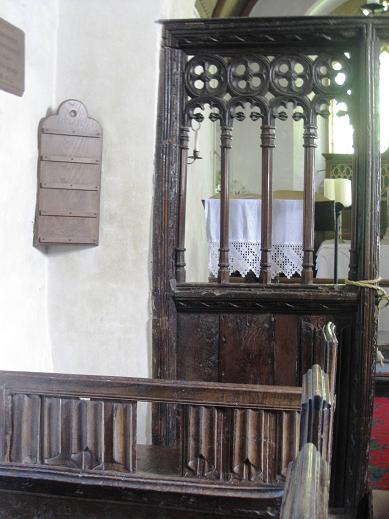
Meanwhile I was enchanted by the sweetly small yet solid entrance door, the rood screen and box pew, the exquisitely carved linenfold panelling on the back of one of the pews.


In the churchyard lots of graves of people with either the surname or middle name of 'Red'.  A bit more earthy than Rufus or Scarlett, lovely names as they are.


Then back to Porlock Weir and the drive home, via Kilve where we stopped for ice cream.  Sadly, my dad was too tired to go up to the beach as he'd hoped and we went home without him seeing the bleak beauty of that part of the coastline. Never mind, hopefully we can return another of these fine days ...