About Me

My photo
Bristol , United Kingdom
Poet and poetry facilitator. Neurodishevelled. My sixth poetry collection, Love the Albatross, is available from Indigo Dreams or directly from me.
Showing posts with label Horfield Common. Show all posts

Monday, 9 October 2023

Horses on Horfield Common (again)

Every now and then I fall down a rabbit hole into the past, sometimes more than once. 

All these years later I remember what a treat it was to spot horses on Horfield Common just before Christmas in 2011, and last Friday there was an echo of that visitation when I saw more horse-drawn vans making camp on the common, alongside the rather more mundane motorised vans, caravans and camper vans that line Kellaway Avenue in these days of scant social housing. 

I was on my way to the reading by Alice Oswald and Kim Moore in town, so couldn't stop for a closer look, and since I was due to drive to Oxford the next day to take Son the Elder to a roboteering event, I concluded, sadly, that I probably wouldn't get a closer look at them. But in the morning, as luck would - or wouldn't - have it, my car started making disconcerting juddering noises before we'd even got as far as the M4, which meant the trip was off, and having driven it rather gingerly  to our garage in Redland, my walk home took me straight past the Common and the new camp there. 


Important, I feel, not to romanticise hard lives; nevertheless, both I and the little girl who used to hang around outside the blacksmiths at the bottom of nearby Bishop Road in the 1960s in the hope of seeing a horse in need of shoeing (but never did), felt all kinds of happy to see horses grazing the common. 

Friday, 5 November 2021

All Hallows and the stories we tell ourselves

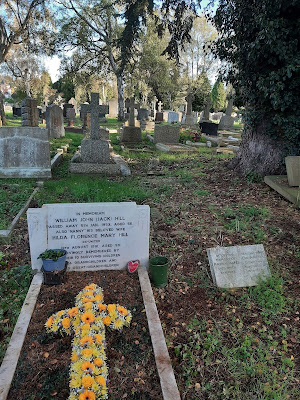
There's always a few jobs to do after a funeral. On Tuesday I went to the cemetery and crematorium to move my mother's funeral flowers to my grandmother's grave. 


Can't say I'm fond of formal flower arrangements myself, but the cross was right for my mother, and I liked the colours and the personal significance of the Michaelmas daisies. 

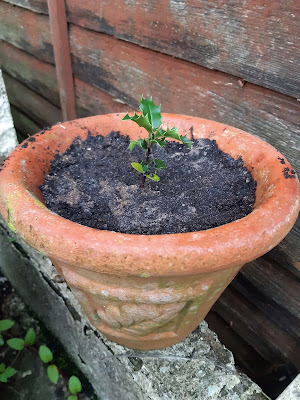
My grandmother's grave had some Herb Robert growing on it, which I'm fond of and would have left growing, but I know my aunts aren't and wouldn't have, so I did a spot of weeding and put my hand on something spiky. It turned out to be a tiny holly bush that had probably self-seeded from a Christmas wreath, so I took it home and planted it up. It felt like a gift from my grandmother, thirty years after her death, and I hope it will eventually grow big enough to produce berries - if it's female - and attract blackbirds and thrushes.


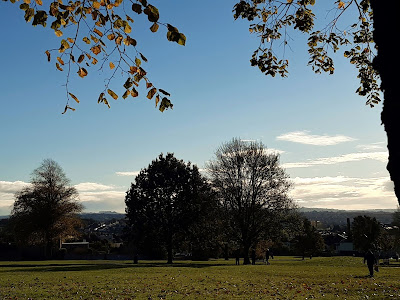
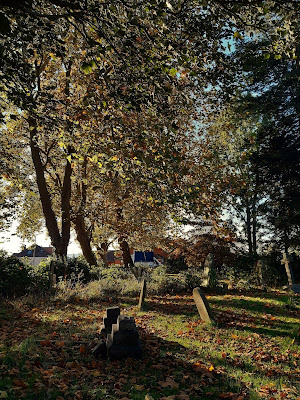
I also had to catch up on other jobs that had gone undone over the previous month, like an oil change for my car. On the way back from the garage, I walked over Horfield Common, which was looking beautiful in November sun. 


I always look to the skyline for the familiar landmarks, and there they are: to the left of the pair of trees, Freezing Hill (which I still haven't visited); to the right, Kelston Roundhill (which I have).


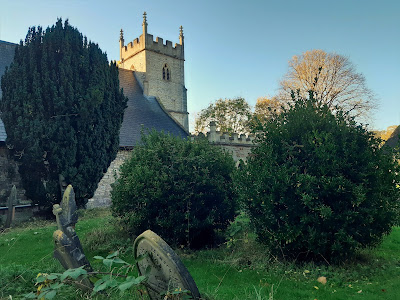
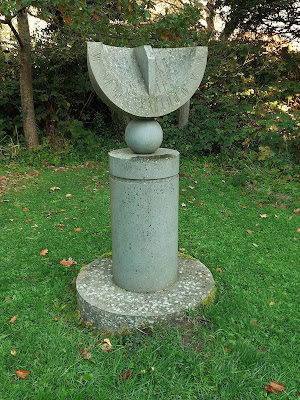
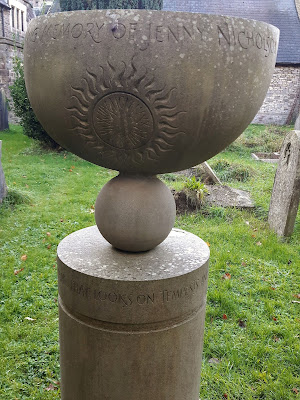
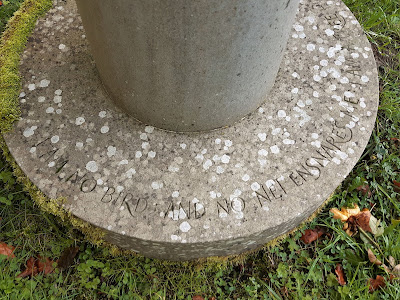
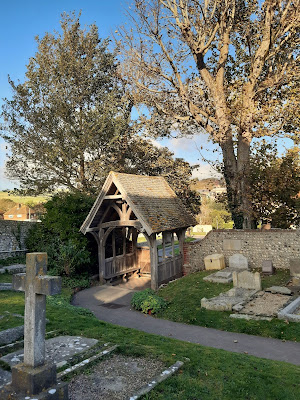
I spent a little time wandering through the churchyard of Holy Trinity with St Edmund (Horfield Parish Church), and I realised that it must have been years since I'd walked right around it, as there was a beautiful monument I hadn't acquainted myself with before, even though it's been there long enough to have acquired a smattering of lichen and moss. 


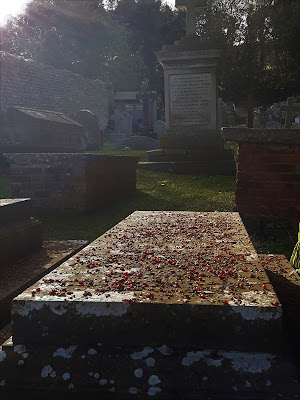
Jenny Nicholson was murdered on 7th July 2005 in the London bombings. She was 24. The inscriptions are a quotation from Sonnet 116, and another from Charlotte Bronte: 'I am no bird and no net ensnares me: I am a free human being with an independent will'. 


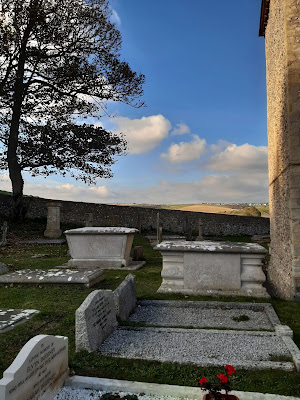
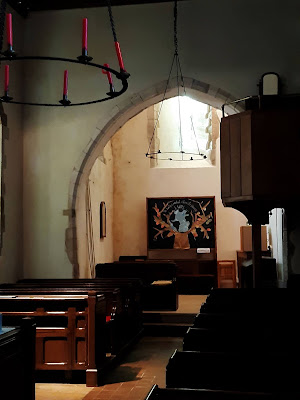
In between these jobs, I drove my daughter back to her home on the south coast. As it happened, St Wulfran's Church at nearby Ovingdean had popped up in my social media feed that morning, so we diverted for a quick picnic in the sunshine. 


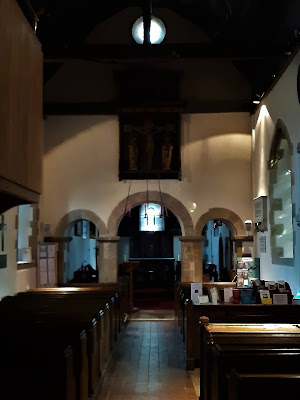
The village was the birthplace of Charles Eamer Kempe, the Victorian designer and friend of William Morris, who was closely involved in its 'restoration' in the 1860s. It was at this time that he designed the painted ceiling.


The reredos was also designed in the late 19th century.


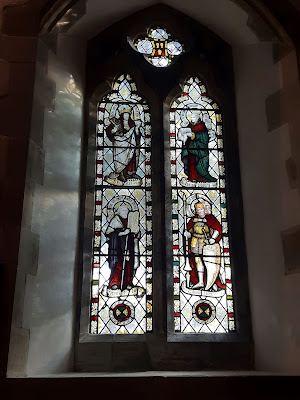
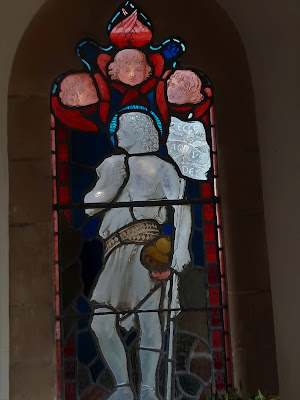
Most of my photos of Kempe's windows, which were donated to the Church before his death in 1907, didn't come out too well; here's a few that were OK. 


We wandered around outside for a bit looking for the Kempe family vault but failed to spot it. I found a very early primrose growing on an unmarked grave, however ... 


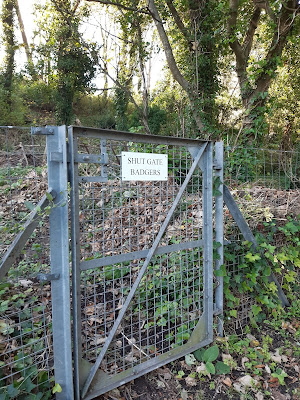
... and an instruction to badgers with opposable thumbs.


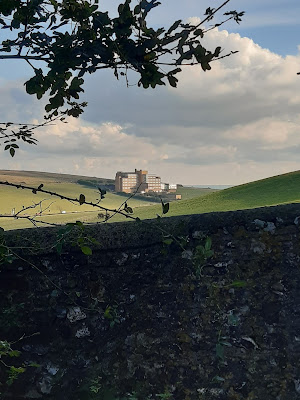
In an extension of the churchyard there was a view of the sea ...


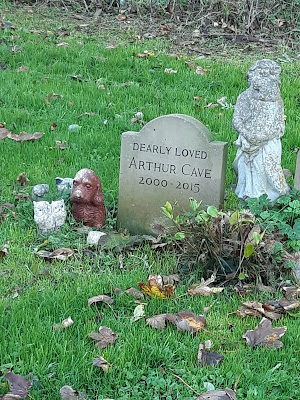
... and another memorial to a life that ended abruptly amid much publicity. 


I've been thinking a lot lately about the stories we tell ourselves to give shape to our lives and those of the people closest to us, but how hard must it be to find that shape if someone you love dies when their lives were just starting? 


Monday, 31 August 2020

On Poetry, Hot-Air Balloons and Getting Up Horribly Early

Up betimes yesterday morning to record a poem for the upcoming anthology 'Places of Poetry: Mapping the Nation in Verse'. 

My poem is about the death of my grandmother, Hilda Hill, during the 1991 Bristol Balloon Fiesta. Which is relevant because I saw hot-air balloons rising over the city the evening before she died, something I found beautiful and strangely comforting. 

Somehow this memory became conflated in my head with another summer evening spent watching balloons from the vantage point of Horfield Common as they drifted over the northern suburbs of the city - something which doesn't happen too frequently, as the Festival is held at Ashton Court to the south of the city, and often the balloons float off over Somerset. Judging by the then age of my children, I think this particular occasion must have happened a year, maybe two, after my grandmother died, but poems are timeless things, and anyhow it was another quarter of a century later before I wrote it.

I decided that if I was going to produce of recording of me reading a poem so closely tied to its location, it would have to be recorded on the Common itself, rather than at home, sitting in front of the obligatory bookcase. This presented problems, as it's a popular place for joggers, dog-walkers, and children, with several busy roads marking its boundaries. Hence the horribly early Sunday morning start. 

The recording went well. We did four takes, and upon my return home, I steeled myself to do battle with Dropbox and/or Google Drive or whatever I would have to use to get the file sent, only to find that we should have recorded it in landscape format rather than portrait. Which meant another early rising this morning to repeat the whole process.

It was a beautiful dawn - dew-soaked, and more autumnal than yesterday's. We stood on the tump, which was originally raised for archery practice, so that there would be a good view of the city behind me. And surprisingly - almost miraculously, in fact, since the pandemic prevented this year's Balloon Fiesta from taking place - hot-air balloons were drifting up the Frome valley in the misty distance. Which, since we are poets, is Clearly A Sign. 


Saturday, 4 July 2020

More TED Walks in the ... well, we think it's still the time of Coronavirus Pt 9

Not been anywhere. Crap weather, for the most part.  Also, it's the worst bits about life that seem to have been reinstated, despite the continuing presence of Coronavirus - working from work, Wetherspoons, golf, shopping as a hobby, queuing traffic. The best bits - poetry events and writing groups, theatre and gigs, hugging people you love, and feeling safe - have not. 


Though there's still the meadow and the common to explore in good weather and bad. And I even caught an almost midsummer sunrise from my bedroom window one morning ...


... and a picture book moon over thistles.


And wildlife! Here's some of my wildlife photography. (I'm prepared to wait for seconds to get the perfect shot.)


A rabbit


A bumble on bramble


A wood pigeon stripping cherries from a tree


A kestrel


A flock of rooks and jackdaws 


A dead hedgehog (or a very uncomfy slipper). My cousin reliably informs me that this is the work of a badger. 


The fox who is always waiting for us in the road when we get home, ready for a stand-off with the eponymous TED


My photos of trees and flowers are generally more successful. 

Here's some June blackberries ...


... and two of my favourite trees which we don't see so often now most of the golf course is out-of-bounds.

(It was dusk on a Saturday night and no one was playing.) 


And this is the magnificent ash in the ditch, nearly hidden from view now by brambles and bindweed.  


Purple hogweed seeds


Wild carrot, entering the Queen Mother's Hat circa 1965 stage of seed-setting


My favourite not-an-umbellifer, yarrow ... 


... and another beloved, the red-berried rowan


Golden rod


I've stopped wondering whether this year's ubiquitous crow garlic is the triffid component of Covid-19, and now think it might be the cure, right under our anosmic noses. After all, there's lungwort for pulmonary problems, and woundwort for wounds. So why not crow garlic for Corvid-19?


As well as walking over the golf course to the meadow and Charlton Common, we've also had cause to walk past Horfield Common the other evening. It was lovely. 


c
The Church of the Holy Trinity with St Edmund
And it made a change to be watching the sunset from a different viewpoint from usual, in this case the former parade ground opposite what used to be Horfield Barracks but is now a housing development full of assorted shoe boxes ... 


... even though the meadow and Charlton Common sunsets remain a huge bonus of life in (varying stages of) lockdown.


Charlton Common


Solstice sunsets on the highest part of the Welsh Hills 


Getting a bit Old Testament


These walks in the same small area have been as much a mapping of an era (and a very strange one at that) as of place and the changing seasons. Bud to flower to berry. Floret to seed. I've committed Lady Macbeth's speech to memory for hand-washing purposes and can now identify at least some of the more common umbellifers. I've made an important decision about my future. And already the jackdaws and rooks are starting to flock again, and the setting sun is beginning its crawl back along the Welsh hilltops towards winter.