About Me

My photo
Bristol , United Kingdom
Poet and poetry facilitator. Neurodishevelled. My sixth poetry collection, Love the Albatross, is available from Indigo Dreams or directly from me.
Showing posts with label William Morris. Show all posts

Monday, 16 October 2023

Alfriston Clergy House ... and a rainbow for Virginia Woolf

Timed tickets booked and paid for in advance are a bit tricky when you have to drive 180 miles to get to the place in question, especially when part of that journey involves the M25, where I spent a happy four hours in stationary traffic with my sons and our dog back in May. 

This time, though, all went to plan, and as I drove across the easternmost end of the South Downs to Saltdean, I began to imagine that my daughter, Jenny, and I might even complete an ambitious itinerary that involved a visit to Alfriston Clergy House, followed by a pub lunch, followed by the all-important timed ticket at Monk's House, the rural bolthole of Virginia and Leonard Woolf at Rodmell.

Alas. It turned out the A27 south of Lewes was closed for the weekend because of roadworks, the traffic along the coast road was worse than anything I'd ever seen in the height of summer, and our eleven mile drive to Alfriston was going to take an hour, according to the sat nav. As we approached a Sainsbury's Local in Peacehaven, I turned down a side street and hastily parked. Time to get some emergency rations in case the pub lunch was off. 


Eventually we reached the ridiculously quaint village of Alfriston, and made our way from the car park, along the River Cuckmere to the Church of St Andrew, a large cruciform building constructed, it's thought, during the 14
th century on a pre-Christian site, of flint and all in one go, by persons unknown.  


On the south porch wall, a scratch sundial ...
 

 ...and this more modern dial, about which I could find out very little, other than there appears to be an indentical one in nearby Alciston churchyard. Maybe they are waymarks for a modern pilgrimage.

The interior of the church is spacious and airy, the walls covered with peeling whitewash. Apparently there are mediaeval murals underneath. It would be so good to see them, but, I suspect, costly to have them uncovered and preserved.


Early mediaeval font
 
 
As well as some mediaeval glass, there was a beautiful East window designed by James Powell in 1904 ...

 
... a window depicting the Tree of Jesse, designed in 1914 by Charles Eamer Kempe ...
 

... and a very modern window (2004) of St Peter the Fisherman by Joseph Nuttgens.
 
 
I also like this Arts and Crafts-influenced memorial to the 23-year-old son of the Vicar of Alfriston, William Beynon. Beynon also played an important role in the story of the nearby Alfriston Clergy House, which I'd wanted to visit for many years, ever since I'd first become interested in William Morris and the Arts and Crafts Movement. It was Beynon who involved Morris and the Society for the Protection of Ancient Buildings, along with the mewly formed National Trust, in the campaign to save this early 15th century building, which was in danger of being demolished. 


I was so taken by this beautiful old house, mainly because unlike many mediaeval houses with huge draughty halls, it's on just the right scale to imagine living there.

 
The floor in the hall is especially interesting, being made of chalk, which was rammed into the floor and strengthened with the addition of sour milk.

 
This carved oak leaf in the hall is said to have inspired the design of the Trust's familiar logo, when it was designed in the 1940s.


 The garden is also Arts and Crafts-inspired, and structurally very pleasing, although, of course, we were visiting at the wrong time of year for much in the way of colour.


We then set off for the village of Rodmell, eleven miles away in the neighbouring valley of the River Ouse, but again the traffic was very heavy and we resigned ourselves to not getting a pub lunch; in fact, we only just made it to Monk's House by 3pm. 

Once inside, I was immediately reminded of Charleston, the house seven miles away that belonged to Virginia Woolf's sister, Vanessa Bell, with its paintings, tiled fireplaces and decorated furniture commissioned from the Bloomsbury Group, although in this house visitors are permitted to take photos.  


Tiled table by Duncan Grant


Painted table by Vanessa Bell 


In spite of the difference in eras, wealth and class, there was a moment when I felt Virginia and Leonard  Woolf might have been kin.


Needlepoint mirror frame ...

 
... and chair backs

 
Portrait of Virginia by Vanessa


The house is a lot older than it appears, at least from the outside. It was actually built in the mid-16th century, and I really loved the brick steps that show the passage of many feet.


Virginia's bedroom


Virginia and Leonard were both buried in the garden, Virginia in 1941, following her suicide, and Leonard in 1969.


In
Virginia's writing room at the bottom of the garden, something ethereal was happening with the light,which illuminated her chair and the balls of screwed-up paper on her desk ...
 

 ... and while we stood, a little sadly, it has to be said, in that glorious garden set in the beautiful countryside of the South Downs, a rainbow arched over the Ouse valley. 


Sunday, 12 June 2022

Headstrong in Lewes

It was a Lucky Thirteen Red Kite Day yesterday (plus a buzzard and a kestrel) for my trip, along with Son the Elder, east and south to Sussex to visit my daughter. The fourteenth red kite was dead in the fast lane of the M4 and clearly wasn't lucky, so I didn't count it. (Sometimes you have to be selective when it comes to good omens.)

Our destination, having collected Jenny from her abode, was Lewes, though when I saw the gorgeous turquoise colour of the sea, I thought maybe we were mad to head inland. That said, I was pleasantly surprised from our arrival onwards, because after all, who doesn't like a 15th century bookshop ... 


... and a house with the legend Writer and Revolutionary emblazoned on it?


In fact, Thomas Paine, who lived in Lewes from 1768 to 1774 and was radicalised there as a member of the Headstrong Club, was commemorated pretty much all over the place.


The White Hart Inn


The Tom Paine Printing Press and Gallery


The pub 'The Rights of Man' looked particularly inviting - it had my name written all over it - but it was hosting what looked like a wedding, so we didn't get to have lunch there. Which was a double shame, as my paternal grandmother's maiden name was Pain, spelt the way Thomas Paine's name was originally, which meant - surely? - that my claim to a seat and a complimentary pint of Tom Paine from Harvey's brewery was strong.  


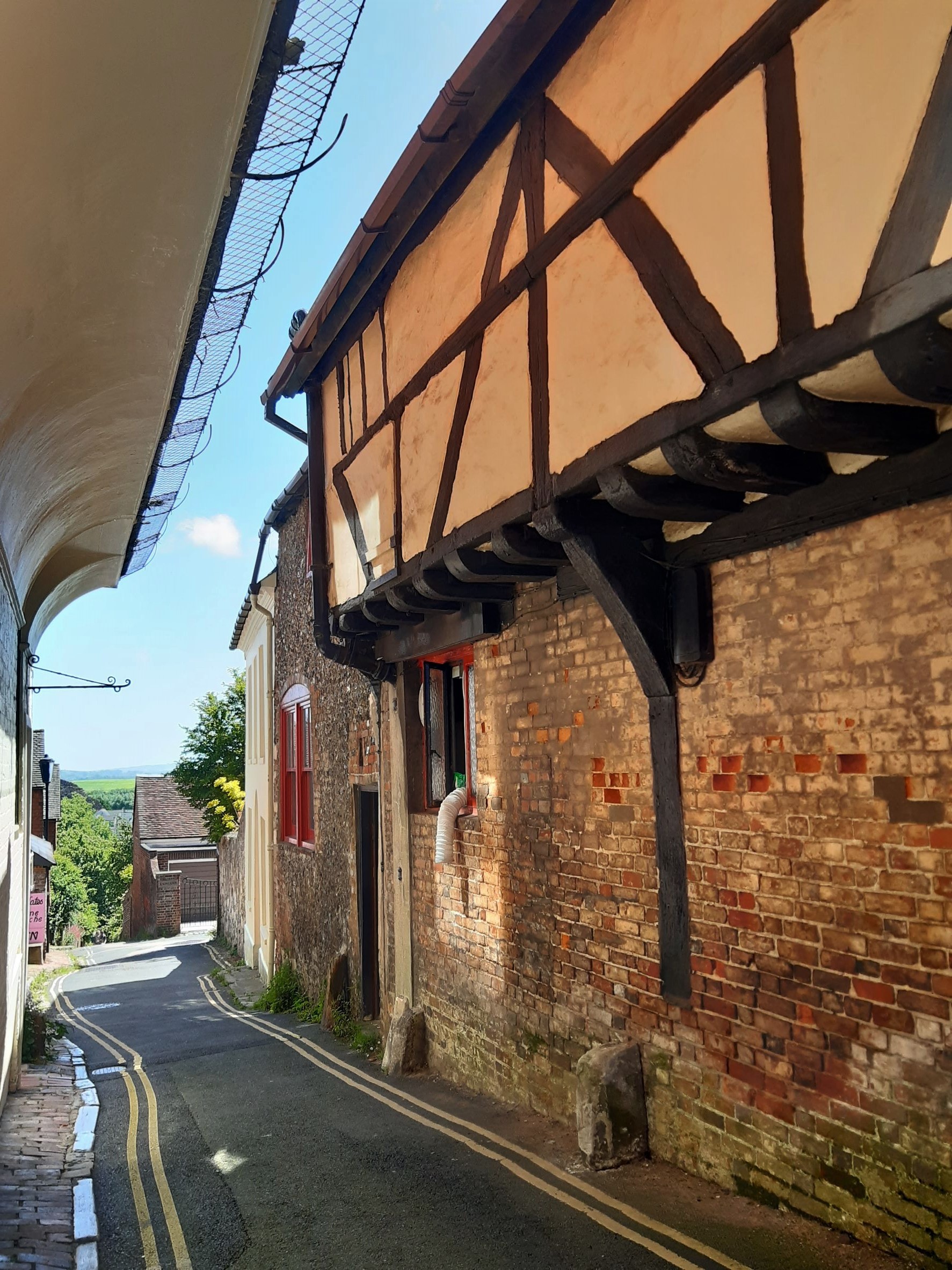
After lunch in an Italian restaurant instead, we had a little wander down the High Street. I especially liked the way the narrow side streets - or twittens - drop downhill, giving views of the hills that surround the town. It reminded me of Ludlow a bit in this respect ... 


... and also with regard to its nooks and interesting old buildings ...


... one of which - Stewards Inn - is believed to date from at least 1330.


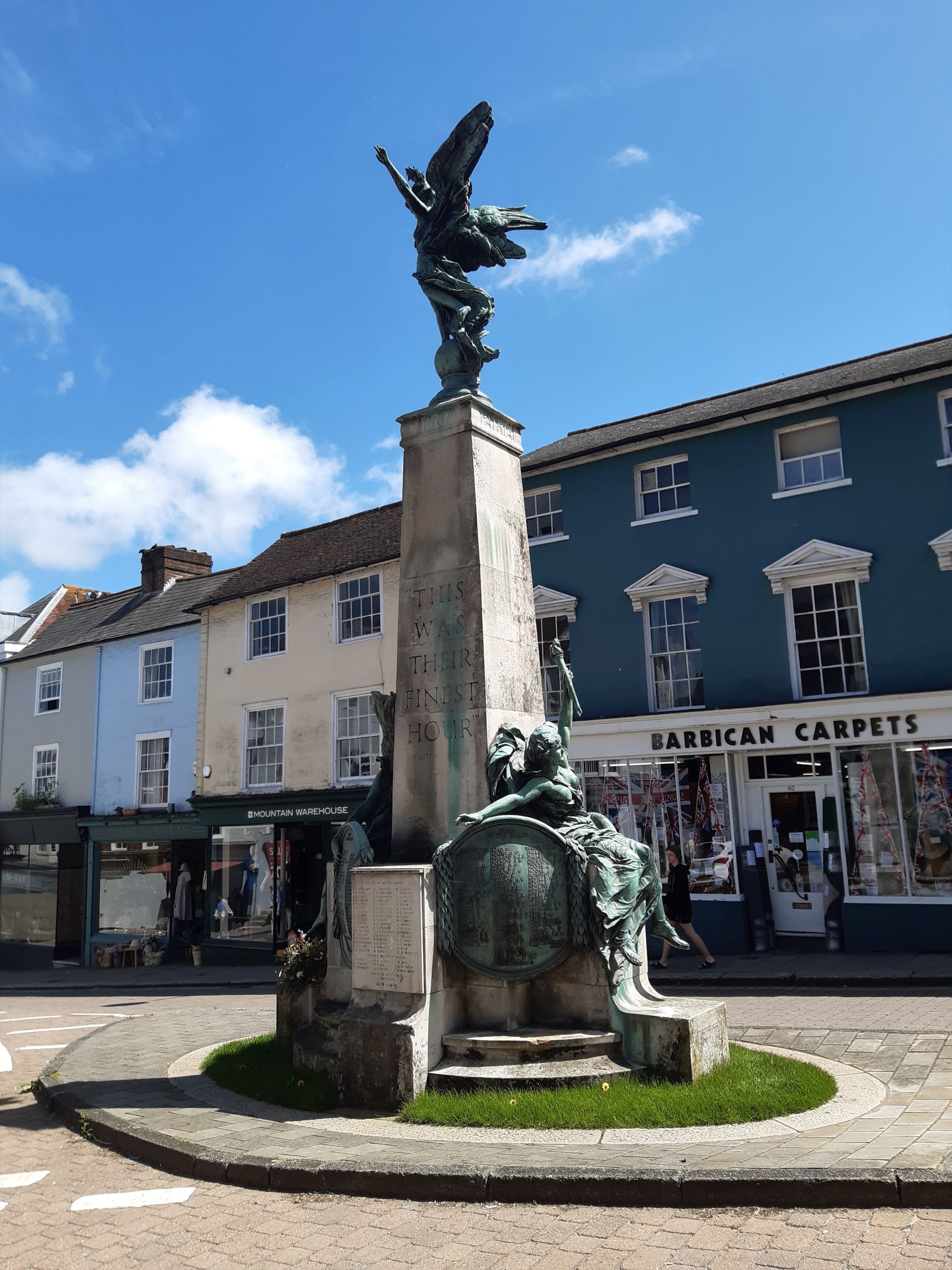
War memorial

I was beginning to conclude that Lewes isn't quite the picturesque, entrenched Tory town I'd rather lazily imagined it was, and having read up a bit since, it seems that in Paine's time it had a reputation for being a hotbed of radicalism and anti-monarchist sentiment. (A friend has subsequently assured me that the current Tory MP is a blip.)   


The town hall with its rainbow flag, which was previously the site of the Star Inn, in front of which the execution by burning of the town's seventeen Marian martyrs took place

We then headed for the Castle, visiting the museum first and then the Castle itself, which dates from just after the Norman Conquest and is splendid. 


Part of the Norman gatehouse to the left; the Barbican to the right


A cannon from the Crimean War

I was keen to test William Morris's famous assertion about the town, namely:

'You can see Lewes lying like a box of toys under a great amphitheatre of chalk hills ... on the whole it is set down better than any town I have seen in England' 

and so headed straight up the steps to the Keep, taking advantage of strategically placed benches on the way. (Well, it was hot.) 

The views were impressive, although of course Lewes would have been a lot more compact in 1882, when Morris visited with his daughter Jenny. 


Back down at ground level, we crossed to the Barbican, which also has great views.


Half a mile or so away is chalk face of Cliffe Hill, the implausible site of the deadliest ever avalanche to occur on these islands, when, in 1832, a build-up of snow collapsed onto the town 330 feet below, killing eight people. Hard to imagine it on such a warm summer day.


By now my offspring were hot and thirsty, so to avoid the onset of recalcitrance, we drove back to the coast. Although you don't see it quoted by the local tourist board, Morris finished his observation by saying that Lewes 'is not a very interesting town in itself'. I disagree, and found myself compiling a list of all the other places there I'd like to visit and rueing the fact that every day-trip I make to Sussex is bookended by a three-hour drive.

Back by the sea, it was still hot but breezy and gulls were having fun riding the updraughts. We bought ice cream and drinks, and sat ourselves down on the beach for an hour or so before the long drive back to Bristol.


It was too late for any kite-sightings on the way back down the M4, Ma and Pa Kite being tucked up with their soon-to-be-fledglings by then. We did see a few white kites near Gatwick and Heathrow, though - Son the Elder's joke - and a kestrel to match the one from our outward journey, hovering over one of the many instances of roadkill littering the hard shoulder. A good day for us, though, at least.