About Me

My photo
Bristol , United Kingdom
Poet and poetry facilitator. Neurodishevelled. My sixth poetry collection, Love the Albatross, is available from Indigo Dreams or directly from me.
Showing posts with label Seamus Heaney. Show all posts

Friday, 29 October 2021

Poetry changes lives

You hear it a lot. Poetry changed - or saved - my life. And it's not just me saying it, though I do have cause to be grateful, since this month marks ten years since my first collection, 'Communion', was published by Indigo Dreams and my life's ambition - to occupy a few millimetres on a bookshelf somewhere - happened. Since then, I've had three further collections published by the wonderfully generous Ronnie and Dawn, as well as a now suddenly topical coming-of-age novel set during the Black Death. 
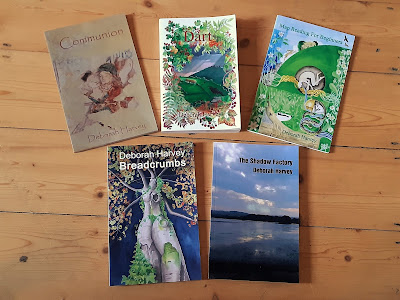

Good things continue to happen for me where poetry is concerned. I'm currently more than half way through an MA in Creative Writing at the Manchester Writing School. Recently one of my poems was shortlisted in the 2021 Bridport Prize. And in February 2022, my next collection, a series of poems about my home city, Bristol, entitled 'Learning Finity', will be published.

After my children, my poems are my best things. I could never have dreamt I would be writing this post a dozen years ago, when I was at my lowest ebb. 

Talk to most poets and you'll likely find some sadness hidden not too assiduously in the background. Poetry attracts thinkers, and maybe also over-thinkers. Reading it can be a source of comfort. Using metaphor to shape loss, and come to terms with our unspoken fears, is a powerful way of moving past them. Noli timere, to quote Seamus Heaney.


Friday, 10 May 2019

For the Silent - an anthology of poems in aid of the League Against Cruel Sports


Yes, foxes can be a pest on farms, and sometimes their numbers need to be controlled, but I've never been able to imagine my way into the mindset of someone who would hunt animals to the point of exhaustion, and then kill them and call it 'sport'.

Nor can my publishers, Ronnie Goodyer and Dawn Bauling of Indigo Dreams, and to spread the word (literally), they have produced this beautiful anthology of poems, For the Silent, proceeds from the sale of which go to the League Against Cruel Sports.

I'm delighted to have a poem in it, rubbing its humble shoulders with poems by Mary Oliver, Simon Armitage, Thomas Hardy, Margaret Atwood, Pascale Petit, Liz Berry, Seamus Heaney, Alison Brackenbury, Siegfried Sassoon, John Clare, Ted Hughes and many more.

If you have a heart and a soul, this book is for you. It costs £10 + p&p and is available from the Indigo Dreams website. (Buying directly from Ronnie and Dawn will maximise funds for the League.)

Friday, 11 November 2016

Love's the only engine of survival


I'm going to have to ban early morning phone calls from my younger son; they never bring good tidings. In January it was the death of David Bowie, his voice tender because he knew how upset I'd be. Our shared desolation at the outcome of the EU referendum in June was mirrored this Wednesday last by horror at Donald Trump's ascent to power.  This morning he was too upset himself to get the words out, but I guessed straightaway.  There was no one else left.


I was 14 when I first encountered Leonard Cohen in 1976. I was on an exchange visit to Bordeaux; he was singing in French and called Graeme Allwright.  I soon tracked down the originals of these cover versions and Leonard took over the soundtrack of my life, a conglomerate father/older brother/lover/husband/ mentor figure who addressed my needs in a way the actual men in my life couldn't or wouldn't. (Though to be fair, my older brother never existed.)  And unlike real-life Leonard - or, indeed, my later, eventual ex-husband - my personal Leonard was constant, always there. If anyone in that particular relationship ever drifted off for too long, it was me.


I've never found him depressing (though I do avoid listening to some of his songs when things aren't good - notably, Dress Rehearsal Rag). In fact, I'd say it was the other way around - when I've been at my lowest and turned to him, his songs and poems have lifted me. I think it's because although his great theme is endings - the loss, mess, despair and emotional exhaustion of them - he shows us their beauty too. 


But now - with the exception of Alan Garner - my heroes are gone, all within the space of three years - first, Seamus Heaney, then Terry Pratchett and David Bowie, and now Leonard Cohen. White, English-speaking men - I know - and flawed too, at least in the case of the singers. But as Leonard himself put it 'Ring the bells that still can ring/Forget your perfect offering/There is a crack in everything/That's how the light gets in'. And between them, they've taught me the importance of recognising beauty in the moment and celebrating it, that being good and being nice are not the same thing, that being yourself and pushing beyond your comfort zone is vital to creativity, and how to pick yourself up again and again and carry on with grace to the end.  

Finally, that I'm not alone. 


Recently, some of Leonard's darker, prophetic songs from the 80s have taken on a new insistency as our island turns in on itself, quoting the John of Gaunt death-bed speech out of context as usual, and a quasi-fascistic mindset takes hold in the country formerly known as the land of the free.  And, as a friend observed earlier, without the certainty that somewhere far to the west Leonard is writing and sleeping and eating and fiddling about on that Casio keyboard of his makes this lurch to the far right even harder to bear. But from the same song that contains such catastrophic images of war - 'The Future' - one line stands out today. It is 'love's the only engine of survival', and this is the route map he left us. 


Saturday, 26 December 2015

Emergency Bookshoppery

No matter how timely and organised I've been in executing the 'final' Christmas shop, there's always a need to brave the late rush for suddenly remembered, essential extras. A quick recce two days before the big day revealed that whilst moving house had uncovered lost hoards of tea spoons under beds, down the back of settees, etc, we still had a dearth of knives.  And the dodgy electrics in our new home would be sure to blow the old-style fuse box during the cooking of Christmas dinner if we didn't ensure we had a range of fuse wire to hand in three different gauges, even if we didn't have a clue what to do with it - a sort of precautionary magic.  Plus, while we're in the hardware shop, a new bin for the kitchen, hinges to re-secure the loft hatch at some point and some silver Brasso (a misnomer if ever there was). 


Pausing to admire the sign outside Bishopston Books was a mistake, for how you can you loiter there on the pavement without succumbing to the musk of foxed pages, the yearn and murmur of fading notes and inscriptions?  

With most of our books still stowed in boxes awaiting shelving, I racked my brain in the poetry section. Do we have a copy of 'Wintering Out' by Seamus Heaney already or not? Never mind, it's only £3, we can buy it, read it and pass it on later if it proves to be a duplicate. 

And Ted Hughes' 'The Iron Wolf' - I know I've got it in paperback but this is a first edition hardback and look at the gorgeous illustrations and yes, I know it's £25 but- 'oh, we have to have that,' declares my parter in poetry.


'You do realise it's signed, don't you?' says the bookshop owner as we pay at the till. So it's a bargain too, then. 

'Come on, Deb,' my partner says as I linger over another tome on the way out. 

'Just got caught by an interesting book,' I explain, reluctantly slotting 'Adult Psychopathology Case Studies' back onto the shelf.

'There's never any end to it, is there?' says the bookshop owner, with boundless compassion.


Thursday, 8 October 2015

A Poem For National Poetry Day 2015

It's National Poetry Day today and the theme is light, so naturally I've chosen to post a poem about death and foxes, which has just been published in Hailing Foxes, the beguiling new anthology of illustrated poems newly published by Dru Marland of Gert Macky press.  Except that it's about light also.


 A few months after he died, a literary wake was held for Seamus Heaney in Festival Hall, London. Late that night, on the final leg of the journey home, I had an extraordinary encounter. 

Heaney’s Wake

All year 
from winter to autumn I see them 
most evenings  

on high streets, down side-roads
slipping through hedges
under the bunting of parked cars,
charcoal running stitches 
hemming the edge of dark.  In April 
vixens trail their kits 
                                       like knots 
                                                           in hankies

Come September 
   flashes of amber – intermittent –  
a youngster, trapped by headlights 
           panics on Southmead Road
                                     spins in indecision, 
     his current short-circuiting, every nerve and instinct                
                                                   scrambled

After the wake
and the long drive back,
two miles from home and my bed
the stupor in my head gives way to quick 
       anticipation  

a dog-fox on Horfield Common 
in Belisha beacon glare 
waits for me to brake, trots over the crossing 
with a twitch of his white-tipped tail. If I could
touch his fur, sparks would 
       jump and crackle  
    
my spirits kindled by this sight, 
this flaring matchstick 
       to hold against the night


©Deborah Harvey 2015


My next poetry collection, Breadcrumbs, is due to be published by Indigo Dreams in 2016. This poem isn't in it. 

Thursday, 2 January 2014

Old Year in Rooky Wood

Having written about rooks roosting, I wanted to reacquaint myself with rookeries. Dru had it on good authority there was a large one in the woods behind Ashton Court mansion, so we parked the car in Clifton and hopped across the bridge.  


The winter woods were open to the sky and suspiciously quiet.  No clumpy nests in trees either. There was a beating but not of rook wings; rather, the drums of City fans (boo).  A pair of crows flew past. A lone starling.  But no rooks.  


Dru was puzzled.  Her source knows her rooks from her crows and her Motacilla flava from her Emberiza citronella.  We had to be in the wrong wood, but by now it was nearly dark and the spectacle, if it had happened elsewhere on the estate, would be over.  


We walked back over the bridge, resolved to research the disappearing rooks of Bristol and the possibility that their kin roost on Wickwar Common, where the summer before last we'd loitered in the hope of hearing nightingales.  


Such trips are never fruitless.  There were no nightingales singing that dark summer evening, but I did come home with a poem burning a hole in my pocket.  And this night there were stunning views over the city and of our really rather nifty bridge.  


Not a bad way to end the old year and start the new - out and about, cupping the spark of curiousity and always remembering, in the words of Seamus Heaney, to 'credit marvels', whether they're the ones we were expecting or not.


Thursday, 21 November 2013

Setting the Darkness Echoing: A Literary Wake for Seamus Heaney

And so to the Festival Hall for Seamus Heaney's Literary Wake.  

For some reason the woman who, less than five years ago, couldn't pluck up the courage to look at her car as she walked past it, parked outside the house, thought it would be a good idea to drive there.  And actually it was, quite.  (It probably helped that I hadn't cleaned the inside of the windscreen for a while so I couldn't see just how scary all the other traffic was.)  Though I don't feel a pressing need to repeat the experience any time soon.  


Riding shotgun were Colin Brown and Hazel Hammond.  Upon arrival, we wondered around for a bit - helpless Southbank virgins - until we met up with the far more organised Rachael Clyne, who'd sensibly made her own way up from Glastonbury.


The evening got off to an intriguing start when Hazel's glass of orange juice, untouched on a table in the bar, unilaterally upended itself all over the floor tiles.  I suppose such a happening could have been construed as inauspicious, but actually it felt like the prelude to something special.    

Here's Hazel and Rachael, waiting for the show to start.  
At this point, we had a wager about how long it would be before we got emotional.  Rachael claimed she was already teary just reading the programme.  Predictably, I held out only as long as the final line of 'Mid-Term Break', Heaney's early poem about the death of his little brother, read by Bernard O'Donoghue.  


I have a bowl of shell buttons on my table through which I like to run my fingers.  Choosing highlights from an evening featuring so many heroic poets would be as impossible as choosing a favourite button or two.  Except that I did love Paul Muldoon's reading of 'Death of A Naturalist' ...


  ... and Carol Ann Duffy, again accompanied by John Sampson, reading 'The Blackbird of Glanmore', another, later poem about Heaney's little stillness dancer ... lost brother ...


... and Edna O'Brien. who is, unbelievably, 83 now, giving an object lesson in how to read poetry.  And such poems! ... 'Punishment' - so loving, so tender - 'At the Wellhead' - 'Postscript' ... God, I'd've crawled on my hands and knees to London and back to hear her read them, and there she was, alongside the likes of Simon Armitage, Paula Meehan, Tom Paulin, Michael Longley, Christopher Reid, Charlotte Higgins and the actor, Ruth Negga.  Just how lucky were we?


And as if they weren't riches enough, there were reels, jigs and a Lullaby for the Dead from The Chieftains ...


... and the mesmeric sound of the uilleann pipes played by master piper and Heaney collaborator, Liam O'Flynn, with Neil Martin on cello.  

Ooh and as we left, my cup overflowed just a tiny bit more at the realisation that I had been sitting within spitting distance of the lovely Michael Wood for the whole evening!

Anchor for the night, Andrew O'Hagan conjectured that Heaney would have been 'embarrassed but secretly pleased' by the evening's event, and said he might have once more quoted Hugh MacDiarmid - 'it was excessive, but not enough'.  I could have listened for hours longer, but it was time to head west through the London traffic and along the rain-dark M4, cupping the flame that is Seamus Heaney's legacy.  


Wednesday, 11 September 2013

The Biggening Skies

With Son the Elder deposited at the seond day of Robot Wars events, my partner and I set out for the Norfolk coast.  After all, if you are this close to the edge of the country, you might as well continue until you can go no further.  'Anyhow, I've heard East Cromer is really nice,' said my partner.  A little later on, however, he decided that he might be thinking of East Coker.  'Well, my mate Steve definitely said Cromer's worth a visit,' he persisted. 

First, though, there were a couple of churches I wanted to stop at, although things didn't go quite to plan, as when tasked with directing us to Little Witchingham, the sat nav dropped us in the middle of nowhere - in fact, I began to wonder if the witches had bewitched the village away.  In the end I had to resort to reading a signpost.  Crikey.


Then there it was - St Faith's - no longer in regular use (owing to a lack of same?) and in the care of the Churches Conservation Trust.  And open!

And what a church, covered in wall paintings dating from the middle of the 14th century.  And to think they were almost lost for ever, having been discovered only in the 1970s when the church was in a ruinous state and earmarked for demolition.  


Not all of the South Wall appears to have been painted, but Eve Baker, the art historian who discovered the murals, believes that it had been prepared for painting and that something had intervened to stop it happening, almost certainly the Black Death of 1348.   

Outside I was still keeping an eye out for one of those bigenning skies and I wasn't going to go home till I saw one.  This at least was a start ... 

and this not a bad continuation ...

BUT there was something wrong with the qualitative flatness of the place.  I'd been expecting somewhere like the Somerset Levels, where the roads are raised and called causeways, and every winter the land remembers the implications of its name and floods.  But Norfolk - or at least this part of it - is quite bumpy, with hillocks and rises.  Not really flat at all.

Then I realised what was bothering me.  In Somerset your eye runs over the terrain until it hits a range of hills - the Mendips, the Poldens, the Quantocks, the Brendons, the Blackdowns - which accentuate the flatness of the low-lying land, whilst in Norfolk there are no ranges of hills.  It is a different sort of flat, and therein, I'd wager, lie the bigenning skies.  

Relieved, I drove on to Thurgarton, our next stop which boasts a towerless thatched church.  All Saints did once have a tower which fell in the 1880s.  The church was eventually abandoned altogether and only rescued in the 1980s, again thanks to the Churches Conservation Trust. 

Outside there was a pleasingly chubby cherub flanked by two toothsome skulls ... 
and inside a series of carved mediaeval bench ends.  Here's a man (a huntsman or wild man?) creeping up on two dogs fighting ... 


... a liony creature and a man playing the bagpipe, though the bag bit has been lost ... 


... a creature - possibly a gryphon? - holding a man's head in his paws and a dragon ...


... a rather more convincing elephant and castle, than the one I saw in the Choir at Chester Cathedral ... 


There were also some fragmentary Elizabethan texts on the walls.  (Not everyone was impressed by the litany that is the Ten Commandments.)

  
My favourite things were the sense of space you get - always a feature of Conservation Trust Churches which are stripped of all clutter - and the amazing hammerbeam chancel roof, which put me in mind of the final section of Seamus Heaney's sequence, Lightenings.
The annals say: when the monks of Clonmacnoise
Were all at prayers inside the oratory
A ship appeared above them in the air.

The anchor dragged along behind so deep
It hooked itself into the altar rails
And then, as the big hull rocked to a standstill,

A crewman shinned and grappled down the rope
And struggled to release it. But in vain.
'This man can't bear our life here and will drown,'

The abbot said, 'unless we help him.' So
They did, the freed ship sailed, and the man climbed back
Out of the marvellous as he had known it.


Outside big skies were filled with sea gulls as a tractor ploughed the stubble.  We headed on to Cromer.  

Apparently the artist Algernon Swinburne visited Cromer in 1880 and said that it was 'an esplanady sort of place' ... 


... and in 1892 Oscar Wilde claimed he found Cromer 'excellent for writing, golf better'.  We struggled to find a decent pub. 


The colours, however, were gorgeous ... 


... and the skies, yes, the skies were very big indeed.