The Northerner wanted to visit Barnsley. Which was strange as he's barely been back since he was 23. I'd been there more recently, on a wet Sunday afternoon in January, about eight years ago, and had failed to find anywhere to visit, instead whiling away the hours in a cafe reminiscent of Littlewoods c1982. But he was adamant, so off we went.
Except that it wasn't the one up north, it was the one in the sumptuosity of the Cotswolds. He needed to know that he hadn't been born in the wrong one and lived the wrong life by mistake.
Lots of swifts
We had a drink in the pub, where he gave a demonstration of (northern) Barnsley origami.
We wandered up and down the street a bit and saw some pretty things and noticed how most of the grander walls are just above eye height, in a 'this vision of beauty is not for the likes of you' sort of way.
The Church of St Mary looks like a stunner, but unfortunately for me, I couldn't have a fossick inside as it had been readied for a wedding scheduled a few hours later and was being locked as we arrived.
Just as well. With my marriage phobia, who know what havoc I might have wreaked.
We can go back some other time.
Granny Aching's shepherd's hut
We moved on to nearby Bibury, once described by William Morris as 'the most beautiful village in England'.
Bibury is not quite as respectful, I fear.
First, though, lunch in the Catherine Wheel in Bibury's twin village of Arlington, after which I headed out around the village on my own, it being a bit too busy for a neurotic border collie.
Because that's the trouble with Arlington/Bibury: it's full of people like me - tourists. And I remembered why I never go to the Cotswolds in the summer.
Arlington Row is quite possibly the most photographed road on the entire scarp.
I snapped quick photos at judicious moments, and enjoyed the fact that the hill rising behind it is called Awkward Hill. Like Savage Hill in Newland, it reminds me of my relatives (Hill being a family name).
I also loved the lush water meadow, the Rack Isle, which is just the other side of the stream.
Then a quick dash to the late Saxon church, also dedicated to St Mary, across the River Coln in Bibury.
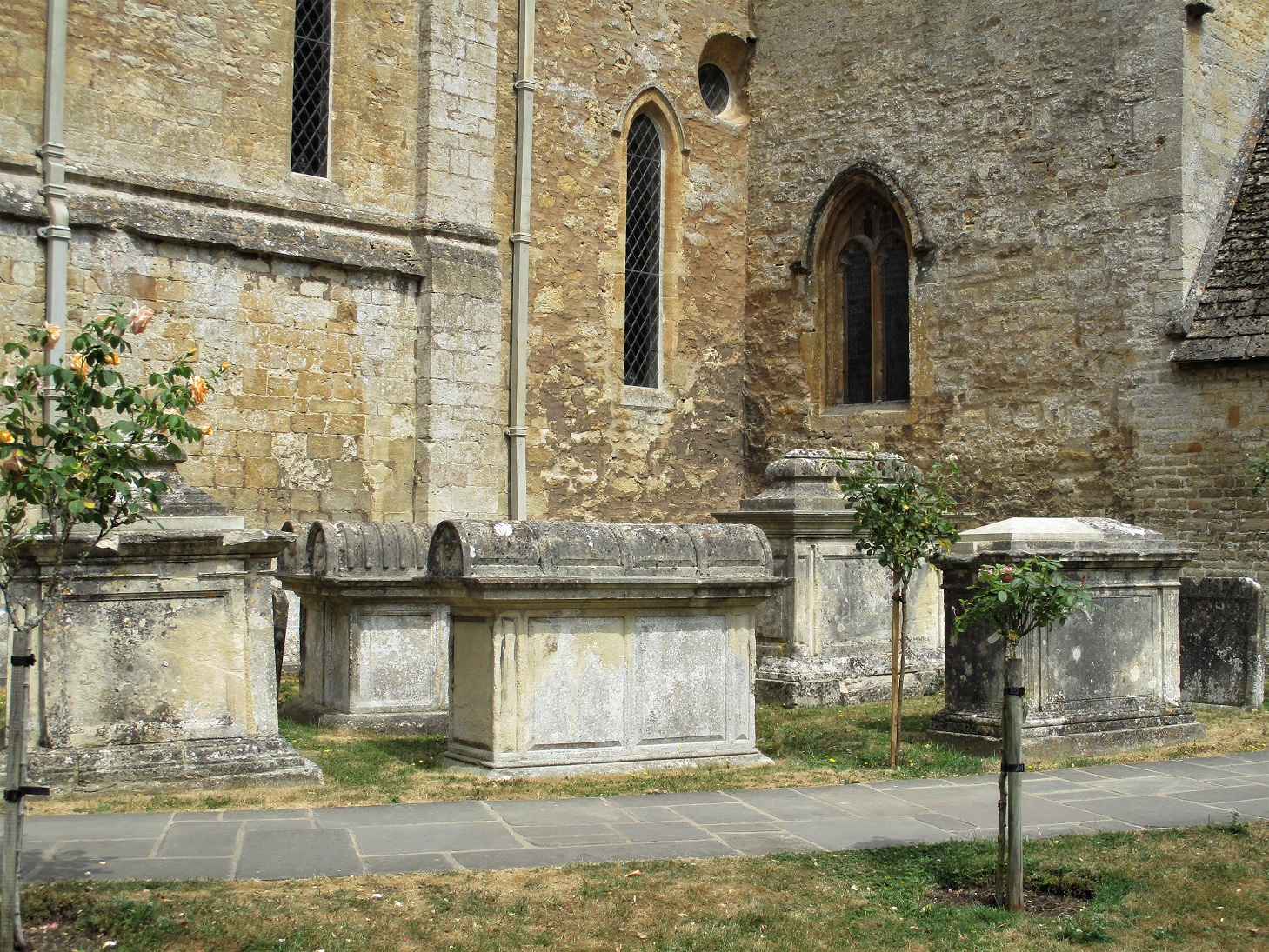
What a treasury of interest! First, so many surviving 17th and 18th century alter tombs and carved headstones.
I don't think I've ever seen a headstone carved in such deep relief as this one.
Scratch sundial
There's another even older gravestone - with beautifully carved Saxon interlace - set into one of the buttresses on the chancel wall.
Then there's the 12th century Norman doorways. The south porch arch is decorated with simple dogtooth carving ...
... while the North door (from about 1180) boasts palm-leaf carvings and trefoil cusping added in the 14th century.
Inside, more jagged Norman moulding, and an even clearer illustration of how our churches evolved over centuries.
The beautiful wooden roof is 15th century.
The arch between the nave and chancel is Saxon. Here is one of the caps to prove it.
But the pointy part is a later 13th century addition. This picture shows how it pierces the older Saxon string course.
And there's blocked-up windows which would have lit the rood loft, the former doorway from the rood stair, the remains of the decoration of the rood screen, all lost during the Reformation.
I liked the early 18th century brass skeleton tomb plates ...
... and the stained glass. This is by the Arts and Crafts stained glass artist Karl Parsons, whose work I first encountered last year in East Harptree. It dates from 1927 and featured on the Christmas stamps in 1992.
... and this lovely survival from the 13th century, also in the chancel.
And the selection of Saxon stonework in a tomb recess.
And the way the altar echoes the Saxon gravestone outside, and the ancient aumbries act as a reredos filled with candles.
(Look, I know all these words now and me brought up Methodist too.)
Ted was very good too, all the while he waited for - hang on, he's still in the pub with the Northerner.
Indeed, time was getting on. A quick bit of ad hoc first aid for a bumble bee I'm pretty sure was dead, actually ...
... and a hurry back along a still busy Arlington Row, feeling a bit sorry for the people who live there but then deciding that they have an awful lot of smooth to go with their allotment of rough.
Arlington Mill
I like rich chocolate mousse but driving home I felt a bit queasy, like I'd eaten slightly too much of it. The Cotswolds are lovely, but we decided that the Northerner had been born in the right Barnsley after all. That actually we might even prefer it. Though we might not be dashing up there for a while yet.
Number of stone stiles on our rou-
Nah, I'm bored with that ... and with these keyhole squeeze stiles. I mean, they might be OK for pugs, but they are no friend to the older, more statesmanlike dog, and Ted - who has yet to realise he can jump - had to suffer the ignominy of being carried over.
First, though, the 12th century Church of St Laurence ...
... which has the distinction of being the only one I've visited with a tomb in its porch.
Sir John Newton, who died in 1568, was evicted from the spot where the altar stands in 1883. Along the bottom of his tomb are ranged his 20 children, twelve daughters and eight sons.
There's a lovely soft light in St Laurence Church which was evident the moment Ted and I set foot (and paw) in it.
I think this beautiful, ancient window has something to do with it.
Next to it is the outstanding Great War Memorial window depicting St George flanked by St Laurence and St Agnes, by Arts and Crafts stained glass artist, Karl Parsons.
The dragon wouldn't disgrace Daenerys Stormborn ...
... though my favourite detail right at the bottom of the central panel is the illustration of a mother and child waving farewell to a man setting off to fight in France.
I also loved the bench ends, a few of which date from the 14th century ...
... especially the honest way in which they've been repaired, with no attempt to dupe or deceive.
Outside the difference in height between the churchyard and the surrounding field is accounted for by the large number of burials.
Ted and I were off over said field in the direction of Harptree Combe. On the way we glimpsed the ubiquitous Chew Valley Lake with Maes Knoll beyond it.
 My walking book was quite eloquent on the loveliness of the combe ...
... but omitted to mention how muddy it is. Within a few yards, I was wishing I'd worn my stoutest walking boots - or even wellies.
My walking book was quite eloquent on the loveliness of the combe ...
... but omitted to mention how muddy it is. Within a few yards, I was wishing I'd worn my stoutest walking boots - or even wellies.
We pressed on - well, I did; Ted, being a border collie, really didn't care - and before long we encountered the East Harptree aqueduct, a feat of engineering dating from 1851 and still instrumental in providing water to Bristol today.
However, it couldn't compete with the 11th century motte and bailey castle also in the vicinity.
Up there somewhere, in fact.
I re-acquainted myself with the few known facts. The original owner was one Azeline de Percheval, who came over with William the Conqueror and whose cruelty earned him the sobriquet 'Lupus' or 'the Wolf'. After passing to his son - unpromisingly called 'the Wolf Cub' - it eventually came into the ownership of the de Harptree family, and was held for the Empress Matilda in 1138 by Sir William against Stephen, who only managed to take it by luring the defenders out. It was destroyed during the reign of Henry VIII.
For me, however, the most compelling thing about it was that it was described as 'inaccessible'.
 The route up didn't look bad from the bottom - until a few feet from the top where I had to resort to proper hand and foot climbing.
Once up, however, I had the nasty feeling that I wouldn't be able to get back down - not even by sliding on my bum.
Rumour has it there is still some masonry to be found under the vegetation, but all I saw was a series of earthworks, some of which pertain to the castle and some to the calamine workings which went on spasmodically until the 19th century.
I felt thankful that when my kids were poxy, I just had to go to the local chemist.
Considering the steepness of the motte, I decided to leave the rest of the combe until bluebell time next year and consulted my map to see if there was a way down that didn't involve risking my neck.
It turned out there was a footpath all the short distance back to the village. 'Inaccessible', my arse.
I'll check the map first next time.