About Me

My photo
Bristol , United Kingdom
Poet and poetry facilitator. Neurodishevelled. My sixth poetry collection, Love the Albatross, is available from Indigo Dreams or directly from me.
Showing posts with label World War I. Show all posts

Saturday, 6 August 2022

Poetry-walking the poetry streets of Upper Horfield

Maybe we IsamBards were off our trolleys, holding a poetry walk through Upper Horfield estate on a hot August afternoon ...


... but it's something I'd wanted to do for ages. I first mentioned it to the Northerner probably back in about 2011, as a possible outreach event for one of the poetry festivals, but actually, I'd been fascinated by the poetry streets, where my father grew up, since I was a child. 

The Northerner's response back then was 'well, go ahead and organise it'.  I suppose I could use the excuse that the entire estate was being rebuilt at the time as an explanation for why it took so long, but the construction work was completed in 2013. Any delay was largely just a matter of me not pulling my finger out. 

But finally here we were, in Poets Park, waiting for our audience - always a nerve-wracking moment. But they arrived, and what brilliant listeners they turned out to be. 
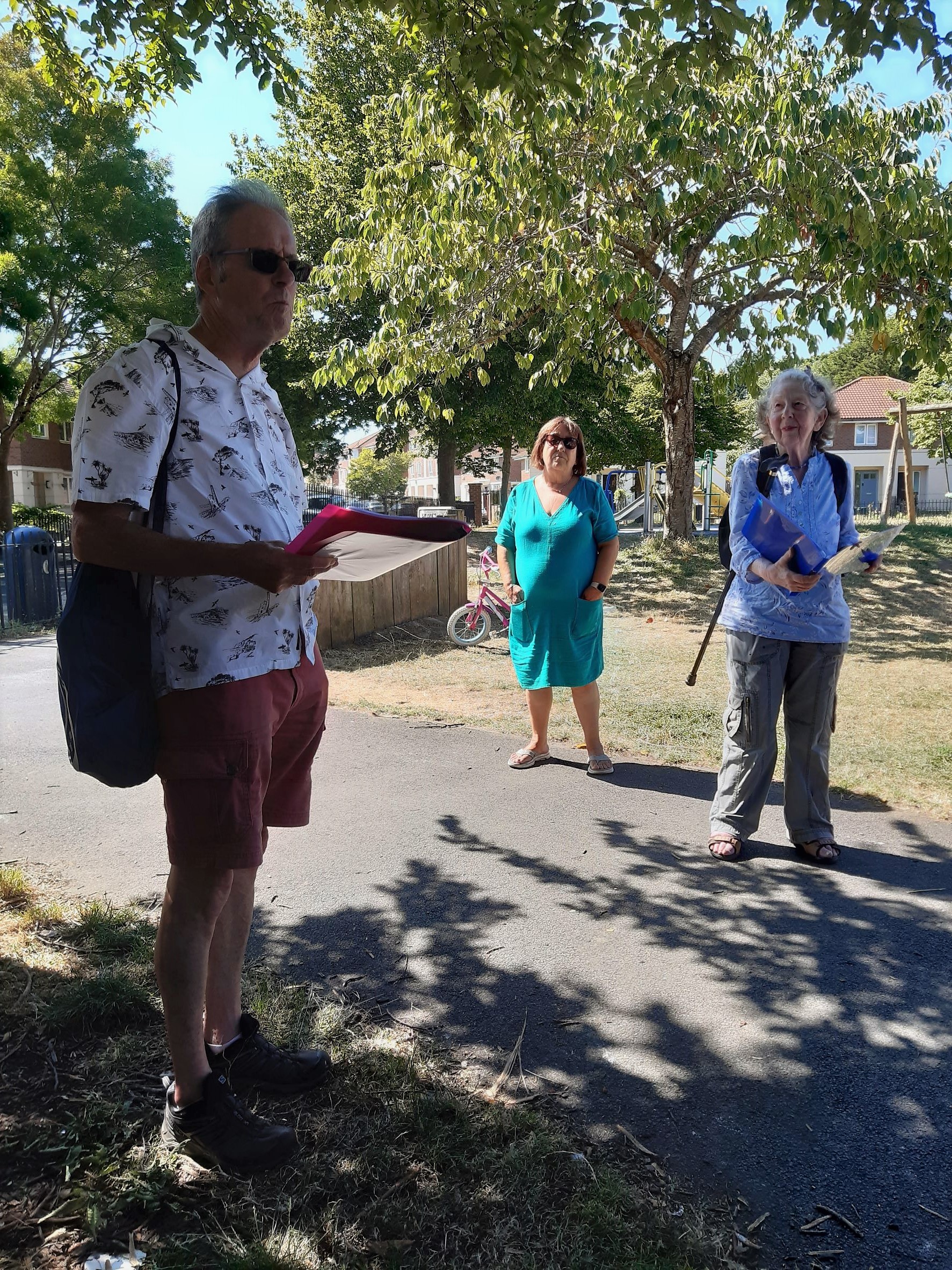


For the first time, in addition to our own work, we were reading poems by other, famous poets, namely those after whom the streets are named, as commemorating them was the main purpose of the walk. So in the park, which is on Eliot Close, we read 'The Rum Tum Tugger' from T S Eliot's 'Old Possum's Book of Practical Cats' and, as we were within earshot of  Larkin Place, Philip Larkin's melancholic poem, 'The Trees'. 


Our next stop was Auden Mead, near Keats Close.  The installation here, which was designed by local school children and is inscribed with lines from John Keats' memento mori, 'This Living Hand', took on a life of its own in the run-up to the poetry walk. I tweeted my indignation about the positioning of litter bin bang in front of it, making the poem impossible to read without getting a whiff of dog poo, and it was picked up by the Bristol Post, an interview ensued and suddenly Angry of Bristol's diatribe got some traction.* 

The obvious poem, then, to read at this point was 'This Living Hand', which is fragmentary and very moving, written in 1819 when Keats' health was failing as a result of TB. He was to die in 1821 at the age of 25. 


Since we'd just walked up Shelley Way, we also read a few verses from Percy Shelley's 'The Mask of Anarchy', with a rousing 'Ye are many - they are few!' to end it, while Dominic read W H Auden's 'Refugee Blues', which is more poignant and pertinent than ever. 


On then to a little grassy spot on Thackeray, via Shakespeare Avenue, which prompted some Bard-related poems, and, in anticipation of our walk down Hughes Gardens, David's poem about his mother-in-law going fishing on the River Exe with Ted Hughes. And as we were just a street away from Macauley [sic] Road, where my father grew up in the 1920s, I read a poem not by Thomas Babbington Macaulay but me, about my grandfather and father's experiences of the first and second world war respectively. 


Leading the stragglers

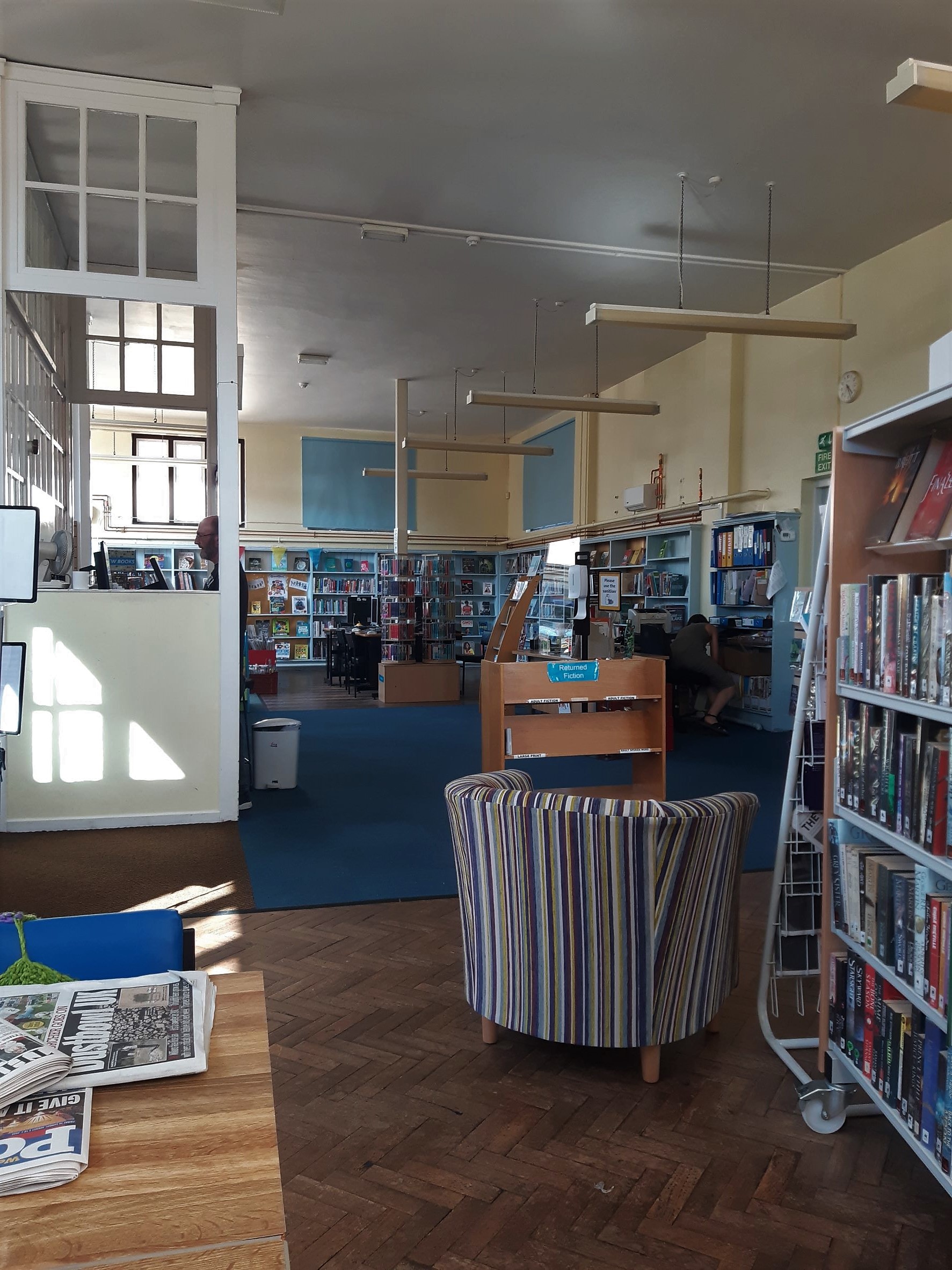
Our destination was Horfield Library on Filton Avenue, where there was tea and cake waiting, courtesy of the Friends of Horfield Library ... 


... and poems about Wordsworth and Coleridge, whose streets are somewhat further afield than the route of our walk permitted us to explore.  Coleridge was particularly relevant here, given that he used to make an 80 mile round trip on foot between Nether Stowey, north of Bridgwater, to his nearest lending library, which was in King Street, Bristol. Thanks to its Friends, Horfield library is still going and residents are spared that effort ... for now. 


If you think the Council should move this bin so that this installation and its poem can be appreciated properly, please contact its parks team. There’s a page on the council website called ‘Improve a park or green space.’ The name of the park is Auden Mead and you don't need to be a resident to make your suggestion.

Saturday, 7 March 2020

No Name Brook and Sam Treasure's Quarry

Does a brook called No Name Brook have a name? Possibly not. 

Actually, this might not be No Name Brook. It might be a tributary of No Name Brook but I can't check on a map because it isn't named. 
We were in Stoke St Michael visiting local poet, Louise Green, who took us down the lane that runs past her house to Stoke Lane Quarry, known locally as Sam Treasure's Quarry, which is all kinds of pleasing.


I was consumed with envy. What a place to walk your dog, or sit and write poems. 


We then headed on through the wood ... 


... to where either No Name Brook - or the tributary of No Name Brook - disappears into a swallet, which is, I suppose, a cross between a swallow and a gullet, etymologically speaking.  


The black holey thing is the entrance to a cave, of which there are many under the Mendip Hills. A sign on the rock reminds cavers to tell people where they are going in case they don't come back at the expected time. 


Back in the village we popped into St Michael's Church, which is mostly a Victorian rebuild and somewhat lacking in quirk, to be honest. 


Even St Michael's dragon failed to cut much of a dash. 


The real treasure on show is the appliqued hanging depicting the village as it was in 1918, which Lou had a hand in stitching and which was made to mark the 100th anniversary of the end of World War I. 


It's hard to get a good general photo of it because of the non non-reflective glass, but the real joy is in the detail anyway. 
Seventeen men and boys from the village died during that conflict. 

They are represented by tiny silver figures, each with its own red poppy of remembrance. 
There is one outside what is now Lou's house but then was his. It seems fitting that he should be commemorated by a member of the family who lives there now. 


Friday, 21 June 2019

A visit to the Doris Hatt exhibition at the Museum of Somerset

From the passenger seat of the car, Taunton seemed to have changed enormously from how it was when I lived there briefly, 30-odd years ago, but there was no time for a proper look as my Friend-Formerly-Known-As-'Er-Over-The-Road and I were on a mission, having only a week left to find a parking space and get to the Museum of Somerset before the exhibition of work by Doris Hatt closed. 

Because when would we next get the chance to see a whole exhibition devoted to Doris, whose art should be far more celebrated than it is?

Doris Brabham Hatt was born in Bath and into money in 1890. She decided to make a career for herself in art while she was at finishing school in Kassel, Germany, and subsequently studied art at the Bath School of Art, Goldsmith's and the Royal College of Art. 

One of Doris' earliest commissions came in 1915, in the form of a World War I recruiting poster for the Parliamentary Recruiting Committee. 

Doris soon disowned her work as news came through of the appalling casualties of the conflict. At the same time she was becoming radicalised in London through exposure to the poverty she saw in the city, the plight of returning soldiers, the Women's Suffrage movement, and the writings of William Morris.   

You can argue - and we did a bit - that like Morris before her, it's easy to build a beautiful, cutting-edge home to live in and devote your life to your art when you have pots of inherited money. 

But, again like Morris before her, Doris put her not inconsiderable money where her mouth was. In 1917 she joined the Independent Labour Party, and in 1935 the Communist Party. She travelled to the Soviet Union, became a regular seller of the Daily Worker, and stood as
party candidate in the Clevedon Urban District Council election in 1946 and 1947. She also taught children how to draw, and ran adult education classes into the 1960s. 

 Doris shared her life with her partner, the teacher, artist and weaver, Margery Mack Smith. Their extensive travels in the UK and abroad had a significant influence on the development of Doris's art. They were often joined by close members of their family, and I naively hoped for a
loving acceptance of their relationship, but tragically and horribly, a large quantity of her letters and personal records were burned by a relative after her death in 1969. Fortunately, two chests of material,
including sketch books, were saved by Margery, who took them to their second home in Watchet.  


On to the exhibition.


Doris was very influenced by the landscape of her native West Country. Here's Cumberland Basin with the Clifton Suspension Bridge in the background ... 


... and an instantly recognisable Brandon Hill, both in Bristol. 


She often revisited the same scenes in different media ... 


... and it's fascinating to compare landscapes to see how her style developed over years. 

Here, Sennen Cove in Cornwall. 


I love the feeling of movement in a lot of her work. Here the mad, wind-swept trees on the front in Clevedon ...


... and a still life, which is anything but. 


I also loved her paintings that make use of counterpoint.

Sursum corda - lift up your heart


The Melon Picker


Bay Cottage, Lyme Regis


Some of Margery's weaving


I think this might be my favourite painting of all. I love this woman's placid strength. 


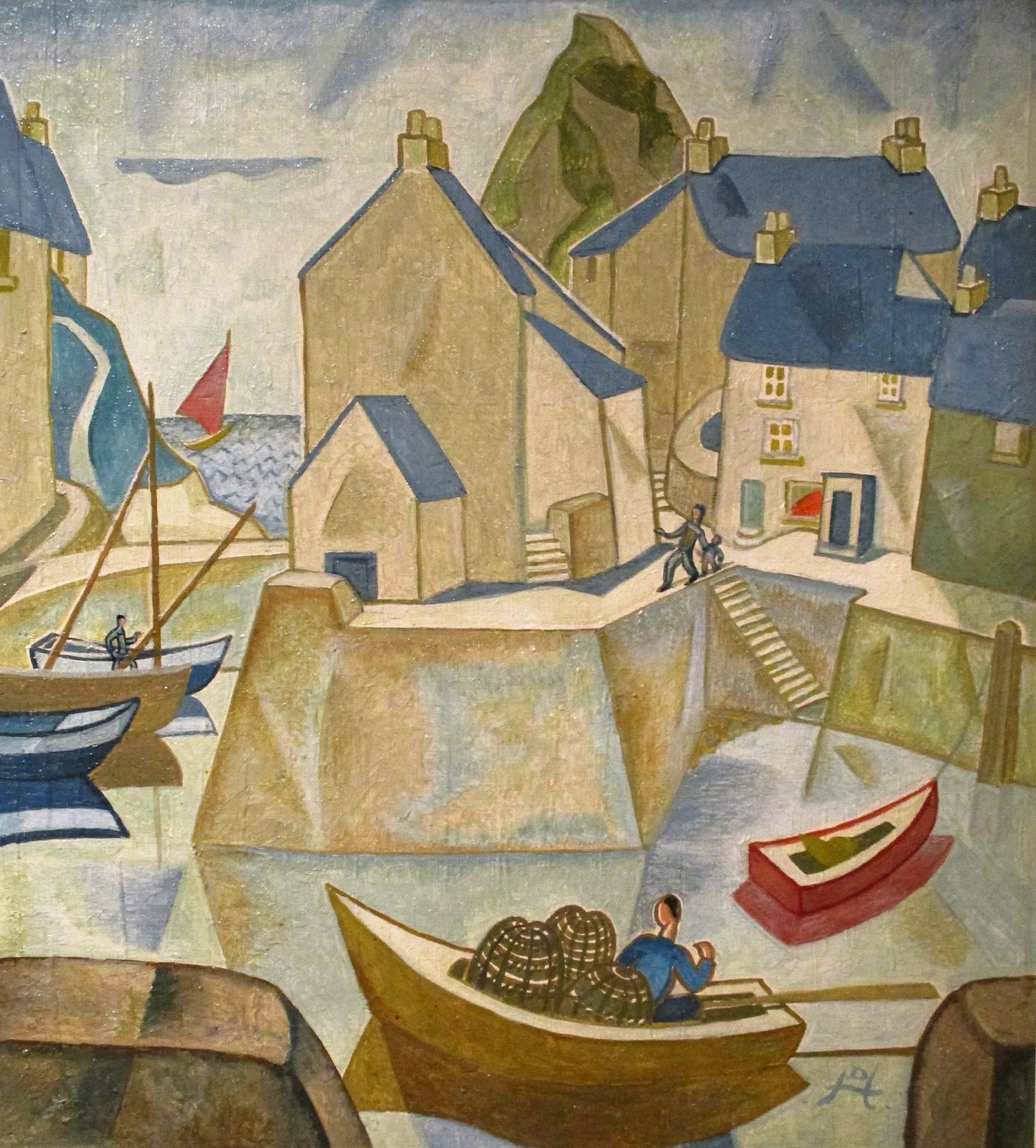
Polperro

After we finished the exhibition, we went around again because it was that good - informative and beautiful. Not everyone agreed ... the only man there while we were was loudly explaining how he would have framed everything differently, although to be fair there was also a woman complaining that the paintings hadn't always been hung in the strict
chronological order she craved, which shows you can't please everyone. 

Anyway, the exhibition ends on 29th June so if you are reading this and think you'd like to go, you'd better get your skates on.