Despite being born, raised and resident in Bristol, there are lots of buildings in the city I don't know well, or indeed at all. One is the 13th century church on College Green, just off the city centre, which has had several names during its long existence.
Founded in c1230, it started life as Gaunt's Chapel, adjacent to Gaunt's Hospital and part of St Augustine's Abbey. It was then known for centuries as St Mark's Church, both before and after its purchase in 1539 by what is now Bristol City Council, following the dissolution of the monasteries. Since 1722, when it became the official church of the Lord Mayor and the city corporation, it's generally gone by the name of the Lord Mayor's Chapel.
Its elusive nature is in part because until recently, it was often closed to the public. My sole previous visit was on one of the Bristol Open Doors weekends, back when you didn't have to buy a wristband and the whole point of the initiative was that it was free to visit places that were usually out-of-bounds, giving it a vaguely illicit, 'mass trespass' feel that's been lost now you're required to pay for the privilege.
For the last year, however, the Chapel's been open from Thursdays to Saturdays, and as I recently found myself in town with no need to hurry home to the dog, I decided to revisit it.
Another reason for not having been there more often could be that it's relatively easy to walk past it without really noticing it. For a start it's in the middle of a rank of shops, so that with the exception of the frontage, you get little idea of how the building looks.
(About that frontage: it's a rebuild dating from the 1820s, when the cast-iron viaduct was built over Frogmore Street to raise the level of Park Street and improve its gradient. The original was removed to Sheep Wood in Henbury, to provide a picturesque folly in the back garden of some wealthy Bristolian whose identity is in dispute.)
To see it better - or at least, its south elevation - you have to go down a little alleyway, itself easily overlooked.
Because of this tucked-away appearance, when you go inside, there's a Tardis effect.
16th century Tudor roof
The Chapel of Jesus, or Poyntz Chantry, built c1523 by the Poyntz family of Iron Acton ...
.. with its contemporaneous floor tiles from Seville
The Chapel of St Andrew, with 17th century wrought-iron screen and gates by Bristol blacksmith William Edney, removed from Temple Church following the latter's bombing in the Bristol Blitz
The Lord Mayor's Chapel is filled with treasures. Its collection of 16th century French stained glass was purchased by the council in the early 19th century and so, to me at least, is somewhat less interesting for not being original - presumably those windows went the way of most mediaeval glass during the Reformation. Most of the panels seem to be made up of fragments of this earlier glass mixed with far more modern work, as in the East Window.
Likewise, the corbel tables contain mostly 19th century corbels carved when the Chapel was restored, although there are some that date from the 13th century, that were found in the rubble infill of walls when the new Choir vestry was constructed.
Also originating in the 19th century are these - well, I've seen them described online as horses holding shields, but looking at their foreheads and their tails, I'm sure they're unicorns, which have an association with Bristol dating back to 1529, when the city was granted a crest supported by a golden pair of the beasts.
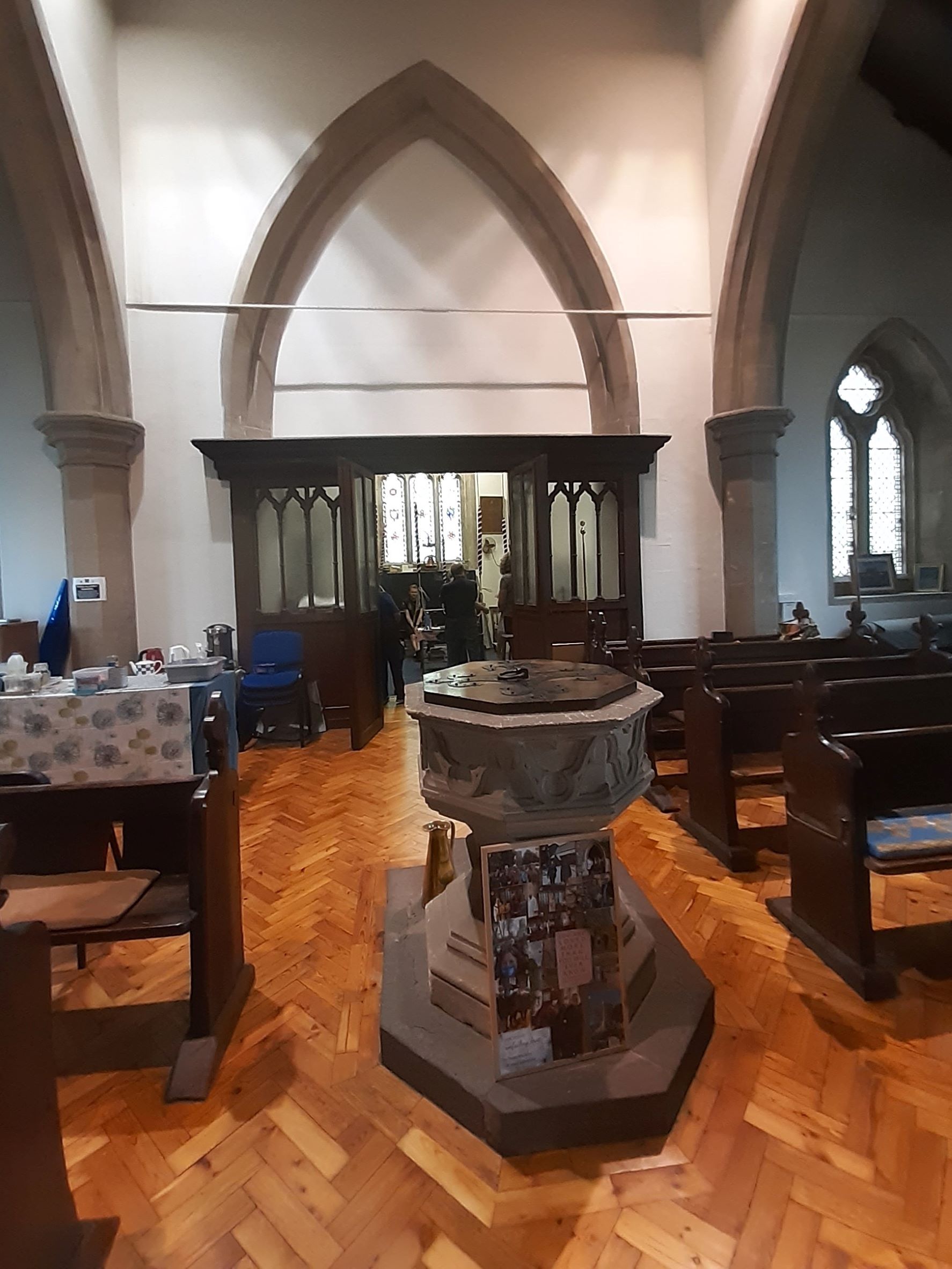
Rather older is the font, which has been dated to the late 13th or early 14th century ...
... and fragmentary wall paintings (c1500), which were discovered by chance in 1824. From left to right they depict the Resurrection, the Nativity, and the appearance of Christ to Mary Magdalene in the garden.
But the best thing about the Chapel is the proliferation of mediaeval and early modern tombs and memorials, some of which are dedicated to women.
Necessarily early are the effigies of the founders of Gaunt's Chapel, Maurice de Gaunt who died in 1230 and his nephew, Robert de Gourney, who died in 1269, their feet resting on a dog and a lion respectively.
Unknown merchant, dating from c1360 and erroneously identified as Henry de Gaunt as early as 1531
Sir Maurice Berkeley of Uley or Stoke Gifford, who died in 1464, and his wife, Ellen (1475)
Bishop Miles Salley, died 1516
Willian Birde, Lord Mayor of Bristol, died 1590
Elizabeth James, died 1599
(Look at that fabulous winged death's head mask)
Sir Richard Berkeley of Stoke Gifford, died 1604
The tomb of George Upton Esq, 1553 - 1608
John Aldworth (died 1615) and his son, Francis (died 1623)
William Swift, 1571 - 1623
died aged 11 in 1627
Dame Mary Baynton, 1623 - 1667
I've saved my favourite tomb till last. It was erected by Sir Baynham Throkmorton of Tortworth in memory of his wife, Lady Margaret, who died in childbirth in 1635, at the age of 25.
Sir Baynton was the great-grandson of Sir Richard Berkeley of Stoke Gifford (tomb above). He's depicted on the tomb but not in it: he married twice more, and is buried in St Margaret's Church in Westminster. In any event, it's Margaret that draws the eye with her daisy emblem on her chest, her baby in one arm, her free hand in her husband's.
Seeing the tomb again, I found that although I'd remembered lovely Margaret quite clearly, I'd completely expunged Sir Baynton in the intervening years.
The other thing I like about it is the fascinating graffiti on it, dating from thirty years after its installation to the late 20th century.
Now all I have to do is visit Sheep Wood to find the original Chapel facade. Maybe in the New Year.


.jpg)