About Me

My photo
Bristol , United Kingdom
Poet and poetry facilitator. Neurodishevelled. My sixth poetry collection, Love the Albatross, is available from Indigo Dreams or directly from me.
Showing posts with label Harford. Show all posts

Wednesday, 26 October 2016

Walking the Last of the Light on Southernmost Dartmoor

With the biscuit tin by the sea fallen victim to the forces of capitalism, I'd vowed I'd have at least one annual walk on Dartmoor. But though I'd been there twice this year, the physical effort - and consequent euphoria - of climbing a tor or two had eluded me.  And time was running out, because once the clocks have turned back ... well, this is how I feel, only in reverse. 


So with the forecast of fine weather yesterday, the dog and I drove off through thick murk which only got thicker. By the time we reached Exeter, I thought we were probably both completely mad, but once past Telegraph Hill, we rounded a bend and there was glorious blue sky, with fog chiefly in the valleys. The ensuing astoundment must have been what stout Cortez and all his men felt when they clapped eyes on the Pacific.  


And by the time we reached our destination - the car park at Harford Moor Gate, to the north of Ivybridge - we had perfect Dartmoor walking conditions.  

With no particular route to follow but a few things I wanted to see, we struck off in a northeasterly direction, up the side of the Erme valley. The stillness was broken only by birds - a flock of redwings whirring past, crows and a couple of ravens overhead, even the occasional snatch of larksong ...


... and my shortness of breath. I'm clearly not as fit as I was before I broke my leg. 


Before long we had great views opening up all around. This looking back the way we'd come, with Plymouth Sound in the distance ... 


... and here the gleamy bit to the far right is the Erme estuary.


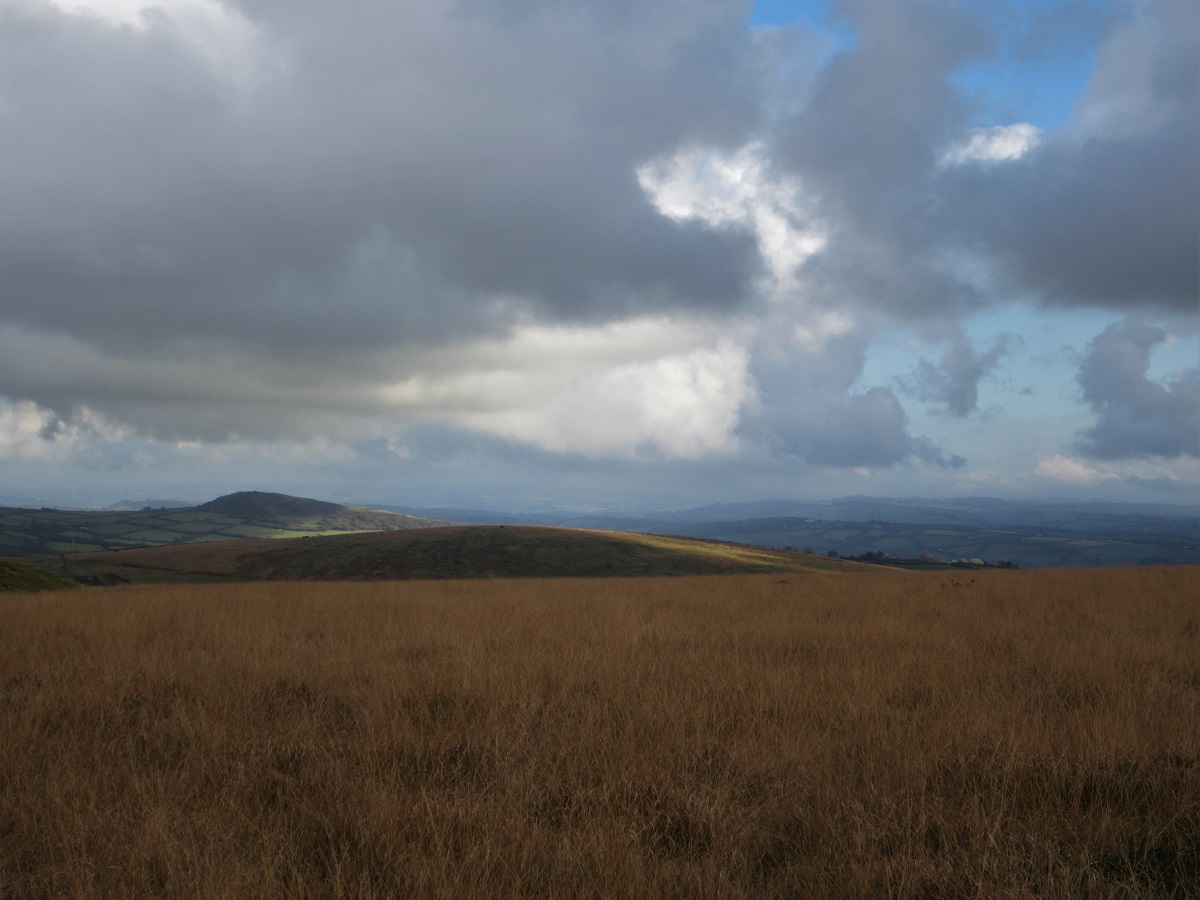
Up ahead, the play of shadow and light was striking.

Ted and I were heading for the Satanic looking promontery on the right, Sharp Tor ...


... but first the sharing of an egg and cress sandwich ...
... on a cairn on Piles Hill ... 


... and a photo opportunity. (Choose the right profile, Ted.) 


Looking over to Three Barrows


Up the Erme again 


We pressed on. It was still pretty squelchy underfoot ... 


... but then we reached the old Redlake tramway and the going became much easier.  


A sharpish turn to the left ...  
... and we gained rocky Sharp Tor.


Ted and I walked to the furthermost outcrop. All was still until the final step up onto the rocks and suddenly the sound of the River Erme far below was loud in our ears. (Dru Marland once explained this phenomenon to me - how one moment you can not hear something and then one step later you can, very clearly because it's loud, but I can't remember exactly what she said.)


Directly below us was Piles Copse, and I remembered the walk Ted and I did up the valley on the opposite bank some years back, when the Erme had been too high for us to ford and we'd had to turn back. You could see the track we'd followed quite distinctly. 


Rather than descend to the wood - though I shall get there one day - Ted and I made for a nearby cairn ... 


... from which there were amazing views of the heart of the southern moor.  My own heart filled up with the beauty of it. 


Heading south now and looking over to Corrington Ball and Brent Hill


As well as cairns, there are lots of other Bronze age relics in the area. This menhir is marked as longstone recumbent on the OS map. As you can see, it's been re-erected and is now also known as the Lazarus Stone. 


There are many boundary stones too, marking the border between the parishes of Harford and Ugborough.   This one is known as Hobajohn's Cross, though it isn't really a cross at all but an incised stone, which probably started out as the terminal stone of Butterdon Stone Row.  


Talking of which ... 


Oh but I'd wanted to see Spurrell's Cross! I must have walked past it.  I retraced my steps and started to cast about. 

I saw Dartmoor ponies ... 


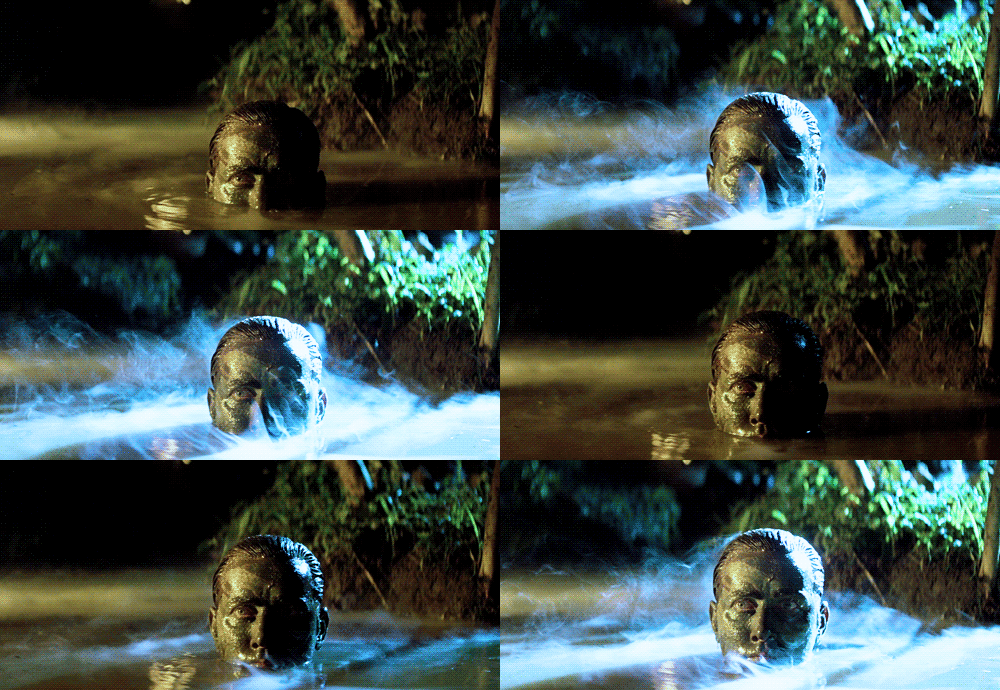
... and this fairly typical bog, which is probably the one in which Martin Sheen is having a dip in Apocalypse Now ... 
... but no cross. I went further eastwards looking for a conjunction of tracks, because that's what it would originally have marked. Then I climbed a few cairns. Still nothing ... though I had a clear view of one of my favourite spots on south Dartmoor, Owley Corner. 


I love it not just because of its name, but because it reminds me a bit of 'Trees on a Hill' by John Nash.


But I was damned if I could find Spurrell's Cross. I even wondered if it had fallen - not for the first time - or been stolen. (It is microchipped because of past attempts.) Next time I'd have to bring my long-distance glasses with me as well as my reading specs. 

'Silly moo,' said the cows.


But it was time to head home. One last longing look up to Ugborough Beacon ...


... a glance back up the valley ... 


... and we were gone. 


Friday, 31 August 2012

Testing Times on Dratmore

It was clear from the fast-flowing, peat-stained waters barging under Harford Bridge that the River Erme was running very high, and this was bad because Ted and I would have to ford it several miles upstream.  But faint heart never got wet feet, so we continued on our way, up onto the moor via the gate at Hall Plantation.
Our first stop was the Tristis Rock.  I've long wondered why it's called that, wondering if the name has its etymology in the Latin tristis, which means 'sad' or 'foul-smelling' - like, say, star-crossed lovers met there and fell into a bog - or if it's connected to a person, for example, a garlic sausage-gobbling Norman invader who seized the land, simultaneously spilling his Listerine.  Whatever, I haven't turned up a story yet.

Normally the first thing I do when I get to a tor is climb it, but Tristis looked like quite a challenge with one very dodgy looking foothold in particular so I gave it a miss, deciding that if I did fall and sprain my sprained ankle, it would be quite tristis for me out there on my own, Ted's Lassie skills leaving rather a lot to be desired.  There were great views from the base of the rocks, anyhow, up the Erme valley to Sharp Tor.

The main reason why I wanted to do this walk was to get a closer look at one of three extreme oaklands on the moor.  Like bumble bees, which, the laws of physics assure us, cannot fly, Piles Copse, Black-a-Tor Copse and Wistmans Wood do not exist because oak trees cannot grow at such a high altitude and in such exposed conditions.  Except that they do.  And there, up ahead on the right hand bank of the Erme, was Piles Copse, the only one of the three I had yet to visit.

First though, the locating of a rather whimsical path through boggy scrub, through a gap in a wall and another gate, followed by a slantwise trek up hill before joining a good track leading up the valley from the Water Treatment Works through a well preserved bronze age settlement containing hut circles in an enclosure.


When walking through such sites, I always wonder about the people who were born, worked and died here so long ago, what their lives were like, what hopes and dreams they had.


The path headed on up the valley alongside the copse. It was easy walking, albeit pretty wet in places.  

There were lots of sheep and ponies about, so Ted went back on the lead.


We were now opposite the copse.  A handful of oaks and one or two rowans had even seeded themselves on our side of the river, which, incidentally, was still looking pretty fierce.  I wondered about the crossing.  I s
omehow doubted we would get over but kept on going, not least because the walking instructions said to turn right at the lone hawthorn and make one's way down to the bank, which pleased my inner Blytonesque adventurer no end.
  

And there it was, the lone hawthorn, its berries reddening ...

... and there the river was, nigh on impassable.


  At this point I had three options.  1. Risk it.  2. Carry on upstream for another two and a half miles where there was a second crossing point.  3. Admit defeat.

Number 1 option was a non starter.  
Dartmoor rivers are notorious for sweeping people away and not just in folk tales, either.  I couldn't risk Ted's safety, nor mine for that matter. 

Number 2 option also lacked appeal.  It was already mid afternoon and the weather was closing in.  What's more, there was no guarantee the ford upstream would be any less dangerous and I risked adding an extra five miles to my journey and still having to resort the dreaded option 3 ...
  
Every particle of my body hates, loathes and detests turning around and retracing my steps, and it never gets any more palatable.  But Dartmoor is my teacher and its lessons are always challenging, this one just more so.
  

It's never as easy finding the path on the way back.  And I'd forgotten how bloody boggy the Erme valley is, I'm sure it's wetter than all the others.   Ted seemed quite happy, though.  And before I'd got back to the car, I was already working out a different route for next time.  


Tuesday, 19 April 2011

Beating the Bounds

As far as visiting Dartmoor is concerned, Easter is my New Year, and the first visit to my patch a taking stock of the months that have passed since the previous one, and of those to come. 
The biscuit tin by the sea is only five minutes from the beach, but being contrary, my first footing has to be on Dartmoor. 
To that purpose, Ted and I were up and out early(ish) last Friday despite the grey and misty weather.  

At Harford Gate, we rendez-voused with my co-worker Ellie, her partner, Vicky, and their two Lab-Collie crosses, Teddy and Dougal, who were camping close by.


Our walk took us up onto the dismantled tramway that runs from the former Red Lake China Clay pits, high on the moor, to Ivybridge. This offered easy walking below Hangershell Rock and Weatherdon Hill, with the added advantage of avoiding cattle which both Ellie and Ted (my Ted) dislike. 

This is a dead thing I saw – an (extraordinarily well-endowed) shrew. (Or maybe they are all that well hung?)


We then climbed to the cairns south of Butterdon Hill and strolled along the ridge to Western Beacon, the southernmost peak on Dartmoor.  

From here there’s often a spectacular view of the coast, but today it was murky.  Though we agreed that Dartmoor is best viewed in a mantle of cloud, and as it was Ellie and Vicky’s first walk there, it was as well they saw it in all its brooding magnificence.        

We then wandered back to the car, stopping off on the way at Butter Brook, where the dogs had a good splash and a play, and the humans teetered over the stepping stones. 


Having said goodbye to our friends,Ted and I popped into Harford’s Church of St Petroc.  Best feature was the rugged cross in the churchyard, a former wayside cross ‘rediscovered’ in 1909 being used as a gatepost. 

Later, back at Holcombe, my son Samuel, Ted and I went for our traditional evening walk a short way along the coast path and back via footpaths and fields – a sort of literal and spiritual beating of the bounds.

We were too early for the bats which throng the lane from dusk, but Ted alerted me to our first swallow of the year as it fluttered seductively past. Another first was this whitethorn in one of the more sheltered spots on the coast path, its gorgeous, sexy perfume so much more alluring than the pong of alexanders, lamentably ubiquitous this time of year. 

The fields were sprouting with some cereal crop, while the bluebell wood was still relentlessly green.  It will look spectacular in a couple of weeks’ time, but alas, I shall be in Bristol and shan't see it.