About Me

My photo
Bristol , United Kingdom
Poet and poetry facilitator. Neurodishevelled. My sixth poetry collection, Love the Albatross, is available from Indigo Dreams or directly from me.
Showing posts with label nursery rhymes. Show all posts

Monday, 6 May 2019

Poetting in Bucks Mills

This year's been generous so far with day-trips to my heartland. Yesterday my destination was Bucks Mills in North Devon, to read some poems at the inaugural poetry festival there. But first a meander down the very steep lane to the beach ...


... except that I got sidetracked by the Cabin on the slipway, which somehow manages to out-boathouse Dylan Thomas's shed at Laugharne as a desirable writing retreat.

The Cabin was originally a fisherman's store, but from the 1920s to 1971, it was used as a summer studio by the painter Judith Ackland and her partner, the poet and painter Mary Stella Edwards, with whom she made dioramas.

When Judith died, Mary shut the Cabin up and never went back there. Since 2008, it's been in the

care of the National Trust, its interior and contents preserved almost as the women left them.

The Cabin is made available by the Trust to artists-in-residence, but as there's no electricity, running water or toilet, anyone applying for a sojourn needs to have somewhere else to stay overnight. 


It would be great, though, wouldn't it? 

I mean, this is the beach from the garden. 


And here's the view looking east towards Westward Ho!, the Taw-Torridge estuary and Baggy Point ...


... and west towards Hartland Point, with a too-hazy-to-photograph Lundy Island on the horizon ...


... and the white cottages of Clovelly tumbling down the cliffs to the sea, in much the same way the ones at Bucks Mills do. 

Not literally, of course ...


... except in the case of this one, abandoned and poised to crumble.
The beach itself reminded me a lot of the one at Kilve in Somerset, only with sandstone formations rather than limestone. And no easier to walk over.


And with its waterfall pouring onto the pebbles, intimations of St Audries in Somerset also.


There was an interesting - if faded - visitors' board on the quay with useful-to-know, local stuff on it, like how Bucks Mills has its own nursery rhyme claim to rival Mells, Holcombe and Kilmersdon in North Somerset; namely, that in 1598, Richard Cole built a quay here which is now only visible at low tide, the cliff having eroded in the meantime. Old King Cole, anyone? ... Thought not. 

And about the Gore and the Gut - the former being the the pebble bank that runs out to sea and then turns towards Lundy. According to legend, it was built by the Devil as a
causeway, but he gave up when the handle of his shovel broke. Whereas the Gut has a far more prosaic history, having been blasted through rocks (Richard Cole, again) to allow small vessels to unload directly onto the beach.


I began to regret nipping down to the beach before the Festival when I realised just how steep it was climbing back up through the valley to the Gallery, where it was being held. Red-faced, sweaty and panting is not a poetic look.


There were lots of interesting things to pretend to look at while I was catching my breath, though.


Here's Dominic Fisher, kicking off the readings, which went well. 


Afterwards, there was just time to pop up to the Church, which is modern by most country church standards, having been built in 1862 in the Gothic Revival style. 

No worries about getting into the church on account of it having to stay open in order to comply with the terms of its covenant. Something to do with supplying shelter. 
Perhaps that's why it's quite plain inside.
There's also a sign which stipulates that all the seats apart from those in the chancel are to be reserved for the use of the poorer inhabitants of the parish. 

And then it was time to drive home again, over the Torridge and the Taw and the Exe and the Tone and the Parrett and the Axe, and all those rhynes on the Levels with names like Blind Yeo and Grumble Pill, and finally the Avon. Home from home. 


Sunday, 11 February 2018

A Jaunt to Nursery Rhyme Land

February is a rather exacting month for church-hopping, what with the cold and the dark and the general deathliness of it all, but there I was in north-east Somerset with a few hours to kill (ahem) so that's what I ended up doing. 


First stop, Leigh-on-Mendip, at the eastern, less familiar end of the Mendip Hills. The church there, St Giles, was originally a Chapel of Ease for nearby Mells and was completed around 1350. 


Its dimensions are narrow and high, but it also feels cosy and intimate, even on a drizzly grey day. 


I loved the scraps of mediaeval glass in the windows (this the Great West) ... 


... and the original, late 14th century bench ends ... 


... and oh! that magnificent tie-beam roof, with its beautiful carvings.  


This was my favourite thing, though. 


Leaving Leigh-on-Mendip, I headed four and a half miles up the road to what was perhaps the main attraction of my morning's itinerary, Holcombe Old Church.


Because how could I resist visiting an ancient church, far from any village, with the sobriquet The Plague Church? 


Though actually there would be no going inside, as I didn't have time to seek out one of the several keys being held in the rather distant village of Holcombe.  

But it didn't matter. I was interested in the story of the old village which was buried and abandoned in the 1660s when the Great Plague arrived.
It's under these humps here, apparently. 

There are assertions online that Holcombe is where the nursery rhyme 'Ring a ring o' roses' originated. 


Hmmm. My book of the origins of folk rhymes has debunked the debunking of the song as having anything to do with plague - there are pneumonic forms too, you know - but it would be good to have even a shred of evidence linking the rhyme to the village.


Maybe, thought I, the villagers claim this because the nearby village of Mells is supposed to have a connection with the rhyme Little Jack Horner. Anything they can do. Yes, that must be it. 


The Norman arch and worn steps of the porch


Upsidedown? Back-to-front? Partially Greek?   graffiti with serifs in the doorway


This is the grave of Widow Joan ? who was buried in April 1666. I wonder if she died of the plague.


Grave of Bessie Pole, aged 10; Clifford Pole, aged 8; Thomas Pole, aged 7; Eveline Long, aged 11 and Ewart Long, aged 8, who were drowned in a pond in this parish 'by the insecurity of the ice, Dec 20 1899' ...


... also of Harcourt Morely Long, who was drowned at Kilmersdon Common, July 27 1894 aged 14 months, and was buried in this churchyard. 


It was raining quite hard by now, so I gave up my attempt to find the family grave of Robert Falcon Scott and headed instead for the Church of St Peter and St Paul in Kilmersdon ... 


... which boasts a lych gate by Sir Edwin Lutyens. And very lovely it is too. 

Unfortunately the man who'd been doing in something in the church was leaving just as I arrived, so I didn't get to look inside. 
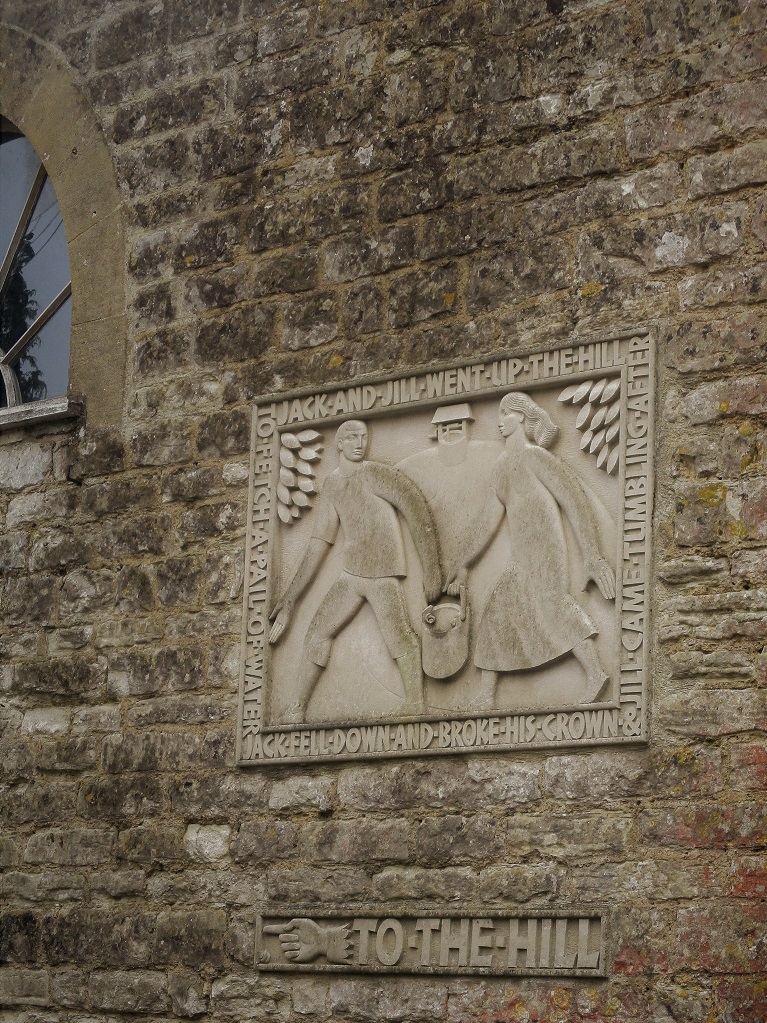
No matter. I'd spotted something interesting set into a nearby wall ... 

Blimey! Another nursery rhyme!


So, the story here is that in 1697 a local unmarried woman (Jill) fell pregnant. Shortly afterwards, the presumed father (Jack) was hit by a stone from Badstone Quarry (Very Badstone for him) and died. Jill had her baby but naturally she died not long afterwards too, the harlot, and the child was raised by villagers. It's said this is where the common local surname Gilson comes from. 


Being short of both time and vinegar and brown paper, I decided not to climb the hill. That can wait for another day.