An armed man was holding a two-year-old boy hostage in a stand-off with police on the M4. As a result, the motorway was closed and by the time we'd negotiated a series of traffic-choked A and B roads to reach the irredeemably posh Cotswold pub where my then husband had booked a table for my 40th birthday lunch, we were very late indeed. The staff took one look at us and our neurologically interesting children, and showed us into the skittle alley where we ate our indifferent (but expensive) meals in isolation. And by the time we emerged, this being late October, it was getting dark, the motorway was still out of bounds, and there was no time to do any of the things we'd planned apart from the briefest of visits to the clapper bridge spanning the River Leach in the neighbouring villages of Eastleach Turville and Eastleach Martin.*
 Here's the bridge, in the etching by Robin Tanner I'd been given to mark my great age.
It's taken me 16 years (almost) to muster the heart to go back.
This time the worst thing that happened on the motorway was a sudden squally shower. Not to worry, I told the dog. We are poets. What care we about soaked jeans and dripping hair?
But by the time we'd parked in Eastleach Turville and made our way down to the river it had stopped and the worst hazard we had to negotiate was some over-protective swans and their offspring.
It isn't an exact rendering of the bridge, by the way, nor the view from it. It's more of an idealised composite, but no less pleasing for that.
After the bridge, the next stop on our short but sweet route was the mediaeval Church of St Michael and St Martin, which gives the village on yonder side of the bridge its name.
Even I could throw a stone from this House of God to the neighbouring church of St Andrew's, so it's no surprise that only one of the buildings is still in regular use.
St Michael and St Martin drew the short straw for closure and is in the care of the Churches Conservation Trust. It has that pleasing emptiness of such churches that makes it easier to focus on the fabric of the building.
One of the windows contains fragments of mediaeval glass.
I am always drawn to the faces.
It's hard to pick up in photos, but there's a delicious wonkiness to the north and south walls and windows.
There were also postcards on sale featuring the local hunt. This was less pleasing. I bought one, pointed out the incongruity on the back, and left it there.
Our route took us down a lane past an orchard with already rosying apples, and trees dripping with damsons and plums. Putting thoughts of my favourite damson vodka from my mind, I conceded that even if they weren't owned by anyone, their bounty properly belonged to the villagers rather than me, but it was a close call.
The walking book boasted an idyllic path by the river with herons and even the chance of a kingfisher, but sadly the route has been diverted away across a field, I suspect due to erosion.
And when I did spot it, the river was clearly a bit of a winterbourne, being almost completely dry in parts.
And instead of herons and kingfishers, I was accompanied by the bedraggled squeak of a bullfinch.
There were one or two impressive trees, though, and it was interesting to see how the river, in more prosperous times, has affected the lie of the land.
Eventually our route turned south and climbed. On top of a ridge, I encountered a sizeable collection of puffballs. Yum.
No more self-restraint - I seized a couple, stuffed the smaller in my satchel and tucked the other under my arm.
Having stowed them safely in the car, I made my way back into the village to visit the other Church, that of St Andrew.
Its saddleback tower is so very familiar from the etching.
St Andrew's obvious glory is its Norman doorway, dating from 1130 ...
... the tympanum of which depicts a defaced Christ in Majestas, flanked by angels.
The interior feels rather more lived in than that of its sister Church, though still very stripped back.
There was just time for a last maunder down by the bridge, this time sans swans. With the trees beginning to think about changing their garb for something rather more seasonal, it felt like the last lushness of summer.
*As I recall, the little lad was safely rescued.
In order to write a poem for her exhibition of landscapes, I needed to visit sites where Bryony had taken earth to make paint. Our original plan was to visit Church Norton and Selsey, before heading to the holloway at Halnaker.
The traffic had other ideas, however. Still, at least there was a good view over flat fields to Chichester Cathedral.
Time was already getting on when we reached Church Norton, so we hurried through the salt marsh of Pagham Harbour to the beach.
My sort of bleak. It seems to fit into my eye comfortably, somehow.
Bryony pointed out the spots where she had taken sand and mud to make her paints.
The beach itself was lonely and lulling ...
... and with a tidal range far smaller than that of the Severn, we could loiter happily on Church Norton spit, unlike the causeway at Sully Island in South Wales a couple of weeks earlier.
There was sea kale and yellow horned poppy sprouting in the shingle ...
... and fossils to be photographed.
Heading back to the church, we passed the site of Norman castle, the earthworks of which are still visible.
I was a bit puzzled about the Chapel. It too proclaimed itself to be Norman, but the dimensions were wrong. It looked more like a Saxon Church to me.
Then I learnt that what we see here today is actually just the chancel of the original Church, the rest having been transported to, and rebuilt at, Selsey. It seems that with the transference of the Church's HQ to Chichester and the building of the Cathedral, there was simply no need for a large church here.
 The Chapel is now in the care of the Churches Preservation Trust.
There's a gruesome plaque on the tomb of John and Agnes Lewis of the martyrdom of St Agatha. Who, in a twist (ahem) of that peculiarly Roman Catholic propensity to take things literally, is the patron saint of breast cancer patients.
There's also pleasing, modern stained glass in there, of St Wilfrid 'teaching the locals to fish' and of the salt marsh and its inhabitants. More landscapes made out of sand ... but it was time we moved on to our last destination of the day.
 After an enjoyable evening's poetry at Bradford on Avon the night before, courtsy of Dawn Gorman's Words and Ears, Pameli and I were on the road relatively early for a morning jaunt to the Church of St James of Compostela in Cameley, North Somerset.
As soon as we entered the churchyard we were met by its resident robin, who seemed quite unbothered by our presence.
Maybe s/he was trying to draw our attention to various headstones, like this one to Charles Sage, who died in 1808. It has a coal wagon carved on it - a reminder of the North Somerset coalfield.
Or this to a Quarman, who died on November 17th. His age - 67 - was left out and added with an omission mark. Damage to one side means key details are missing, though t'internet names him as James and gives his year of death as 1783.
St James is one of those churches that got left behind when its congregation shifted, in this case to Temple Cloud, which developed in Victorian times around what is now the A37, just under a mile to the east. Its gradual decline meant it escaped the attention of Victorian 'restorers'.
 No worries about getting into it as it is cared for by the Churches Conservation Trust and open daily in the summer. First, though, we admired some remnants of paint on the Norman doorway in the porch.
Inside, a hotchpotch of ancient and not-so-ancient fixtures and fittings, murals and carvings
John Betjeman called St James 'Rip Van Winkle's Church', and it's true, a history of the Church can be traced in its fabric and fittings. Pre-Reformation wall paintings, discovered behind layers of whitewash in the 1960s, line up alongside seats of royal arms and the Puritan-approved Ten Commandments; the vestiges of mediaeval side chapels and the mediaeval door to the rood screen partly obscured by 17th and 18th century box pews and the 18th century and 19th century galleries.
18th century hat pegs, far left
The last surviving pieces of the Church's mediaeval glass
The pulpit with its magnificent sounding board is dated 1637. This is where the sermon would have been delivered; the rest of the service being conducted from the reading desk.
The 12th century font with its cover, which was made in 1634 at a cost of £1 12s 4d
An iron peg which could have been designed by C F A Voysey, though I suspect it's a fair bit earlier.
 And then there are the wall paintings: here, all that remains of what would have been a huge early 14th century St Christopher carrying the infant Christ, namely, a foot surrounded by little fishes and a fearsome crab.
The lower part of the royal arms of King James I (1603-25), most of which has been obscured by the gallery above.
A contemporaneous set of the Ten Commandments; above, the traces of a yellow sun or 'Glory'.
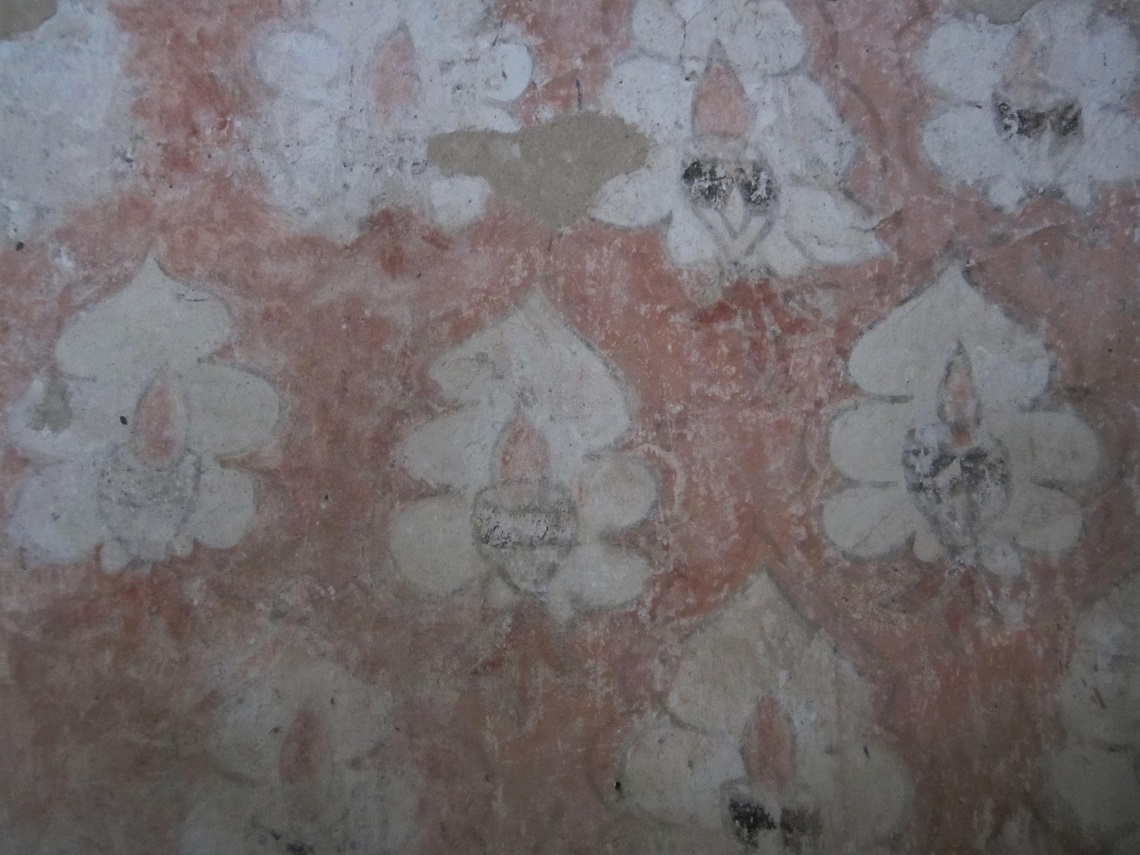
A damask pattern of what Pameli and I mistook for candles at first, but are 15th century acorns and oak leaves.
Red dash and scroll patterns from the 1200s on the chancel arch, and early 15th century black and yellow damask patterns in the former side chapel.
My favourite - a mid-14th century jester with a forked tongue, holding a scroll. Apparently there's a possible St George in armour and on horseback behind him, but I couldn't really make that out.
At the back of the church, carved into the seat of one of the narrow mediaeval pews, there's a design that looks very like the daisy wheels or hexafoils that protect the tithe barn at Bradford on Avon from the evil eye. While I snapped things in dim corners, Pameli and I swapped hex stories, mine being about the outlines of shoes I've come across in various churches and churchyards.
 It was only when I uploaded my photos to my laptop that I realised St James has its own sole outlines.
The guide to the Church describes these as 'three pieces of lead from the roof, where presumably those who laid or repaired it autographed it with their footprints and the dates 1733, 1757 and 1795.' But like the lead outlines on the roof at Muchelney, and the other examples I've come across, I think they might well be examples of apotropaios.
 Outside, we came across a door that was the perfect size for Pameli ...
 ... complete with miniature handle.
 The robin was still knocking about too, and gave me quite a shock when I went to sit on the bench for a moment.
 There was just time to admire the poultry belonging to nearby Cameley Lodge (is that cockerel a Buff Orpington?) ...
 ... and views so bucolic we seemed to have stumbled into an Eclogue. All this a bare 11 miles from the centre of Bristol, our final destination.

 Here's the bridge, in the etching by Robin Tanner I'd been given to mark my great age.