About Me

My photo
Bristol , United Kingdom
Poet and poetry facilitator. Neurodishevelled. My sixth poetry collection, Love the Albatross, is available from Indigo Dreams or directly from me.
Showing posts with label archaeology. Show all posts

Monday, 1 May 2023

April Elsewhere

As I write, it's the first of May and there is no may to be seen up the field, or out over the farmland. The wet cold weather this spring means the whitethorns are several weeks late blossoming. And when I say wet, it has been wet. 


Never mind, all the heady exhilaration of hawthorn is still to come, and if the display is anything like the (also late) blackthorn we've had this last month, it will have been worth waiting for. 


It's been like watching colossal, slow-moving waves of white blossom roll their way around the field edges, from the sunnier hedgerows to the more northerly ones.

Flowers are starting to pop their heads up above the parapet now too. The white violets in the Small Dark Wood of the Mind and the purple ones I spotted in the middle of the Field of the Hollowing Oak for the first time were past their best before April had much advanced, but the celandines and ground ivy are still going strong, and have been joined by silverweed, buttercups, herb Robert, cowslips, bugle, forget-me-nots, and the most spectacular display of dandelions. Grasses are starting to flower now too, and some of the anthills in the field have covered themselves in speedwell and bittercress. 


A fragile pleated inkcap appeared briefly in the field ... 


... and some insects have stayed still long enough for me to photograph them too. 


a Common Carder bumble bee, a green dock beetle, first ladybird of the year and something that looks superficially like a ladybird but isn't and I don't know what it is

Meanwhile, the rookery is full of Sturm und Drang. There have been ravens and buzzards, but none of them have stayed around to be photographed. I did find this beautiful starling feather in the field, which is a bit strange as I don't think I've ever seen starlings up there. Maybe it was flying over.


Most exciting of all, the roe deer are back - I've seen hoofprints out on the farmland and in the field, though no sighting of them in person just yet.


And all the time, the hollowing oak has been getting on with the process of leafing, and for the first time in three years, it's also covered in blossom. Expect an excellent mast year.


1st April 


6th April 


7th April


19th April


20th April 


26th April


29th April 

There was despair early in the month when the footpath along the embankment was closed and a digger turned up in the skylarks' field, solidifying our vague feeling of dread into resignation that the building of the access road had finally started. 


Then a sign was attached to the fencing explaining that the digging constituted temporary archaeological works. I was a bit sceptical about the instruments these archaeologists were using, till the Northerner reminded me that there's a digger on site in Detectorists, when they're excavating the crashed WWII bomber (series 2).


And then they'd gone and taken their digger with them. Presumably they found no long lost Roman city or plaguey burial pit. There will be no scraping of trowel on mosaic to hold off the building of houses here, but with luck, we might get another summer walking the footpath.

The other progress has been of the sun along the line of hills to the west, on evenings when the cloud hasn't been too thick to see it. 


1st April


4th April


7th April


20th April 


The sun lodged in the hollow between Mynydd Maen and Twmbarlwm on 20th April


29th April 


Sunday, 23 October 2016

Calleva Atrebatum and St Mary the Virgin, Silchester

Time for a joint birthday jaunt for Daughter No 2 and me. We had a think and decided to go to Silchester in Hampshire. 

We had lunch in the Calleva Arms. Calleva Atrebatum, we are told, is the Roman name of the town they built near the present village in the first century AD. 


Our first stop was the ancient Church of St Mary the Virgin, but we arrived ten minutes before a baptism was due to take place, so diverted to the site of the Roman town walls and amphitheatre instead. 


We walked along the drove cutting through the centre of the site. Now it's fields; then there was a grid of streets with houses, public buildings and a forum. Discoveries are still made during the annual summer excavations by Reading University. 


Silchester was never built over or reoccupied after it was abandoned in the 6th or 7th century, and so archaeologists have an unusually complete picture of life there. 

I bet it didn't include alpacas. 


There were several groups of people wandering about trying to find the amphitheatre. We were misdirected twice before we found it. 

I had that knot of emotion in my throat again as I walked into the middle. 


No evidence survives to indicate the sort of entertainment taking place here. Shows involving gladiators or wild beasts might have been too expensive, but blood sports with bulls, dogs and bears are possibilities, and public executions would have been carried out. 


The opposing entrance/exit 


One of two semi-circular niches recessed into the seating banks  on the east-west axis. They might have been refuges for 'participants' in the 'games'; elsewhere, evidence has been found suggesting that such recesses contained altars to Nemesis. 


On our arrival, we'd noticed a slightly alarming sign which said the car park would be locked at 4pm, and time was getting on, so we hurried back via the walls on one side of the site. 
Silchester boasts 'some of the best preserved Roman town defences in England' - and they are quite impressive. 
The North Gate, then and now
Back, then, to St Mary the Virgin, where the only remnant of the baptism was a disposable nappy left behind in the car park. 
The church is ancient and a far more modern site than the walls we'd just walked. The earliest surviving masonry dates from the early 12th century, though its position, tucked up inside the east wall of Calleva, suggests it inhabits a site held sacred in pagan times. 
As soon as you step inside, you see the plain, late 14th/early 15th century font - clearly still in use - with its beautiful 1985 corona by Giuseppe Lund, representing shoots growing from seeds to maturity. Behind it, a modern memento mori in the form of the striking Carpe Diem window by Jon Callan, a memorial to two young people, Andrew Culbert and Sophie Wilsdon, who died in accidents within six months of each other. 
Here's a more traditional one. 
The chancel  screen, dated by its carved pomegranates to the time of Henry VIII's marriage to Catherine of Aragon ... 
... the frieze of which is comprised largely of finely carved angels. 
As someone brought up in the Methodist church and attuned to the Virtues of Plain, I wasn't surprised to learn that the pulpit dates from the Commonwealth, c1650. The sounding board above it is 11 years earlier and illustrates the change in prevailing attitude towards church furniture of the intervening years. 
Enormous spider descending
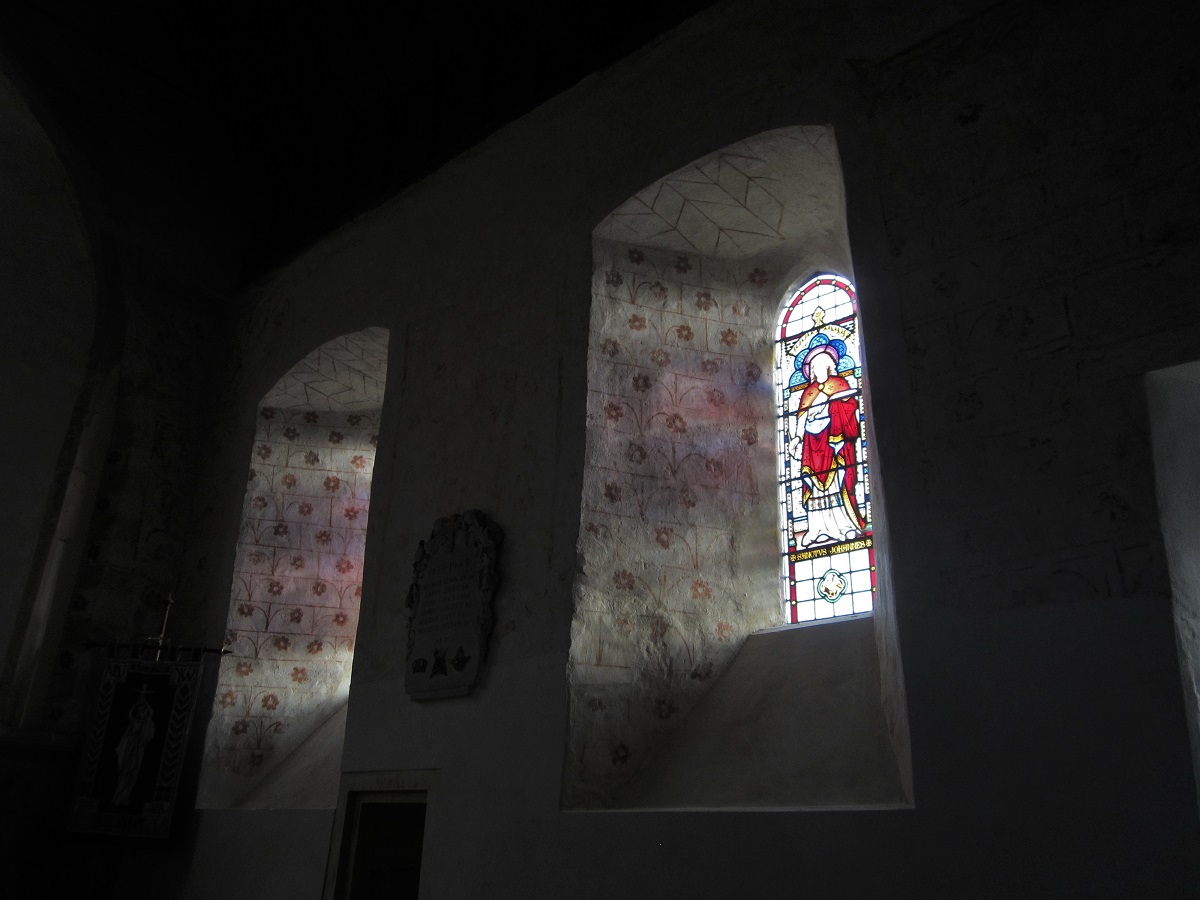
Quite a few traces of paint have been uncovered that give the imagination a tiny glimpse of what it might have been like inside before the wielding of great brushes of whitewash. 
The tomb of Eleanor Baynard, depicted in her widow's weeds, who survived the first incursion of the Black Death and died some time after 1359. 
Chancel wall decoration, c1230