About Me

My photo
Bristol , United Kingdom
Poet and poetry facilitator. Neurodishevelled. My sixth poetry collection, Love the Albatross, is available from Indigo Dreams or directly from me.
Showing posts with label D G Rossetti. Show all posts

Tuesday, 18 February 2020

Tail Feathers from Storm Dennis

The plan had been for Son the Younger and I to drive separately to his garage in Newport, leave his car there for servicing and head to Llantwit Major for a walk, but Storm Dennis put paid to that. It also nearly put paid to me when my windscreen wiper motor failed during a ferocious squall on the M4. It took me about five minutes to prise my hands from the steering wheel once I reached my destination.

The worst of the rain having passed, I ordered a new wiper motor from eBay, booked my car into the garage on Friday, and drove to Llandaff with Son the Younger giving the wipers a helping hand, as necessary, through the passenger window. We detoured around a few places from our past, and then visited the Cathedral. Unlike me, it was the first time StY had been back since his grandmother's funeral 14 years ago.


The Rossetti triptych


Sir William Mathew (d 1528) and his wife, Lady Janet/Jenet


The Celtic cross is the only surviving remnant of the first church built on the site in the 6th century. It was rediscovered by the then bishop of Llandaff in 1870, 'embedded in the back wall of the shed over the Dairy Well'. 


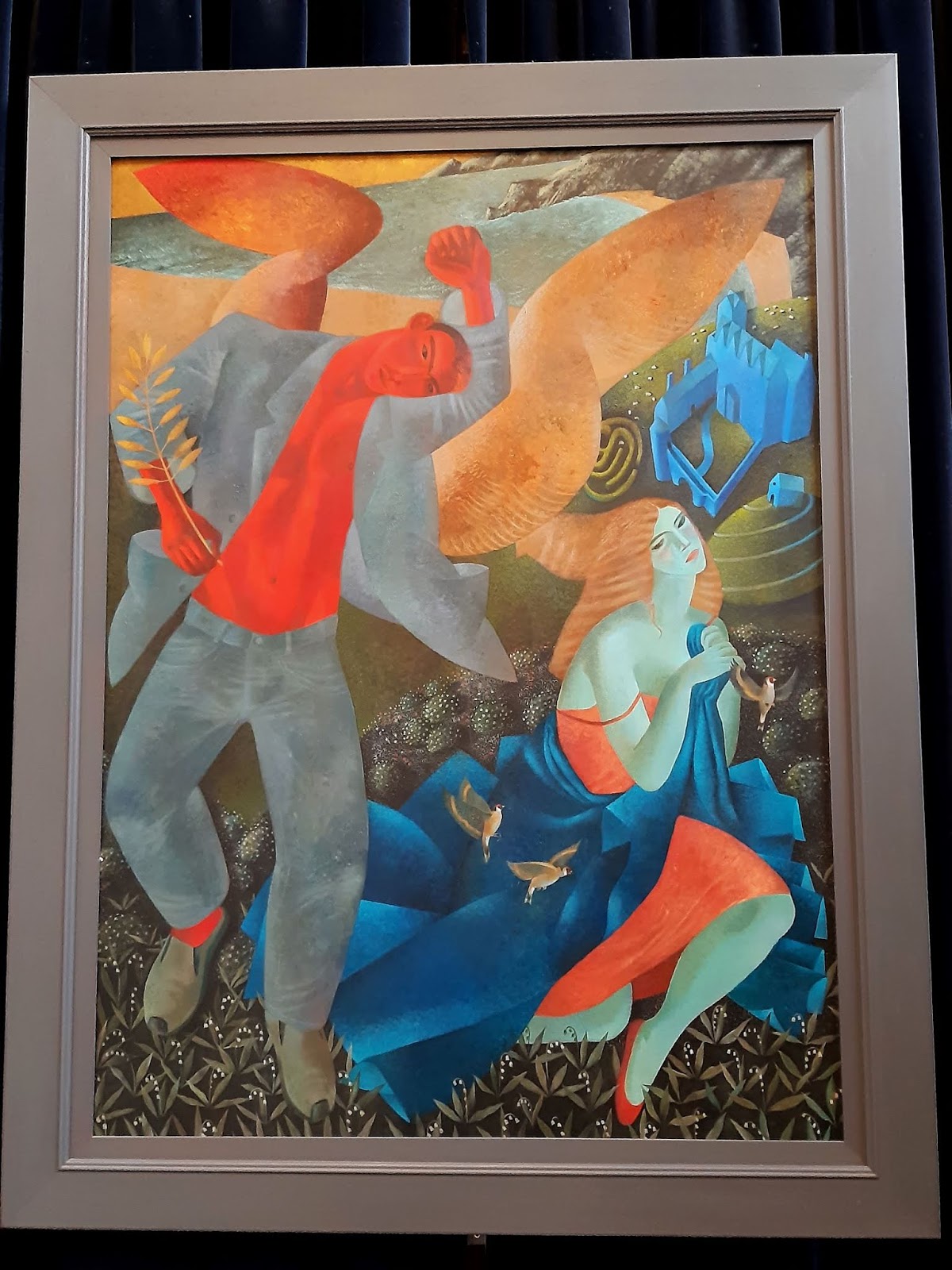
I really like the newly installed painting 'The Virgin of the Goldfinches' by Clive Hicks-Jenkins, though Son the Younger said it reminded him of 'The Green Lady', a copy of which used to hang in his great-aunt's house.


The font at Llandaff has had a chequered history. The one in service during the civil wars was appropriated as a trough for pigs by a local Puritan, who also set up a tavern in the Cathedral and penned his calves in the choir. The predecessor to this one, which was designed and sculpted in 1952 by Alan Durst, was destroyed by the parachute mine which caused such damage to the cathedral in 1941. 


We headed on to the newly revamped Welsh Folk Museum at St Fagan's, which neither of us had visited in years. (That's not what it's called any more, but old habits die hard.)
I was excited as they'd moved and rebuilt a mediaeval church, complete with wall paintings, since I'd last been, but first we stopped off at my favourite of all the buildings there, the Kennixton farmhouse from Llangennith on the Gower, which was built in 1610 and re-erected at St Fagan's in 1955.

Red paint to ward off evil spirits


I've always wanted a bed like this. Well, maybe I'm too old and arthritickal for one now but I would have loved one years ago. 


Outside it was raining again. We headed for the reconstructed Iron Age hut but the path was closed,  so we visited a couple of other places and then made for St Teilo's, upon the wall of which a robin was singing loudly. 


The exterior is amazing. You have to boggle at the feat of planning that involved numbering every stone so that it could be reassembled correctly, over a period of 20 years. 


Forty percent of the original wall paintings were discovered under plaster, and I'd been looking forward to seeing them in situ, since miraculously, they were able to be moved, but apparently they are in storage. Instead, the interior has been painted to recreate how it might have looked pre-Reformation. 


I can understand why the curators might have decided to do that, but I was left longing for the atmosphere and authenticity of St Cadoc's Church in nearby Llancarfan.

13th century font


Over a lunch of Welsh rarebit in the cafe above the hardware store, we studied the weather forecast. Another belt of rain was due to pass over the area at 3pm, so we decided on a quick skip around our other favourite buildings and a leisurely return on a more auspicious day.


Llawr-y-glyn smithy


One of the terraced cottages from Rhyd-y-car


The communal bread oven from Poplar Place, Georgetown


The cast-iron urinal from Llanwrtyd Wells

We still have three of these in Bristol, Grade II listed and no longer in use but still in situ.


I like the prefab from Gabalfa and wondered aloud if a modern version that complied with building regulations might be an affordable solution to the housing crisis, but the guide explained that a prefab takes the same amount of land as two three storey town houses. 


The library of Oakdale Workmen's Institute has exactly the same computer system as our local library when I was a kid. 


The toll house from the southern outskirts of Aberystwyth


Maestir school, complete with stove and canes 

A traditional slate fence, reminding me of Ernest Gimson's Cotswold stone slab fence at Kelmscott


Two minutes of the softest drizzle smudged the windscreen as I drove back through Almondsbury interchange and I flicked on the windscreen wipers more in hope than expectation. They managed just one curmudgeonly sweep, but that was enough to see me home in crystal-clear style. Roll on Friday. 


Friday, 1 July 2016

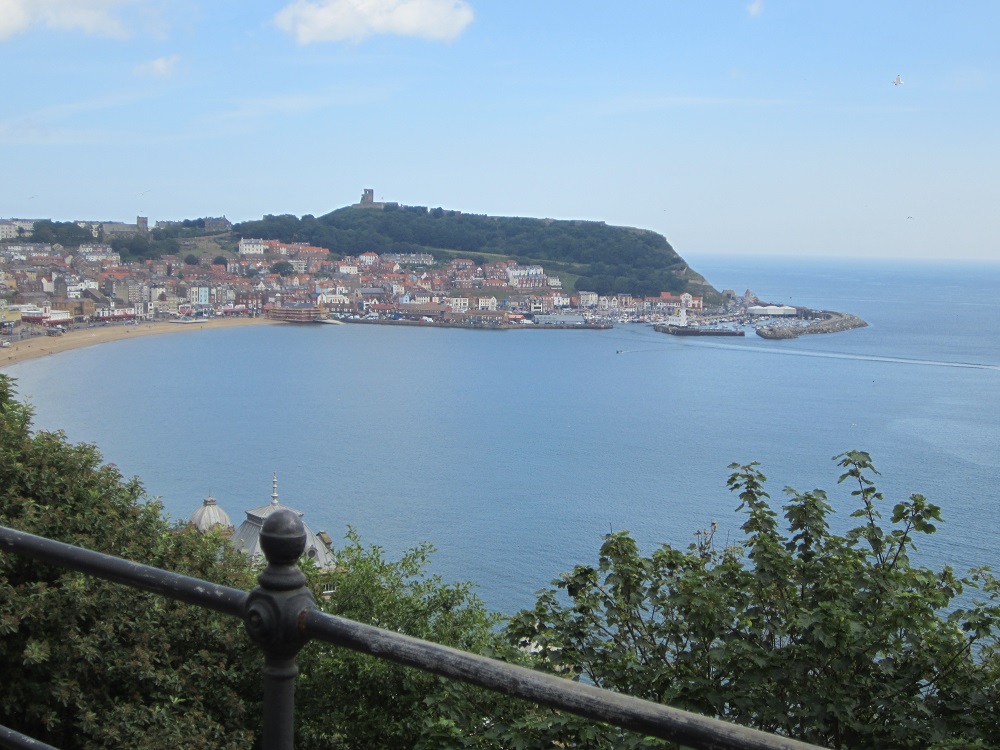
Heaven in Scarborough ... and then we went to Filey


I tried the door. St Martin-on-the-Hill was locked. But there was a sign alongside - guided tours at 10.30am every Tuesday. I looked at my phone. It was nearly 10am. I looked at my partner. Was it Tuesday? Yes, it was. 

While he took Ted dog off to sample the delights of Scarborough, I counted off the minutes until I could get in. The guide and his wife made me a cup of coffee when they arrived. I was about to enter heaven on earth.  

Almost immediately, I was struck by the similarity with All Saints Church in Selsley, near Stroud, so it was no surprise to learn that this church and that are sister churches, designed by the same architect, G F Bodley, and both fitted out by Morris & Co.  
Our guide took me and three other people who had arrived on a guided tour of the beautiful windows. I'm posting pictures of some my favourites but there are more. 


St Martin divides his cloak in two and gives half to a beggar ...


... then dreams that the beggar is Christ in Majesty, conqueror of sin and  death, holding up the cloak while angels wipe their noses on it kiss it.


The rose window in the west wall, with a central Annunciation designed by Burne Jones, and circling angels by him and William Morris 


The story of SS Dorothea and Theophilus (now demoted to non-official sainthood owing to Lack Of Evidence Of Their Existence), with the most beautiful angel/fruit bearer between them. Dorothea is modelled by Jane Morris.  Burne Jones was paid £12 for its design.


The Three Marys window, originally made for St Martin's Church in Brighton but rejected because it features Lizzie Siddal, a probable suicide 


Mary Magdalene, modelled by Annie Miller and designed by Morris


Mary the Virgin, modelled by Georgiana Burne Jones and designed by her husband


Mary of Bethany, modelled by Lizzie Siddal and designed by Morris


As well as these and other beautiful windows, there is a pulpit with panels on the front painted to designs by Ford Madox Brown and Morris. The top row shows the Four Evangelists; the bottom panels, depicting SS Augustine of Hippo, Gregory, Jerome and Ambrose of Milan, were considered close to popery by some of the townsfolk of Scarborough and had to be curtained when the pulpit was first installed, for fear of causing offence. 


To the side there are two panels featuring scenes from the Annunciation by Dante Gabriel Rossetti. 
The organ 


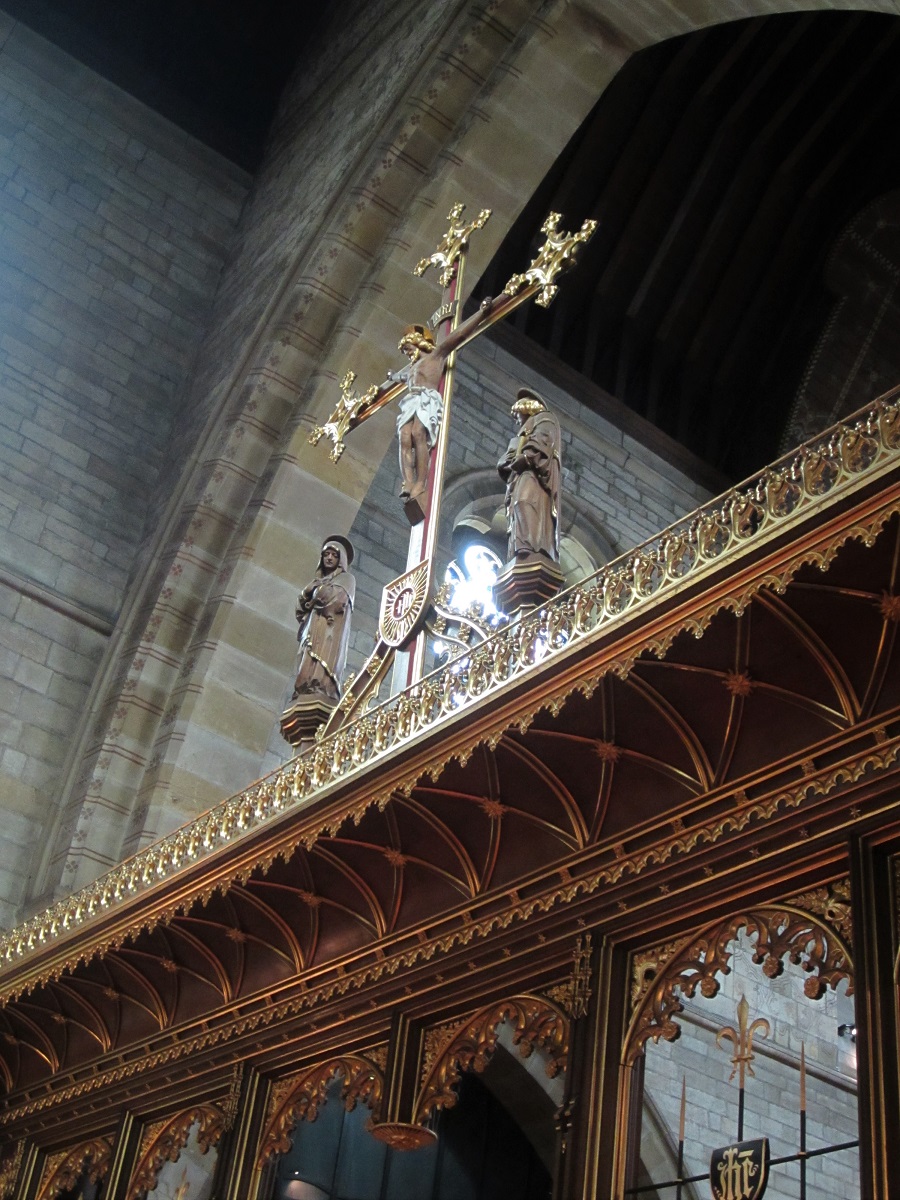
The rood screen and cross, both late additions after the death of the principle benefactor of the Church, Mary Craven, the crossing of which  symbolises death


The chancel, or heaven


The east window, telling the story of the Crucifixion through the Parable of the Vineyard


The beautiful beautiful ceiling of the Lady Chapel


Tearing myself away, I met up with the Northerner, who was rather underwhelmed by the secular delights of Scarborough, and we headed off to Filey, his childhood holiday destination. I'd been enthusing about how much I'd liked it during my stay a couple of years ago, when I went to my nephew's wedding, but I hadn't had my dog with me then and now much of the beach was out of bounds to us - or under water. 


And it was really hard to find anywhere decent to eat. And a gull managed to shit on both of us with one well-aimed evacuation. 

'Never mind,' said the woman in Boots when we went in for baby wipes. 'At least it wasn't one of those horrible gulls from Bridlington.' 

Yes, even non local gulls are to be denigrated in post-Brexit Britain. 


'We must remember to buy a lottery ticket' said the Northerner as he dabbed off a second direct hit - but needless to say, we forgot. 


Still at least one of our party was having a great time ... 


Saturday, 13 July 2013

Llandaff Cathedral and the Senghenydd Mining Memorial

And so to Cardiff to take Son the Elder to an audition.  I lived in Cardiff, briefly, 20-odd years ago, and my younger daughter was born there.  It also happens to be my ex-husband's former home city, and although I have been back and forward over the bridge regularly these last four and a half years, this was to be my first trip to Llandaff since. But nothing daunted - time to overlay all those bad memories with some good ones.  


So, after dropping the budding thespian off, I parked in Pontcanna, in the street where I used to live, and walked my swain over Llandaff and Pontcanna Fields to Llandaff village, where we had coffee and flapjack before visiting the Cathdral.  It was early but already sweltering, so the Cathedral felt like a very comfortable place to be.  And it was great to catch up with some old friends.  There are Arts and Crafts favourites, like Rossetti's triptych 'The Seed of David', Morris & Co and John Piper stained glass,  and the lovely Della Robbia ceramic panels depicting Edward Burne Jones' 'The Six Days of Creation'. (Unfortunately the side chapel in which the latter live was roped off, but you can just glimpse them here, the far side of this rather fetching knight's tomb, still with some original paint, look.)

Today, however, it was the vistas that struck me, perhaps because the great West door was open, bringing the outside in.  This is looking east towards Jacob Epstein's Majestas (Christ in Majesty) which was commissioned to commemorate the ... well, resurrection seems the most appropriate word ... of the Cathedral after it was partially destroyed during the Cardiff blitz. (Only Coventry Cathedral sustained more damage during the war.) 


 This is the rear view of the Majestas looking towards the West Door - and look, there's reflected heart on the arch, which is mighty pleasing and which I am taking to be A Sign.  


This is a view through a Norman arch of the Lady Chapel, from the other side of the High Altar.  


And this is the Lady Chapel's beautiful painted roof.


Llandaff can trace its line of bishops back to c500AD, which is most impressive.  This mediaeval memento mori is postively modern by comparison, but I find myself drawn also to the contemporary, particularly the bold way in which the Cathedral was restored in the 1950s following the bombing.


Here's one of my favourite post-war parts, the Welch Regiment Memorial Chapel.  I love the red lettering on the walls of places around the world where the regiment has been stationed ...
   ... but best of all are the copper panels set into the floor, which were engraved by my former brother-in-law. I like to think of them as the shining footprints of the dead ... except that sadly, only officers are commemorated thus.


Then it was time to walk into town along the banks of the River Taff.  The first part of this walk takes us through an old part of the cemetry, where the grass is allowed to grow tall in the summer.  It was almost like being under water in parts. 


Out here nature was in competition with all the artists who have work inside the Cathedral, and giving a good account of itself too. 


Talking of water, the Taff looked quite inviting for once, and we did see one or two local sirens bathing.  


As we were whiling away time until the auditions ended by slaking our thirst in a hostelry, we were treated to lusty renditions of some mining songs by a choir who were raising money for the Welsh National Mining Memorial, which will pay tribute to the legacy of coal mining and commemorate the 8000 people who died in Welsh mines and the many more who succumbed to mining-related illnesses.  The statue in a garden of remembrance is due to be unveiled on 14th October near the site of the former colliery at Senghenydd.  This date marks the 100th anniversary of the UK's worst ever mining disaster in which 440 men and boys died. 

Oh but it did my heart good to hear some socialist songs in these politically dark days, and for such an excellent cause also.  Money is still needed to pay for a national memorial pathway so if the spirit moves you, please call 02920 830444/5 or email senghen.heritage@btconnect.com to make a donation.