It was off to Arnos Vale Cemetery on Saturday, with the friend formerly known as 'Er-Over-The-Road, for a talk by Jane Duffus on The Women who Built Bristol.
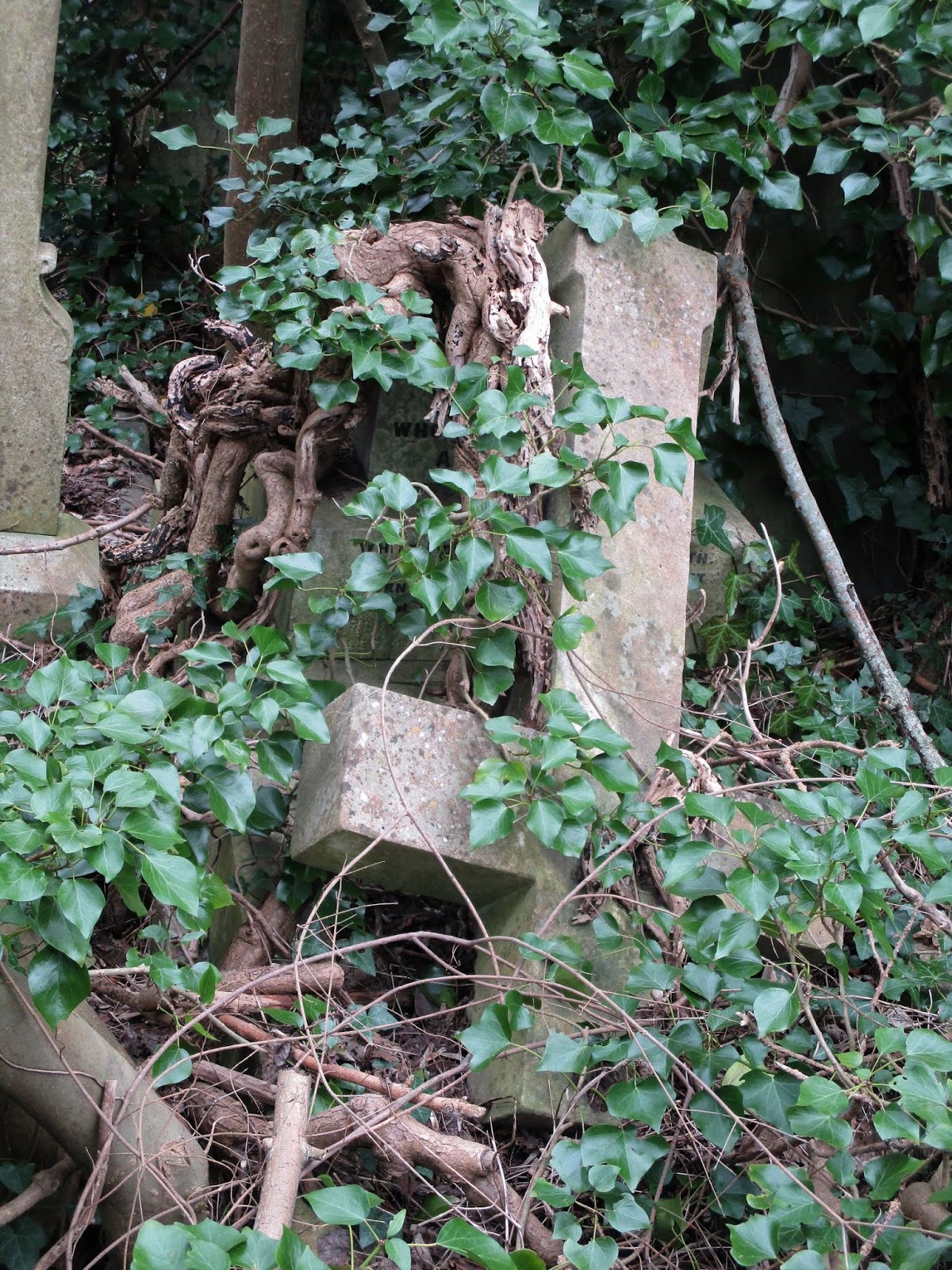
This gave us the chance to walk around the cemetery a bit, which was looking particularly photogenic.
With so many of the graves seeming to founder and sink under the weight of vegetation, it could have provided a handy metaphor for the state of this nation ...
... although we tried to focus on resurgent nature as an act of reclamation.
'Come live with me and be my love, And we will all the pleasures prove'
An old friend
The eyes have it
The modest, tucked-away grave of George Müller, founder of the Ashley Down orphanage
My first bluebell (and chiff-chaff) of the year
Laocoön and his sons (detail)
Before we returned to the far north of the city, we popped over to Ryde Road, round the side of the local shopping centre, to pay homage to my favourite Arts and Crafts etcher, Robin Tanner. Although he spent most of his life in North Wiltshire, Tanner was born in this house (no 5).
This Quaker, pacifist, advocate for the education and creativity of children, supporter of refugees and supreme artist-craftsman died aged 84 in 1988, despairing over the policies of Margaret Thatcher.
I could cry to think how he would feel now, as we reap her bitter harvest.
After twenty-one months and a lot of redecorating, I finally hung my Robin Tanner etchings in my not so new house a few days ago, and it has felt like coming home, but to a place that is tranquil and safe.
I've been thinking about Tanner and his wife, Heather, a fair bit - how they aimed to live William Morris's dream, and the symbiosis of their shared lives. (See video below.)
I've also been recalling a visit my friend and I made almost a decade ago now, to the village Bristol-born Tanner grew up in, and which he and Heather immortalised as Kington Borel in their book, Wiltshire Village. I blogged about it at the time on a now obsolete platform, so I've reproduced it here. 17 May 2008: A visit to Old Chapel
Field Today's
trip to Wiltshire with my friend Julie was primarily to explore the village and
surroundings of a hero of ours, the etcher and teacher, Robin Tanner, who lived
in Kington Langley with his wife, Heather, and their adopted son, Dietrich, from the 1930s until his death in 1988. With pleasing synchronicity, his
house stands on Old Chapel Field where the ancestors of Francis Kilvert lie
buried, so we would be paying homage to the great Victorian diarist too. After
an abortive trip to DevizesMuseum to see their set
of Tanner etchings which turned out not to be on display, we made for the
village, clutching the Robin Tanner Heritage Walk we'd downloaded from North Wiltshire District
Council's site. It soon became clear,
however, that both map and directions were so incomplete as to be useless. We couldn't even find our starting point,
Jacksom's Lane.
The common was packed
with people celebrating the annual Scarecrow Festival, so we made our way
through the Morris dancers and the funfair and what can only be described
as a crucifixion of scarecrows to make enquiries at the plant stall in the
churchyard. 'I'm not really local,' one
of the stallholders told me. 'That is, I live here but we don't really know
the area. Probably drive past it every day, though.' 'Well, could youcould point us in the
direction of Robin Tanner's house, then?' I asked the other woman. 'You know, the
artist.' She looked blank. 'Sorry,' she
said. 'Robin who?' Eventually
we located the beautiful 17th century Greathouse at the eastern end
of the village and managed to orientate ourselves, but as we wandered back down
the main street it soon became apparent that Tanner's much loved village was
now largely populated by well-heeled commuters unfamiliar with its surroundings
or its former noteworthy inhabitants. It
seemed ludicrous that in a place only a stone's throw from the M4, we would have
been better off equipping ourselves with an OS map and compass than relying on
local knowledge to find our way around.
At
the opposite end of the village we found a gate which, by process of elimination, we decided must be the Poet's Gate, so called because Kilvert used to lean on
it to admire the view, but it was difficult to be sure because the plaque
dedicating it to him was missing. We then eagerly sought out Robin Tanner's house, but all we could see
was its gate and the tiniest, most tantalising flash of tiles between the
trees.
Thwarted, we made our way down through Bird's Marsh, a
lovely wood boasting fine oaks and beeches. As we went, we consoled ourselves with the
knowledge we were following paths Robin and Heather walked over decades to sketch stone stiles, old chalk roads, and majestic elms, all fast disappearing from the locale.
Sadly, the wood had also been planted with at least four different species of
rhododendra which, unchecked, were crowding the native
trees and smothering any undergrowth that might have flourished. They looked outrageously out of
place and were the cause of so much fulminating on our parts that we forgot to
watch where we were going and lost our way.
Finally we met a woman walking a dog and asked her for directions back
to the village. 'I come here every day,'
she said, 'but I've no idea where you mean. You could try that way. Or maybe that way? – Yes, go that way!' It
was with a sinking feeling that we eventually drove back home. The Tanners had been acutely aware of the
loss of countless features of the Wiltshire countryside, and had sought to record and commemorate them through their art, but today it was apparent that there had
been another loss – that of the connectedness of people to the landscape in
which they live. It might just have been coincidence, but I found it bewildering that every person we encountered seemed to lack even the vaguest acquaintance with their surroundings, let alone the intimate knowledge that
comes from walking its tracks and woods and fields. I know it's a cliché, but if I'd bothered to
count the number of shiny 4x4s that thrashed past us, they'd have amounted
to several dozen.
Back
at my house over tea Julie leafed through my copy of 'From Old Chapel Field',
which contains a selection of Tanner's letters, and tried to make the best of a disappointing day. 'At least,
when we reread this we'll have a better idea of where he's talking about,' she
said. 'Listen to this. "Never was rain so light nor leaves so green nor
buttercups so yellow nor hedge parsley so white as now". Just like
today! Only written on 17th May 1931.' She paused. 'What date is it today?'
Some
things have endured then. And maybe
one day nature might prevail.
An armed man was holding a two-year-old boy hostage in a stand-off with police on the M4. As a result, the motorway was closed and by the time we'd negotiated a series of traffic-choked A and B roads to reach the irredeemably posh Cotswold pub where my then husband had booked a table for my 40th birthday lunch, we were very late indeed. The staff took one look at us and our neurologically interesting children, and showed us into the skittle alley where we ate our indifferent (but expensive) meals in isolation. And by the time we emerged, this being late October, it was getting dark, the motorway was still out of bounds, and there was no time to do any of the things we'd planned apart from the briefest of visits to the clapper bridge spanning the River Leach in the neighbouring villages of Eastleach Turville and Eastleach Martin.* Here's the bridge, in the etching by Robin Tanner I'd been given to mark my great age. It's taken me 16 years (almost) to muster the heart to go back.
This time the worst thing that happened on the motorway was a sudden squally shower. Not to worry, I told the dog. We are poets. What care we about soaked jeans and dripping hair?
But by the time we'd parked in Eastleach Turville and made our way down to the river it had stopped and the worst hazard we had to negotiate was some over-protective swans and their offspring.
It isn't an exact rendering of the bridge, by the way, nor the view from it. It's more of an idealised composite, but no less pleasing for that.
After the bridge, the next stop on our short but sweet route was the mediaeval Church of St Michael and St Martin, which gives the village on yonder side of the bridge its name.
Even I could throw a stone from this House of God to the neighbouring church of St Andrew's, so it's no surprise that only one of the buildings is still in regular use.
St Michael and St Martin drew the short straw for closure and is in the care of the Churches Conservation Trust. It has that pleasing emptiness of such churches that makes it easier to focus on the fabric of the building.
One of the windows contains fragments of mediaeval glass.
I am always drawn to the faces.
It's hard to pick up in photos, but there's a delicious wonkiness to the north and south walls and windows.
There were also postcards on sale featuring the local hunt. This was less pleasing. I bought one, pointed out the incongruity on the back, and left it there.
Our route took us down a lane past an orchard with already rosying apples, and trees dripping with damsons and plums. Putting thoughts of my favourite damson vodka from my mind, I conceded that even if they weren't owned by anyone, their bounty properly belonged to the villagers rather than me, but it was a close call. The walking book boasted an idyllic path by the river with herons and even the chance of a kingfisher, but sadly the route has been diverted away across a field, I suspect due to erosion.
And when I did spot it, the river was clearly a bit of a winterbourne, being almost completely dry in parts. And instead of herons and kingfishers, I was accompanied by the bedraggled squeak of a bullfinch.
There were one or two impressive trees, though, and it was interesting to see how the river, in more prosperous times, has affected the lie of the land.
Eventually our route turned south and climbed. On top of a ridge, I encountered a sizeable collection of puffballs. Yum.
No more self-restraint - I seized a couple, stuffed the smaller in my satchel and tucked the other under my arm.
Having stowed them safely in the car, I made my way back into the village to visit the other Church, that of St Andrew.
Its saddleback tower is so very familiar from the etching.
St Andrew's obvious glory is its Norman doorway, dating from 1130 ...
... the tympanum of which depicts a defaced Christ in Majestas, flanked by angels.
The interior feels rather more lived in than that of its sister Church, though still very stripped back.
There was just time for a last maunder down by the bridge, this time sans swans. With the trees beginning to think about changing their garb for something rather more seasonal, it felt like the last lushness of summer.


 This gave us the chance to walk around the cemetery a bit, which was looking particularly photogenic.
 With so many of the graves seeming to founder and sink under the weight of vegetation, it could have provided a handy metaphor for the state of this nation ...
 'Come live with me and be my love,




 I could cry to think how he would feel now, as we reap her bitter harvest.


