About Me

My photo
Bristol , United Kingdom
Poet and poetry facilitator. Neurodishevelled. My sixth poetry collection, Love the Albatross, is available from Indigo Dreams or directly from me.
Showing posts with label Curry Rivel. Show all posts

Wednesday, 20 December 2017

Alchemy in Curry Rivel

I was bang on time to visit my everso very scary, 94-year-old Aunt in North Curry, in order to collect her Christmas presents for my parents and bring them up to Bristol. That is, until I arrived at the end of her road to find it closed while workmen repaired a broken gas main. Alarmed at the prospect of a nine-mile detour and how late that would make me, I managed to sweet-talk my way through the road block; on our way to the pub for lunch, she climbed out of my car, marched down the lane (tottering only very slightly) and pulled rank by citing her very great age. But there was no way back in; our return journey was to take us through Stathe and Curry Rivel, and along a twisty causeway with deep rhynes on either side.

Upon leaving, again via the scenic route, I decided I might as well use the last hour or so of sunlight to perform an act of alchemy and transmute duty into A Jaunt. So instead of barrelling back through Curry Rivel, I stopped off and visited the Church. 
You wouldn't really mistake St Andrew's for anywhere beyond the Somerset Levels. Like many of the churches around here, it's built of both blue lias stone from the north (Somerton upwards) and golden hamstone from Ham Hill to the south. 


Plus, it's well endowed with hunky punks, which name stems from the attitude of the carved animals, squatting on their hunkers. 

You can see them here below the crenellations. 


I've been watching the TV dramatisation of 'The White Princess' lately, not for its historical accuracy, obvs, but because Son the Elder did a fair bit of extra work on it last summer


So I was interested to see the mother of King Henry VII (and antagonist of the series), Lady Margaret Beaufort's family badge depicting a portcullis on the ornamental frieze above the door. Apparently she owned estates in the area. 


Before I went inside, I wandered around the churchyard in the slanting winter sun. 


There was lots of mistletoe in the trees and I had hankering to pick my own, like I did two Decembers ago in Ilminster churchyard, only it was all way out of my reach. 


There were some already harvested stems in the porch, with a request for donations to the Church in lieu, but I didn't like the idea of reimbursing a Christian institution for so pagan a plant. 


Inside there was lots to explore and marvel at. An unpleasant West window with garish glass was more than compensated for by the remaining windows, many of which incorporated mediaeval glass in the upper lights.


A beautiful window by Victorian stained glass designer and manufacturer Charles Eamer Kempe was half hidden by the organ ... 


... but a trespass into the Sanctuary was rewarded by delicate cobweb visions of etched glass by Laurence Whistler.


I liked the way the tree beyond the 18th century East window gave the impression of being part of the design. The roundel is a piece of 12th century glass from Canterbury Cathedral.  


I also loved the bench ends, some of which date from the 15th century. This one features Tudor roses, presumably to remind parishioners who ruled them. (More of Lady Margaret's influence, perhaps.)


The guide book also tells us that the small cupboard with its original linenfold door in the south wall of the Chancel was probably used to store precious books.

Tombs with 13th century effigies of a knight and children (maybe) of the de Lorti family. Inside the tomb chest the knight rests on are bones thought to be of Lady Sabina de Lorti, née Revel, whose family the village is named for.   


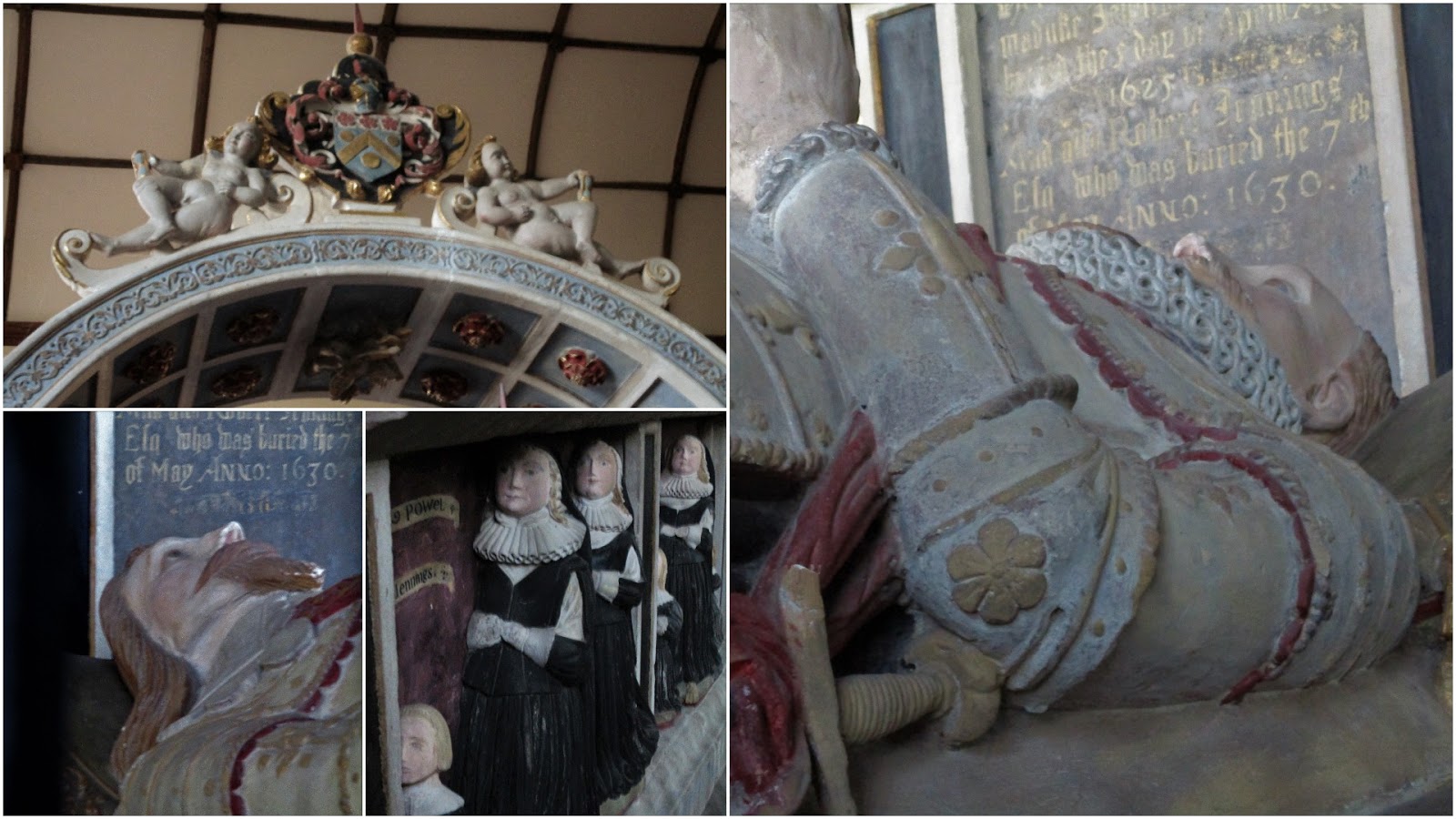
Hard to get a view of the Jennings tomb (Marmaduke d 1625, and son, Robert, d 1630), as it's ringed by railings. On the sides kneel their wives and children, as well as effigies of stillborn infants.
Outside, in the gathering dusk, I noticed a lower tree smothered in mistletoe and happily snapped off a small bunch to take home, getting around the donation conundrum by telling myself I was paying extra for my guide book. 


The journey home along the top of the Polden Hills was moderately arduous but accessorised by a stunning sunset. I couldn't easily stop to take photos, but my friend Jan Lane who is now living just up the road in West Pennard did ... so here is one of hers. 

Saturday, 21 May 2016

Curry and Bier in Somerset

Taking my parents (aged 94 and 88) to North Curry yesterday to see my father's sister (aged 92) offered the opportunity for lunch in the really rather pleasant Bird In Hand Inn (sexist signage aside) and then a quick pop into the Church of St Peter and St Paul.  


The Levels are prone to flooding, of course, and along with every other old settlement, North Curry was built on a ridge of land. Good views from the churchyard, then.  


Octagonal towers are quite common around here. as are gargoyles and hunky punks in glorious golden Ham stone.  


Inside, a man was tuning an old piano with much stabbing of the keys.  The older members of the party sat and chatted while I fossicked quickly and quietly. 


There's a bier, upon which the mortal remains of Colonel Chard, of Rorke's Drift fame, were borne to their everlasting rest in nearby Hatch Beauchamp ... 


Cadaver effigy of an unidentified cleric 


Toma atte Sloo


This is my favourite thing - an old parish chest made of elm that weighs over 600 lbs and is believed, by its form of construction, to date from well before 1200 and possibly even Saxon times. 

Evidence suggests it was at one time forcibly looted. I blame this lot.


1348-9       John Leyat (Seyat) of Harewell
1349           Thomas Dauyntre 
1349-50     John Trowbrugge    
                    John Muleward(e)

We know the Black Death, which arrived in Somerset in early 1349, had a 50% mortality rate in some parts, and that a large proportion of the clergy perished, but I've never spotted quite so many priests appointed in such a short space of time as here in North Curry.    

An entry from nearby Curry Rivel’s court rolls from May 1349:

‘John Pypping who held of the lord a cottage . . . is dead, by whose death there falls to the lord nothing of heriot because there is no live beast. And the said cottage remains empty in the lord’s hands’

It seems the plague had claimed Pypping, his entire family, and all his animals as well.