About Me

My photo
Bristol , United Kingdom
Poet and poetry facilitator. Neurodishevelled. My sixth poetry collection, Love the Albatross, is available from Indigo Dreams or directly from me.
Showing posts with label T S Eliot. Show all posts

Saturday, 6 August 2022

Poetry-walking the poetry streets of Upper Horfield

Maybe we IsamBards were off our trolleys, holding a poetry walk through Upper Horfield estate on a hot August afternoon ...


... but it's something I'd wanted to do for ages. I first mentioned it to the Northerner probably back in about 2011, as a possible outreach event for one of the poetry festivals, but actually, I'd been fascinated by the poetry streets, where my father grew up, since I was a child. 

The Northerner's response back then was 'well, go ahead and organise it'.  I suppose I could use the excuse that the entire estate was being rebuilt at the time as an explanation for why it took so long, but the construction work was completed in 2013. Any delay was largely just a matter of me not pulling my finger out. 

But finally here we were, in Poets Park, waiting for our audience - always a nerve-wracking moment. But they arrived, and what brilliant listeners they turned out to be. 
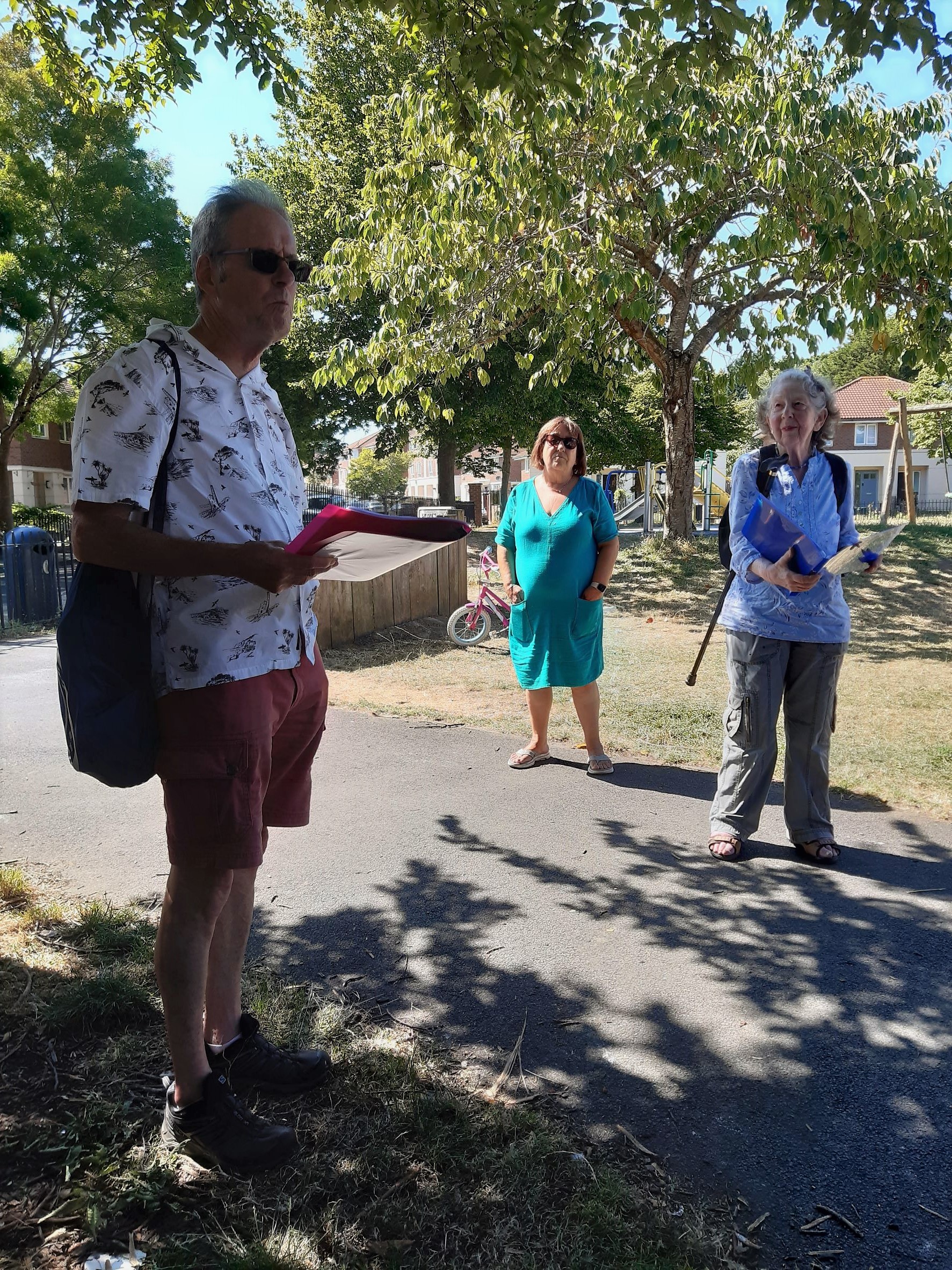


For the first time, in addition to our own work, we were reading poems by other, famous poets, namely those after whom the streets are named, as commemorating them was the main purpose of the walk. So in the park, which is on Eliot Close, we read 'The Rum Tum Tugger' from T S Eliot's 'Old Possum's Book of Practical Cats' and, as we were within earshot of  Larkin Place, Philip Larkin's melancholic poem, 'The Trees'. 


Our next stop was Auden Mead, near Keats Close.  The installation here, which was designed by local school children and is inscribed with lines from John Keats' memento mori, 'This Living Hand', took on a life of its own in the run-up to the poetry walk. I tweeted my indignation about the positioning of litter bin bang in front of it, making the poem impossible to read without getting a whiff of dog poo, and it was picked up by the Bristol Post, an interview ensued and suddenly Angry of Bristol's diatribe got some traction.* 

The obvious poem, then, to read at this point was 'This Living Hand', which is fragmentary and very moving, written in 1819 when Keats' health was failing as a result of TB. He was to die in 1821 at the age of 25. 


Since we'd just walked up Shelley Way, we also read a few verses from Percy Shelley's 'The Mask of Anarchy', with a rousing 'Ye are many - they are few!' to end it, while Dominic read W H Auden's 'Refugee Blues', which is more poignant and pertinent than ever. 


On then to a little grassy spot on Thackeray, via Shakespeare Avenue, which prompted some Bard-related poems, and, in anticipation of our walk down Hughes Gardens, David's poem about his mother-in-law going fishing on the River Exe with Ted Hughes. And as we were just a street away from Macauley [sic] Road, where my father grew up in the 1920s, I read a poem not by Thomas Babbington Macaulay but me, about my grandfather and father's experiences of the first and second world war respectively. 


Leading the stragglers

Our destination was Horfield Library on Filton Avenue, where there was tea and cake waiting, courtesy of the Friends of Horfield Library ... 


... and poems about Wordsworth and Coleridge, whose streets are somewhat further afield than the route of our walk permitted us to explore.  Coleridge was particularly relevant here, given that he used to make an 80 mile round trip on foot between Nether Stowey, north of Bridgwater, to his nearest lending library, which was in King Street, Bristol. Thanks to its Friends, Horfield library is still going and residents are spared that effort ... for now. 


If you think the Council should move this bin so that this installation and its poem can be appreciated properly, please contact its parks team. There’s a page on the council website called ‘Improve a park or green space.’ The name of the park is Auden Mead and you don't need to be a resident to make your suggestion.

Monday, 9 September 2013

Cold Plum Porridge

I've always seen East Anglia as a sort of giant Forest of Dean - somewhere you have to plan to visit as it's too far out of the way to pass on the off-chance - and as this weekend was the first opportunity I'd had of going, I was very excited -in fact, I think I was expecting it to come straight out of a fable.  As soon as we'd passed the turn off to Cambridge I started keeping an eye out for its famous flatness and enormous skies, and got quite carried away by the signpost to Swaffham (even if I couldn't quite remember the story of the pedlar in its entirety), but in fact, the small partI saw turned out to be more pleasant and attractive that anything else ... and a long bloody drive away!

Anyhow, here are some photos of Norwich.


The River Wensum


Wobbliness


More wobbliness


Wobbliness in Tombland (above and below)


Samson and Hercules in a nice mixing of mythologies


Detail, the Ethelbert Gate, built in 1316 after the original Church was burnt down during a riot in 1272.


The Cathedral exterior


The nave of the Cathedral


The Choir


The bronze 14th century Pelican lectern which escaped the Reformation and was found buried in the Bishop's Garden, apparently


Looking towards the apse


An effigy believed to be of St Felix, believed to date from 1100


The best graffiti with serifs I've ever seen ... :-)


All you that do this place pass bye
Remember death for you will dye.
As you are now even so was I
And as I am so shall you be.
Thomas Gooding here do staye
Wayting for God's judgement day.

Epitaph of Thomas Gooding, who died in 1627 and was buried vertically, apparently so that he could spring up and be first into heaven.


Glass door etched with lines from T S. Eliot's 'Burnt Norton' (Four Quartets):

‘Reach out to the silence
at the still point of the turning world.
Except for the still point
there would be no dance.
Love is itself unmoving
only the cause and end of movement
timeless.’


View through the Choir


A Dementor   An Angel


The current copper font, formerly a vessel in which toffee was made in the local Rowntrees factory


14th century roof boss in the Cloisters


Elm Hill at dusk


The Art Nouveau Royal Arcade


Labour In Vain Yard


Opie Street, formerly Gropecuntelane (1305) 
and Turpis Vicus (1333)


Norwich Castle


Tuesday, 30 July 2013

Castles, Poets and the Usual Stuff

After all the half-timbered buildings in Stratford-Upon-Avon, it felt appropriate to continue the theme by going to Wales in Dru's Morris Traveller.


Having deposited Son the Elder in Newport for his Robot Wars sessions, we drove up the Usk valley to Llangybi, stopping first at the St Cybi's well which has A Literary Connection courtesy of T S Eliot, who wrote in his early poem, 'Usk':


'Do not suddenly break the branch, or
Hope to find
The white hart behind the white well.
Glance aside, not for lance, do not spell
Old enchantments. Let them sleep.
'Gently dip, but not too deep.'
Lift your eyes
Where the roads dip and the roads rise
Seek only there
Where the grey light meets the green air
The hermit's chapel, the pilgrim's prayer.'

This sounds a lot less mystical when you realise that the White Hart is a pub.  Unfortunately for the cash-strapped Dru and me, it's a gastro-pub so we had to make do with faggots and peas from the chip shop in Usk, but if you have a few spare coppers to rub together, it might well be worth trying, even if just for the channelling of the poet.   

Llangybi also has a lovely 13th/14th century church with mediaeval wall paintings and all.  See how the walls lean outwards? ... or is it me on the cider? ... no, they are definitely leaning.


This picture is a very rare type of wall painting depicting Christ with the tools of those who work on a Sunday in the process of wounding him.  Hmmm.  Begs the question, just how painful is a black Bic biro and a laptop?  


And this is the top of my favourite headstone in the churchyard.  It holds the bodies of Frederick Evans who died in 1831 aged 2, his father Evan Evans, died 1839 aged 59, and Sarah Evans, a widow until 1867, aged 82.  


'Long nights and days I bore great pain,
To waite for cure twas all in vain;
Till God above he thought it best
To take my pain and give me rest.'


After Llangybi Church but before the faggots and peas, Dru and I took the road less travelled by (probably because it is marked private) up to the castle, which is also known as Castle Tregrug.  En route we were joined by a black dog, which seemed fitting in this shadowy borderland, even if the dog in question was a Labrador with a red collar and a tag in the shape of a bone bearing a Newport postmark.  


Ted found the young whippersnapper a bit of a nuisance.  


The ruins were impressive, however.  I particularly liked the Tower House with its carved remains of fan vaulting amongst the ivy and umbellifers.    


Dru was able to tell me that what looks like an age-old holloway are, in fact, civil war fortifications.  
Having reunited the Labrador, who turned out to be called Sid, with his owners, we went three miles on up the valley to Usk. 

This is Ted waiting patiently for our dinner in the chip shop.


Usk is one of those towns that time forgot, apparently, and whilst not really being Tom Jones country, appropriating the title of one of his hits for the name of a shop selling undergarments doesn't feel like too much of a liberty (bodice).  


Usk Police Station.

'Hey, let's be careful out there!' 


While we ate our not very picnicky picnic we watched locals cooling off in the River Usk, non tidal here and not muddy.   Terrifyingly, some of them were jumping from the disused railway bridge into the not very deep water.  


Usk Castle is less hidden and neglected than Llangibby Castle, but it's still pretty far from being National Trustified.  


This is the view over the town with the Tithe Barn in the foreground.  Trelawney's Cedars to the right were grown from seeds brought back from the Protestant Cemetery in Rome, the last resting place of Keats' body and Shelley's ashes.  


The garden is sensitively maintained, with room for wild strawberries ... 


... and a fenced-off forest of Giant Hogweed.  


I liked the way the almost spent valerian seemed to flame from the walls under the hot sun.  


There was a service going on at Usk Church so we couldn't go in, though we did see the grave of the last Welsh martyr, St David Lewis, who was executed for being a Catholic priest in 1679 and buried in the churchyard.  


There was just time for a drink before picking up the Roboteer, so we stopped off at the Hanbury pub in Caerleon, again on the banks of the Usk, only to spot this plaque commemorating yet another poet, Alfred Lord Tennyson, who, like Eliot, was sufficiently inspired by the area to put pen to paper.  

'What have you two been up to?' asked Son the Elder, after our traditional post Robot Wars debriefing.  

'Oh, castles ... and poets ... and ... '

'The usual stuff then,' he interrupted.  

Well, quite.