About Me

My photo
Bristol , United Kingdom
Poet and poetry facilitator. Neurodishevelled. My sixth poetry collection, Love the Albatross, is available from Indigo Dreams or directly from me.
Showing posts with label mediaeval barn. Show all posts

Thursday, 15 September 2022

The open doors of Winterbourne Mediaeval Barn and St Saviour's Church

Open Doors Day - or Heritage Open Days, as they now seem to be called - have changed, at least in Bristol, and not for the better. Admittedly, the more popular locations have had to be booked in advance for some years, and in our not-really-post-Covid world, arranging these sort of events is certainly more complex than it was, but I was dismayed to see that this year, people wishing to join in had to buy a wristband in advance. Gone the spontaneity of stopping by, deviating from the planned route because somewhere takes your fancy, and going home early when your feet have had enough. Gone, too, the principle of not paying. It feels like something really quite precious has been commercialised, and in commercialising it, made more middle class, more exclusive.


So, I decided to stick to South Gloucestershire venues - only a couple as I only had a couple of hours - and rolled up in a timely fashion at Winterbourne's mediaeval barn, which I'd been keen to see for some years. 


Built in 1343 just before the Black Death decimated the workforce, the barn was commissioned by Thomas de Bradeston, who is, possibly, implicated in the horrible murder of Edward II at nearby Berkeley Castle. 

This barn's importance lies in the fact that whereas other surviving great barns were built by monastic estates, Universities or Knights Hospitallers, this one is one of only three recorded that were built by a Lord of the Manor.


If it looks a bit smaller than some of the other great mediaeval barns, that's because only seven of its eleven original bays have survived.


And because it's important to have an idea of these things, it's estimated that as many as 240 oak trees were used to build the roof structure.


Apparently, the circle of stones is where cattle would tread to turn the mills.


The Church of St Michael is literally a stone's throw from the barn, so I decided to make a swift visit before setting out for my next destination. I'd visited before, and was looking forward to reacquainting myself with my favourite surly cherub in the churchyard. 


What I'd evidently missed on that previous visit was this precursor of the famous last scene of 'Carrie'.


As I was passing the bell tower, I was invited up for a talk on bell-ringing, which turned out to be long, though of interest too, not least because the bells had been muffled and rung the previous day to mark the death of the Queen. Then I had the anxiety of climbing down the narrow winding steps of the tower, although it turned out to be less alarming than the ascent. 

I'm always going to be beguiled by mediaeval wall paintings ... 


... but the tomb of Thomas de Bradeston was of extra interest now I was aware of his role in the building of the barn murder of Edward II (allegedly).


My final destination was St Saviour's Church in Coalpit Heath, the interior of which I'd tried to see on a previous Open Doors Day, only to find it not as open as advertised.  

The church is of interest to me having been built by William Butterfield, a Gothic Revivial architect and forerunner of the architects of the Arts and Crafts Movement.


After all the trying to get in, I was a bit taken aback by the interior. I think I must have been expecting something more ... well, Gothic, but it's actually pretty plain, and reminded me of my artistically constrained Methodist upbringing. The light fitting in the chancel has an Arts and Crafts vibe to it, though, as do the painted inscriptions on the wall.

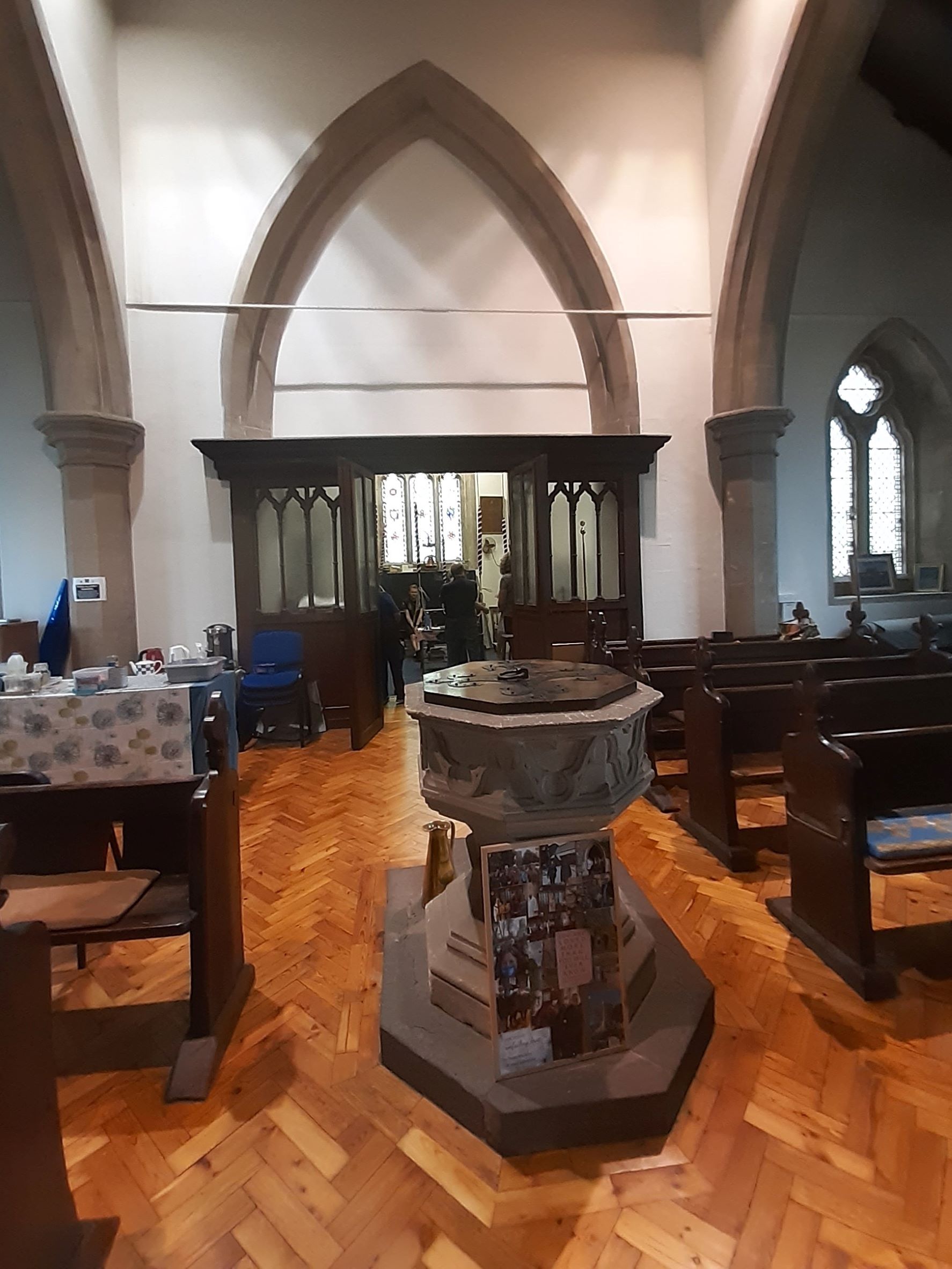
By now the bell-ringers were getting ready to ring for the dead Queen and when I saw the bell-ringer from St Michael's advancing across the car park, I thought I'd better scoot off before I got another potted history, so I did. Things to do, places to be in these strange days.


Sunday, 3 April 2022

Fings ain't where they used to be, or A Kestrel for a King

I was chauffeuring Son the Elder to a roboteering event in Leicestershire yesterday, and as it wasn't far from Coventry where Son the Younger now works, we decided to meet up. I don't know that part of the country at all well, but as it happens my publishers, Ronnie and Dawn of Indigo Dreams, used to live in the next village, and gave me lots of suggestions for places to visit, from which we chose the Bosworth Battlefield trail. First, though, a battle with the car parking meter at Sutton Wharf, which was refusing to issue tickets.


On, then, along the Ashby canal for a short way - just far enough, in fact, to admire a very bold kestrel which passed quite close by us ... 


... and this piece of spalted wood which turned out to be not spalted at all, but faux-crackled with some sort of blackened vegetation ... 


... before turning up through Ambion wood to the Visitor Centre. Inexplicably, Son the Younger decided to rely on my largely fanciful grasp of history instead of the carefully curated exhibition, so after admiring the Earl Shilton stone coffin (Earl Shilton being a place, not a person), which was believed for many years to be that of King Richard III and which has Romano-British tool marks on its side ... 


... and the stocks ... 


... we decided to start the battlefield walk. Now, the problem with history is that it often happened a long time ago, and there's no one alive from 1485 to say with any precision just where Bosworth Field was. And so after more than 220 years of thinking you know exactly where it was, and just when you have got your marker stone set up ...
 

... some bright spark discovers the inconvenient truth that it wasn't there at all, and gets loads of plaudits, while you're left with a massive boulder marking the wrong spot altogether.

It's even worse when you've established the Heritage Centre in a 14th century tithe barn that's handily nearby, and stuck your flagpoles up with your Yorkist and Tudor flags ...


... and hell's teeth, even built your Richard III sundial with commemorative thrones. 


Now, after centuries of mistaken celebration, Ambion Hill has been returned to arable use. 


Down at Shenton Station we saw a diesel train advertising the rather optimistic destination of Scarborough. (It actually goes just a few miles up the track to Shackerstone.) 


We walked back towards Sutton Wharf along Shenton cutting, which is no longer in use.


A short detour past the turning to the canal takes you to what is currently believed to be the site of the battlefield, where, on 22nd August 1485, Henry Tudor's small rebel army defeated the much larger Royal army of King Richard III, with Richard hemmed in by marsh and cut down 'in the thickest press of his foes'. 


I think the historians might have the right location this time, as the reedmace in the far corner looks like spears coming into view.


Marsh marigold


Back at Sutton Wharf, we watched the kestrel which was still hunting and ate lunch outside in the sun. After a bit it started to snow. We vacated the seats by the cafe and watched the driver of a hire boat hurtle into view, scraping the boat along the concrete edge of the tow path. 


By now shift-working son was getting sleepy, so we headed back to robot land, and I read in the car till it was time to set off for home. Another small jaunt in this time of pandemic. I'll take what I can get. 

Saturday, 4 December 2021

A flying visit to the 2021 Kennet & Avon Winter Floating Fayre

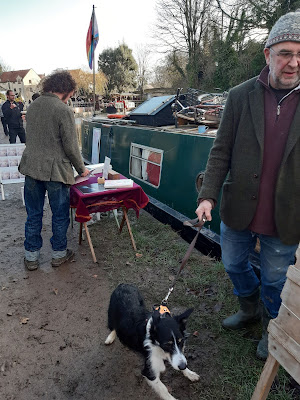
Thanks to the pandemic, it's been nearly two years since I was last in one of my favourite places locally, which is Bradford-on-Avon, and I've missed it, so it was good to visit today to do some Christmas shopping at the Floating Market - or Floating Fayre, as I think it's called these days. 


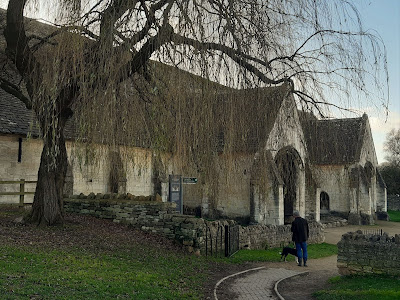
The Tithe barn

We took our collie, Cwtch, with us, who's been to few places apart from the field and the wood and the common and whose whinnies of despair from the back seat of the car started in earnest as we turned the wrong way at the junction - ie not up the road that leads to same.


End gable


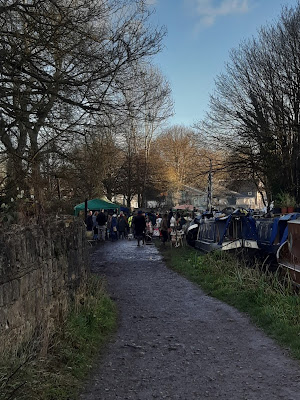
Up on the tow path of the Kennet and Avon canal it was quite busy, with a lot going on that was new to Cwtch, so we decided not to stay beyond the point where it might get too much for her. 


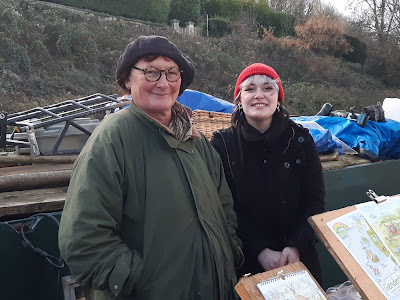
There was time, though, to buy three calendars and some cards from Dru Marland, and an etching from her daughter, Katie. I hadn't seen Dru since the pandemic was just starting so it was good to have a (heads turned) hug. 


Then back to the car, past the trompe l'oeuil doves in their dovecote ... 


... and the magnificent beech pollard off Pound Lane ...


... to leave with our eyes full of colour and light.