About Me

My photo
Bristol , United Kingdom
Poet and poetry facilitator. Neurodishevelled. My sixth poetry collection, Love the Albatross, is available from Indigo Dreams or directly from me.
Showing posts with label St Saviour's Coalpit Heath. Show all posts

Thursday, 15 September 2022

The open doors of Winterbourne Mediaeval Barn and St Saviour's Church

Open Doors Day - or Heritage Open Days, as they now seem to be called - have changed, at least in Bristol, and not for the better. Admittedly, the more popular locations have had to be booked in advance for some years, and in our not-really-post-Covid world, arranging these sort of events is certainly more complex than it was, but I was dismayed to see that this year, people wishing to join in had to buy a wristband in advance. Gone the spontaneity of stopping by, deviating from the planned route because somewhere takes your fancy, and going home early when your feet have had enough. Gone, too, the principle of not paying. It feels like something really quite precious has been commercialised, and in commercialising it, made more middle class, more exclusive.


So, I decided to stick to South Gloucestershire venues - only a couple as I only had a couple of hours - and rolled up in a timely fashion at Winterbourne's mediaeval barn, which I'd been keen to see for some years. 


Built in 1343 just before the Black Death decimated the workforce, the barn was commissioned by Thomas de Bradeston, who is, possibly, implicated in the horrible murder of Edward II at nearby Berkeley Castle. 

This barn's importance lies in the fact that whereas other surviving great barns were built by monastic estates, Universities or Knights Hospitallers, this one is one of only three recorded that were built by a Lord of the Manor.


If it looks a bit smaller than some of the other great mediaeval barns, that's because only seven of its eleven original bays have survived.


And because it's important to have an idea of these things, it's estimated that as many as 240 oak trees were used to build the roof structure.


Apparently, the circle of stones is where cattle would tread to turn the mills.


The Church of St Michael is literally a stone's throw from the barn, so I decided to make a swift visit before setting out for my next destination. I'd visited before, and was looking forward to reacquainting myself with my favourite surly cherub in the churchyard. 


What I'd evidently missed on that previous visit was this precursor of the famous last scene of 'Carrie'.


As I was passing the bell tower, I was invited up for a talk on bell-ringing, which turned out to be long, though of interest too, not least because the bells had been muffled and rung the previous day to mark the death of the Queen. Then I had the anxiety of climbing down the narrow winding steps of the tower, although it turned out to be less alarming than the ascent. 

I'm always going to be beguiled by mediaeval wall paintings ... 


... but the tomb of Thomas de Bradeston was of extra interest now I was aware of his role in the building of the barn murder of Edward II (allegedly).


My final destination was St Saviour's Church in Coalpit Heath, the interior of which I'd tried to see on a previous Open Doors Day, only to find it not as open as advertised.  

The church is of interest to me having been built by William Butterfield, a Gothic Revivial architect and forerunner of the architects of the Arts and Crafts Movement.


After all the trying to get in, I was a bit taken aback by the interior. I think I must have been expecting something more ... well, Gothic, but it's actually pretty plain, and reminded me of my artistically constrained Methodist upbringing. The light fitting in the chancel has an Arts and Crafts vibe to it, though, as do the painted inscriptions on the wall.

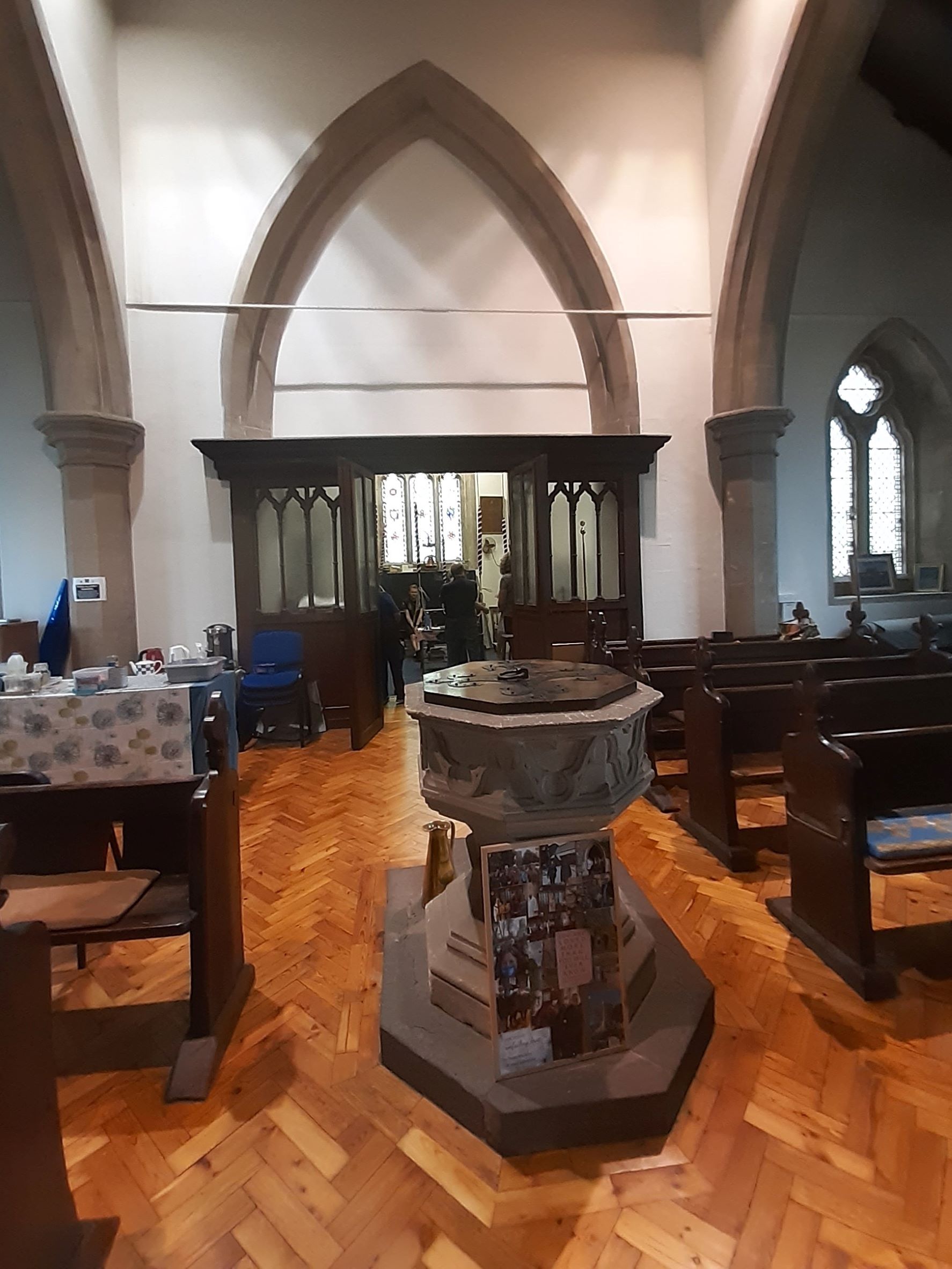
By now the bell-ringers were getting ready to ring for the dead Queen and when I saw the bell-ringer from St Michael's advancing across the car park, I thought I'd better scoot off before I got another potted history, so I did. Things to do, places to be in these strange days.


Tuesday, 17 September 2019

Heritage Open and Not So Open Days

I love Heritage Open Days, but often fail to nosy around places that are usually out of bounds by getting myself booked up to do other stuff the same weekend. Not so this year. I noted the dates in my diary in May, and came up with a packed schedule of Places To Visit that made even seasoned jaunter, the Friend-Formerly-Known-As-'Er-Over-The-Road, baulk.

But then I was asked to be poet-in-residence at the Methodist District Synod in Bath on the Saturday. And I said yes, which necessitated a rethink. Several of the places I'd put on my list were only open on the Saturday. The main thing was to get to the graveyard of St John on the Wall in the centre of Bristol, which hadn't been opened to the public since 1968. The other place I really wanted to visit was St Saviour's in Coalpit Heath, which I'd failed to get inside on two previous attempts. So that's where the F-F-K-A-E-O-T-R and I decided to visit on Friday.

Except when we arrived there was no one about. No signs. No tell-tale bunting. And the door was locked. We walked around the church. No one there. I fished out my phone and googled. THIS EVENT HAS BEEN CANCELLED. Gah. 


Saturday's events at the Methodist Synod weren't that photogenic, but very enjoyable all the same, and included lots of connections made with people through poetry, which was brilliant. 


Sunday morning found me and the Northerner in town, ready to visit the secret, perpetually shut churchyard of St John on the Wall, between the railings of which I've pressed my face for years. 


I could see the gates were open as we wandered down Tailors' Court and felt quite emotional walking through them at last. 


Once inside, there's a feeling that you're treading on the bones of the dead. An average of 13 burials a week were taking place by the mid-18th century, when it was declared full and closed.  And since the church was built in the 14th century, that's a lot of corpses. 
The juxtaposition of the very old and the modern was striking ... 
... and I was fascinated by the views of the familiar lanes from a new perspective. 


Best of all, though, the ruinous, the decayed, the overgrown. 


Memorial of the merchant Edmund Browne, who died in 1635

The mausoleum of  merchant-venturer Hugh Brown (died 1653) and his wife


Detail of mausoleum ceiling


Disappointingly, the church itself was shut and the crypt, though open, was full of modern stained glass that was displayed for sale on cloths spread over the tombs so you couldn't see them.


I consoled myself with the knowledge that I'd seen it all before anyway and we went for a drink in one of our favourite pubs, the Seven Stars, instead.


Thursday, 11 February 2016

On Not Entering the Kingdom of God on Earth

Often it's those places just up the road from you that you never get round to visiting. Such a place is St Saviours Church in Coalpit Heath, designed in the Gothic Revival style by William Butterfield and consecrated in 1845.  I must have driven past it hundreds of times and each time I've thought 'Gah, still haven't been in there.'  Well today - whilst on the road with the dog, whittling away a February half term while electricians rewire the tinder box that is my house - I resolved to put this oversight right. 

First, though, much admiration for the crocuses spreading over the churchyard ... 


... and the snowdrops bursting from graves in wintry sun. 


O glories, glories. And once inside the build-

- but no. Alas, it wasn't open. And after I'd looked on the website too, to check whether it was ever locked. No mention in the porch of whether there was a key-holder nearby either.  Boo. 


Disconsolate, I headed for the church in the neighbouring village of Frampton Cotterell.  St Peter's is a rather splendid Victorian re-build of a much smaller mediaeval church, with a tower dating from 1315.  I'd heard the stained glass was good, so I decided to have a look, but not before I'd had a fossick in the churchyard. 


At first I was a little surprised at the grandeur of this tomb, inhabited by William Tillett, Parish Quarryman, but of course he'd have had access to much stone and mates who could work it for him, and so it is entirely unsurprising after all.  


Much of this magnificent headstone is illegible but the first part reads:

Sacred to the memory of MARY Dau of JOHN & RACHEL TOVEY of this Parish who died 29 Jan 1802 Aged 15 Years 


The incumbent of this grave has clearly sublet part of it. 


When I went to go into the church for a bit of a poke about (and for Ted to spend some time in quiet reflection), I was stopped by the sight of four scooters in the porch and the sound of muffled yet still piping voices emanating from inside. Half term. Still, at least the building was in use and not locked against allcomers.  And I'm going to have to come back another time anyway.