About Me

My photo
Bristol , United Kingdom
Poet and poetry facilitator. Neurodishevelled. My sixth poetry collection, Love the Albatross, is available from Indigo Dreams or directly from me.
Showing posts with label Wells Poetry Prize. Show all posts

Saturday, 26 October 2019

Days-Errant

Been doing a lot of errandry* lately, but at least it's involved some getting out and about to interesting places. I get a bit depressed cooped up in Bristol, especially this time of year when some bugger's pulled the plug and all the light's draining away.

*Now I'm wondering if errandry should be errantry, which has the benefit of being an actual word, but that might just be wandering about without the service element. Hmmm.

Anyhow. My mother was in Bristol for ten days or so recently, following a sojourn in Cornwall, and briefly fancied going to Clevedon, so we took her there before she could change her mind. There's a pub right on the front where you can have something to eat and look out over the estuary and there's light and interest even when the weather forecast is poor, which it was. 

And by the time we emerged, it was into unexpected afternoon sunshine, and a plane, which you probably can't make out in the photo, was doing loop-the-loops and things. 

We made our way to the pier.

I took time to admire my favourite thing about Clevedon which is its less than genteel trees ... 

... though there was no walking the steep cliff path of Poets Walk, of course.

After a flying visit to the pier's gift shop, we manoeuvred our way through the narrow lane that leads from the front to Copse Road, emerging alongside the Royal Oak Pub, which was run by my Great-Great-Uncle Joe Rich during the first half of last century. There are lots of family stories associated with this time.

My mother happily told several passers-by and a couple of workmen about the times she used to pull pints there, aged 14. 

The lane hasn't changed much at all, apparently.

A couple of days later we ventured deeper into Somerset to visit my mother's only surviving elder brother, Noel, in Shepton Beauchamp. They did a great job of bringing their childhood misdemeanours to life, details of which I shan't repeat here.  

The next day, my birthday, the Northerner and I were in Wells for the gathering of shortlisted competition poets at the Festival of Literature ... 

... and then suddenly that was enough Somerset, and my sons and I were off to Sussex for a belated birthday jaunt - my daughter's birthday, not mine. And it rained again.

But then it cleared up enough for a little wander around Brighton Marina ...

View to Ovingdean Gap


... followed by cake. 


Sunday, 15 October 2017

Bristol Poetry Festival so far and a visit to Wells Festival of Literature 2017

The Bristol Poetry Festival is galloping into its final week. The last seven days have seen fantastic sets from Tara Bergin, Liz Berry, Helen Ivory, Lucy English, and Lois P Jones (the winner of this year's Bristol Poetry Prize), and Martin Figura's stylish and affecting new show about love, loss and poetry, Dr Zeeman's Catastrophe Machine, which I absolutely recommend. Plus a ground-breaking fusion of BSL poetry and poetry film, including translations into sung notation (an indequate way to describe it but the best I can do), with Paul Scott, Helen Dewbury, Chaucer Cameron, Victoria Punch and Kyra Love.  And last night a beautiful, beautiful launch for the anthology of poems by contemporary Georgian women poets, 'The House with No Doors', translated by Natalia Bukia-Peters and Victoria Field, with music from the Borjghali Choir which made me want to dance up and down the aisles of St Stephen's Church. (I desisted but it was a close thing.) 

Then there was Dru Marland's launch of her latest collection, Drawn Chorus, published by Gert Macky, which took place last Monday and which was A Roaring Success. 


Here are the guest poets!


Today it was off to Wells Festival of Literature for a bit of a change. I'd been asked to get the reception for this year's shortlisted poets in the poetry competition under way by reading my poem 'Mr Cowper's Hares', which won last year's Hilly Cansdale prize for local poets. And since it's always a pleasure to go to Wells, I was happy to oblige. 

And it all went ever so well. 

Here are a few of the City of Wells in Autumn photos such an occasion demands. 


St Cuthbert's


The view from the pub


Stained glass autumn ash with Cathedral backdrop
The ruined Great Hall of the Bishop's Palace


Stained glass from ruined French churches, post Revolution


Tudor fireplace


Fountain


Not falling into the mediaeval conduit on the way back to the car


Tuesday, 10 October 2017

A Poem for World Mental Health Day 2017


William Cowper was an 18th century poet and hymn writer, born a generation or two before Blake, Coleridge, Clare and Keats, and like them, posthumously diagnosed with bipolar disorder. Of course, we can never really know what caused their mental illness and it seems rather prurient to conjecture about this aspect of their lives. In any event, what's more interesting about Cowper is the fact he kept three orphaned hares as pets and found some comfort in caring for them. 


Mr Cowper’s Hares


And so he sits without moving
holds them in his lap

not so tightly they’ll take fright
leap through the window
scream up the lane
outstripping every attempt to catch them
hurling themselves
from rock to moss to wild supposition
till they’ve gone beyond all returning
no longer know they have a home

and not so softly they’ll take fright
bolt down the passage
out through the door
dodging the grasp of passers-by
plunging
almost suicidal into tan pits
brought back half-drowned in a sack
caked with lime

and so he holds them without moving
pent between his hands

sees his reflection

in their mad amber eyes


©Deborah Harvey 2016


This poem won the Hilly Cansdale Prize for Local Poets at Wells Literature Festival last year, and I'll be reading it at the prize-giving ceremony for this year's shortlisted poets, this Sunday at 3.30pm in the Bishop's Palace. 


Sunday, 16 October 2016

A Visit to Wells Festival of Literature 2016

After two weeks of intense poetry rehearsing, reading and listening at the glorious Bristol Poetry Festival, we were off to Wells today for more of the same at the Wells Festival of Literature. 


It's never a hardship to go there, especially at this time of year. The light is golden on golden stone, the interplay with the trees astounding, even when you've seen it before.


And how can you not love England's smallest city, with this view on one side ... 
... and this on the other? 
We were headed for the poetry judging at the Bishop's Palace, as my poem 'Mr Cowper's Hares' was slugging it out with the other shortlisted poems for one of the prizes on offer. 
I've a soft spot for the Wells Festival of Literature poetry competition because back in 2010, my poem 'Coleridge Changes his Library Books' took first prize. It was this that prompted me to stick my head above the parapet and start going to open mics and entering more competitions - which in turn led to a publishing deal for my poems and my novel, and the making of so many friends in the poetry community.
As it is, 'Mr Cowper's Hares' put up a good fight and came away with the Hilly Cansdale prize for local poets in their paws.   


Wednesday, 8 June 2011

Persons to Porlock


Off to Porlock last Friday.  I first visited three years ago, and it turned out to be the start of a series of jaunts which led to my poem, 'Coleridge changes his library books', so I feel affection and gratitude towards the place.  My father had never been, however, and as he is now 89 and quite frail, I decided to get him down there pronto, along with my mother, my sister and Ted.


So, another chance to visit the Ship Inn, which Sam Coleridge, William Wordsworth and Robert Southey used to frequent. On the wall in what would have been the inglenook, there are a few lines of a poem composed in situ by Southey: 'Porlock! / Thou verdant vale so fair to sight / Thy lofty hill which fern and gorse embrown. / Thou waters which roll musically down, / The woody glens, the traveller with delight, / Recalls to memory.' 


Then, having lunched, we moved on to the implausibly named Church of St Dubricius, with its 1,000-year-old yew tree a friend of mine once likened to Don Quixote on his horse.  


It was lovely to climb up the narrow, spiral staircase to the Chapel of the High Cross once more, the warm and welcoming chantry which once served as a schoolroom and as storage for vestments, and to see the delicately detailed Harington tomb again, with its graffiti dating back to 1531. 
A minor disappointment was that a tomb I was expecting to see - of a reclining woman carved in marble - wasn't there.  I must have encountered it in another church I visited that day. Must try to find out which somehow.
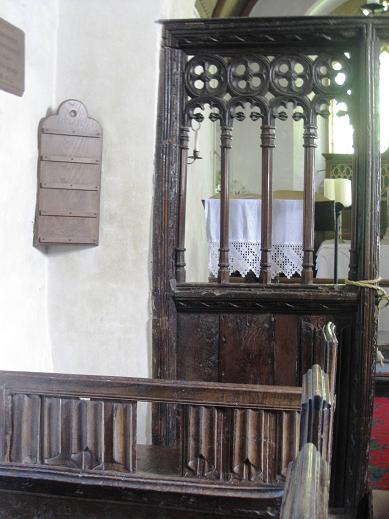


Next stop was Porlock Weir, where I parked my parents and sister in the sun and set off with Ted along the rollercoastery coastal path to Culbone.  Ideally I would have liked to have done the entire walk in my book, especially since the latter part of the route passes Ash Farm, where Coleridge was famously interrupted by a 'person on business from Porlock' whilst writing his sublime, opium-inspired poem, 'Kubla Khan' (and whom Julien Temple in his film 'Pandaemonium' rather scurrilously identifies as Wordsworth).  But I didn't want to leave my parents too long, just in case, so that must wait for another day.


As it was, it was very hot and the four-mile-round trip to Culbone was quite enough for me, if not Ted. I was thankful that the route wound through cool and shady woods before descending to the valley in which the hamlet - famously inaccessible by road - and its tiny church lie. 


Culbone church is reported by some parties to be the smallest in England, although this is open to fierce debate. The guidebook claims it is the smallest complete parish church in England, with its chancel measuring 13'6" x 10' and the nave 21'6" x 12'4". Its total length is 35ft and it is reputed to seat about 30 'in great discomfort'. Another interesting snippet is that in the Assize rolls of 1280, it is recorded that Thomas, the chaplain of Culbone was indicted 'for that he had struck Albert of Esshe (Ash) on the head with a hatchet, and so killed him'.  (Presumably this is the same Ash in the anecdote about Coleridge.  What a history!)  This isn't the first time I've come across a West Country church with a lurid history of murder ...


Meanwhile I was enchanted by the sweetly small yet solid entrance door, the rood screen and box pew, the exquisitely carved linenfold panelling on the back of one of the pews.


In the churchyard lots of graves of people with either the surname or middle name of 'Red'.  A bit more earthy than Rufus or Scarlett, lovely names as they are.


Then back to Porlock Weir and the drive home, via Kilve where we stopped for ice cream.  Sadly, my dad was too tired to go up to the beach as he'd hoped and we went home without him seeing the bleak beauty of that part of the coastline. Never mind, hopefully we can return another of these fine days ... 


Thursday, 14 October 2010

A Visit to Wells Festival of Literature 2010

So, Saturday it was off to the beautiful Somerset city of Wells, at the invitation of the Festival of Literature Committee, for a prize-giving, luncheon in the Bishop’s Palace, and a talk on writing by the novelist Sarah Duncan. With me my writing teacher and friend, Kate Dunn, whom I was delighted to invite by way of a thank you for her support.

As luck would have it, morning dawned fair and our journey passed uneventfully. Having arrived with time to spare, we took a wander around the town. The trees have some way to go before their autumn colouration gains its full intensity, but they were still very beautiful, and given the lovely, slightly misty quality to the light, I was vexed that I’d carefully stowed my camera in the wrong handbag.

After we'd perambulated the moat, we made our way to the main entrance of the Palace and on to the light, high-ceilinged room where the prizes for the Short Story and Poetry Competition were to be given. I was expecting to feel nervous, but didn’t, partly because an actor was reading out the winning poems rather than the poets themselves, but also because it’s the poem that’s being honoured on these occasions, not the person who was fortunate enough to find it and pin it on the page. Still, it was a pleasure to accept the first prize cheque for £500 on behalf of said poem, ‘Coleridge Changes His Library Books’, along with a certificate and a charming terracotta tile depicting the Cathedral fashioned from books.

Lunch was handsome – roast pork and vegetables, followed by syrup pudding with clotted cream – and the company serendipitous. Kate and I sat with the poet who won second prize in the competition, the generous and indefatigable Sue Boyle who runs the Bath Poetry Café, her husband Jim, the actor Dennis Harkness, who won the Silver Wyvern prize for his short story and who tours with a one-man show about Coleridge (how’s that for synchronicity?), and his wife, the very talented artist Juliet Harkness. We were also joined by one of the committee members, who told us there had been 479 entries in the poetry competition this year.

After lunch we attended the talk about writing, and Sue kindly invited me to read at the November Poetry Café. Then, we left the Palace and made our way to the Cathedral, but not before we’d located the bell the swans ring when they want to be fed! Unfortunately part of the south aisle, the transept and everything to the east was closed to visitors as there was a choir practice in full flow, but even so, it was wonderful to drift along the stone avenues, dislocated from time. And that's another reason to go back soon.