About Me

My photo
Bristol , United Kingdom
Poet and poetry facilitator. Neurodishevelled. My sixth poetry collection, Love the Albatross, is available from Indigo Dreams or directly from me.
Showing posts with label William Holman Hunt. Show all posts

Sunday, 31 August 2025

To the Vale of Lune and Cautley Spout

Nine years had passed since I'd last seen my Friend in the North, Jill. And when I say North, I mean North: the woman who for many years lived up the road from me in the Cotswolds has long been based in County Durham. 

But since we were holidaying a mere 67.7 miles away in Lancaster - or to be precise, Dolphinholme - it would be easy to rendezvous half way, with Sedbergh, which somehow manages to be in the Yorkshire Dales and Cumbria simultaneously, the agreed meeting point. First, though, a quick visit to St Gregory's Church at Marthwaite in the Vale of Lune, which has connections with the Arts and Crafts Movement. 


Not the most prepossessing of buildings - although instantly familiar to someone like me, who was raised Methodist - St Gregory's was built in the 1860s as a Mission Chapel for the navvies building the London and North Western Railway, and so it didn't have to be fancy. This doesn't mean it wasn't fitted out with care and an eye for detail following its refurbishment in the 1900s,  the wooden fittings and furniture being supplied by the prestigious firm of Waring & Gillow of Lancaster. 


William Holman Hunt's 'The Light of the World'


It's the stained glass windows, though, that are the real glory here. Installed when the church was enlarged in the 1900s, they were designed by Frederick George Simon and, for the most part, feature local rivers, hills, trees, plants and wildlife.


The church also contains three beautiful windows designed by Morris & Co.


Justice


Fortitude


Peace

It was time to be getting on, however, our destination the National Trust-owned Cross Keys Temperance Inn at Cautley on the other side of Sedbergh. 


A temperance pub? Why yes, the story being that alcohol ceased to be sold there quite abruptly, following a raucous night in 1902 when a drunken customer by the name of Buck was being helped home by the then landlord. Buck fell down the bank of the River Rawthey, only for the landlord, while trying to get him back on his feet, to fall right in and drown. The pub was subsequently sold, the liquor licence removed, and that was that. 

I didn't mind, I was driving. And our Friday pie and peas were washed down quite nicely by tea and ginger beer. 


Since, having met up with Jill and her partner Paul, there were three dogs in our party and an actual, real-life and quite noisy children's party going on inside, we were more than happy to sit out in the back garden overlooking the Howgill Fells, which were very beautiful indeed. 


No, you can't herd them, Cwtch.

For our walk, we crossed a very placid-looking River Rawthey via a rather grand new footbridge, and made our way up the track towards the cascade up ahead of us, which has the rather wonderful name of Cautley Spout. 


The views were lovely, but I was struck by how dry and crackly the vegetation was, even in areas where rushes and sphagnum moss were growing that you would expect to be boggy.


Paul remarked that a dry summer such as this one probably wasn't the best time to go gallivanting after waterfalls, but the Spout was pretty all the same, even if on other occasions, it's a lot more dramatic. 


Sadly, the inn was closed by the time we got back, otherwise we might have felt entitled to some cake after our walk, but nothing could spoil a lovely day in this beautiful part of the North. 


Ee, but it were grand! 

Tuesday, 1 August 2023

On the Edge at Kinver

I like Edges. The one I want to visit most is Alderley Edge, in homage to one of my favourite writers, Alan Garner, and I will get there one day. And then there's the Edge of the Cotswolds at Wotton, just up the road from where I live, and the lovely walk to Tyndale Monument at North Nibley. 

I first heard of Kinver Edge back in the 1990s, when the celebrated rock houses - the last troglodyte dwellings occupied in England - were being restored. It's taken a long time, but with Son the Elder roboteering nearby in Brierly Hill, and me on chauffeur detail, I finally had the opportunity to visit. 

First, though, a wander through the woods. 


Cathedral of beech trees


Meadow cranesbill


Common poppy


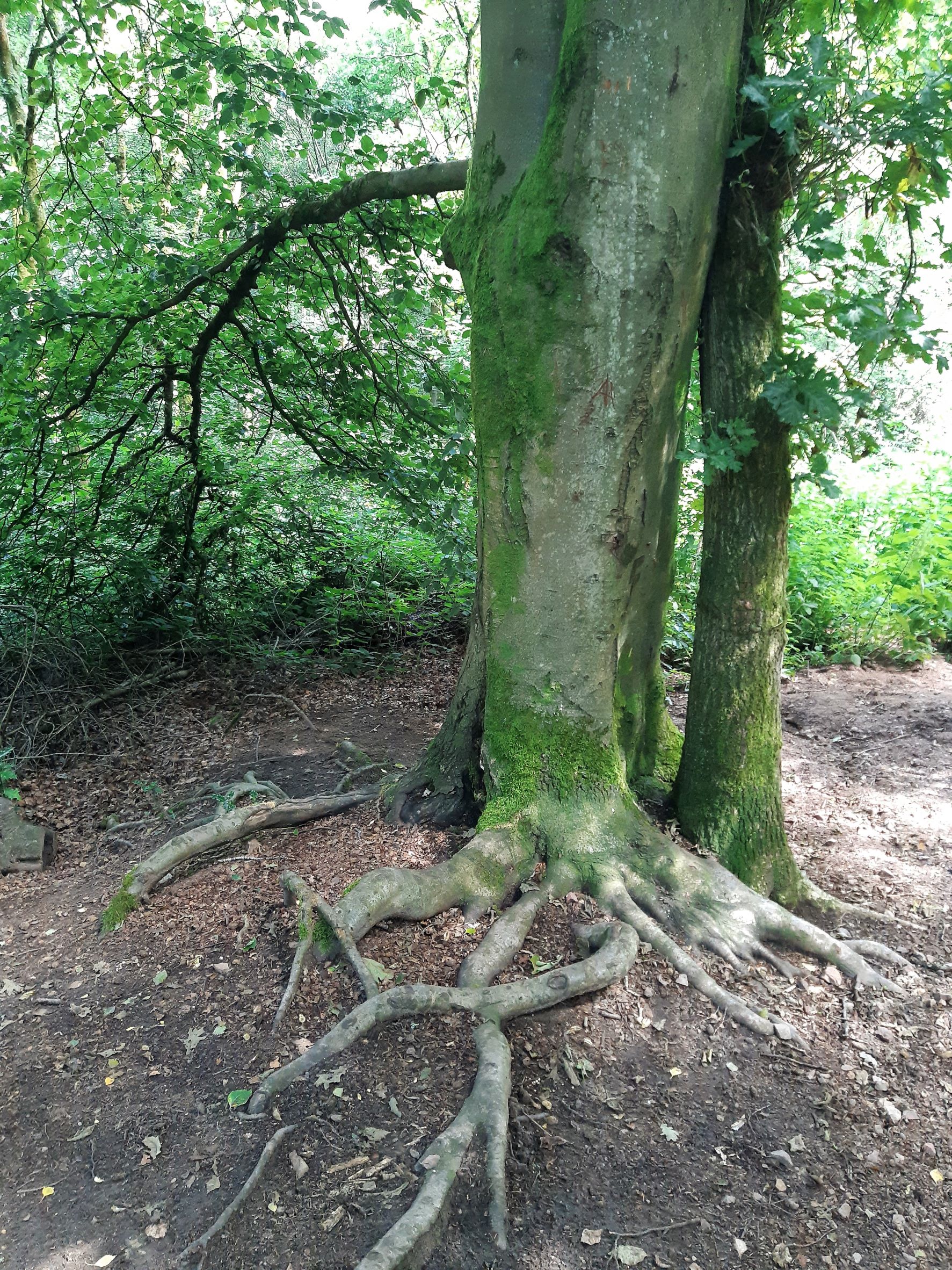
A beech and oak having a smooch

The National Trust was given their first tranche of land at Kinver Edge in 1917, but it wasn't until 1963, when the last inhabitants left, that they were able to acquire the rock houses. The earliest written record of people living there dates to 1777, when one Joseph Heely sought refuge from a storm and describes how he was given shelter by a 'clean and decent family', but it's probable the caves had been used as dwellings long before then. Indeed, the fact the cliff is known locally as Holy Austin Rock, probably after a 16th century hermit, points to a longer tradition of people making their home there.


There are several rock houses at Holy Austin Rock, consisting of natural caves with hollowed-out spaces behind them over three levels. The 1861 census lists eleven families living here.


Two of the houses on the lowest level have been furnished by the National Trust to replicate how they would have looked at different times in the past, a task made easier in the instance of the first, the home of Mr and Mrs Fletcher at the turn of last century, who were visited by both Sir Benjamin Stone, a Tory MP and documentary photographer in 1895, and artist Alfred Rushton RA in 1903. 


The reconstruction is so exact that the mirror between door and window is positioned at the same angle as in the painting (much to the vexation of the NT volunteer, who confided that she longs to straighten it).

It was very warm in the front room, where a fire was burning, and several degrees colder in the bedroom behind it, and it struck me how cool the cottage must have been on hot summer days and how cosy in winter. 

There were lots of household items familiar from my grandmother's Victorian terrace, that made the slightly disorientating experience of being in a house that's actually a cave rather more reassuring. 


the ubiquitous mangle


wooden clothes horse


William Holman Hunt's 'The Light of the World'

Sandstone is, of course, very soft and easy to carve. Furniture too tall for the ceiling? Just hollow it out so it's a little higher.


There's also a tunnel cut through the stone between this house and its neighbour. 'No one knows why,' the volunteer said. 'Maybe it was to let the children run between houses, or perhaps it was cut when there was no one living next door and the inhabitants in the one house thought they'd use the space.'


Of the three houses facing you as you arrive up the path, the middle one is used as an information centre ... 


... while the third is inhabited by a colony of horseshoe bats.


The second furnished house is around the corner from the first. It was home to the Martindale family, and, using old photographs, it's been restored to what it was like in the 1930s. 


Again, there are so many items, familiar from my own (later) childhood, some of which I still use today, like the mixing bowl and willow-patterned plates.


The marks of tools from where the man-made rooms were chiselled out of rock are clearly visible on the walls.


There's a photograph of Mrs Martindale making Bedfordshire lace at this window. 


The dwellings on the middle 'floor' of the escarpment haven't been restored and aren't closed off to visitors. They appear to be little more than hollowed-out caves and it's hard to imagine how they might have looked when they were inhabited.


From the top level, there's a panoramic view which gives some idea of the geography of the place, as well as its geology. 


A terrace of rock cottages here have brick frontages, disguising their origins. The Reeves family lived in one of these, and as the houses became a tourist attraction in the early 20th Century, they served tea to visitors, a tradition the National Trust continues. 


There are vestiges of other rock dwellings on Kinver Edge at Nanny's Rock and Vale's Rock, but for reasons too dull to iterate, I wasn't able to linger. However, since roboteering events have a habit of repeating themselves, maybe I'll get a chance to revisit.