About Me

My photo
Bristol , United Kingdom
Poet and poetry facilitator. Neurodishevelled. My sixth poetry collection, Love the Albatross, is available from Indigo Dreams or directly from me.
Showing posts with label King Edward II. Show all posts

Tuesday, 7 May 2024

A birthday trip on the Severn Valley Railway

Son the Elder's birthday wish was a day out on the Severn Valley Railway, so off we went.


Our starting point was the heritage station in Kidderminster in the West Midlands, which has a Victorian pillar box ...


... and a reasonably authentic-looking tobacconist, except that it was selling second hand books about steam trains. 


Once aboard, the ticket collector came and clipped our tickets. It was all very exciting.


We'd decided our outward journey should be straight through to Bridgnorth at the end of the line. En route we stopped at Bewdley, Arley, Highley and Hampton Loade. 


Bewdley


Trimpley Reservoir


We passed oceans of bluebells and universes of wild garlic.


A glimpse of the River Severn

Diesel locomotive 'Sir John Betjeman' in commemorative London Transport livery


Hampton Loade


Bridgnorth


We had an hour and a half to spend at Bridgnorth, so after lunch in the refurbished Refreshment Room, we climbed Cannon Steps to Bridgnorth Town Park, which is sited on top of a sandstone cliff in the grounds of the ruined castle.


A glimpse of Bridgnorth High Town


It turns out Brignorth Castle was strategic in rebellions against Kings Henry I, Henry II and Edward II before being destroyed by Parliamentarians during the Civil Wars. My kinda town.


A wallflower growing on the walls of the ruined castle


Looking down on the Severn Valley Railway


The train we took back down the line as far as the village of Highley, where there's an engine shed housing a number of heritage locomotives, was one of the familiar green and yellow Diesel engines of my childhood, and it struck me that almost all the people with legitimate feelings of nostalgia for steam trains are now old enough to be dead. 

Not that Diesels were any less mucky, mind. 


While Son the Elder visited the museum, I enjoyed the view of the River Severn and videoed a steam engine on its way to Bridgnorth. I even began to wonder if I was in danger of turning into a train spotter, except it was flowers and wildlife I'd been happily identifying as we chuffed our leisurely way through the valley. I even saw two rhinos in fields alongside the track just outside of Bewdley, attractions at the West Midlands Safari Park, which I remember visiting nearly 30 years ago when my kids were small. Sadly, my phone battery conked before we reached them on our return route, so no photos of tranquilly grazing rhinoceroses in the Worcestershire countryside were taken after all. Maybe we'll have to come back for that.


Thursday, 15 September 2022

The open doors of Winterbourne Mediaeval Barn and St Saviour's Church

Open Doors Day - or Heritage Open Days, as they now seem to be called - have changed, at least in Bristol, and not for the better. Admittedly, the more popular locations have had to be booked in advance for some years, and in our not-really-post-Covid world, arranging these sort of events is certainly more complex than it was, but I was dismayed to see that this year, people wishing to join in had to buy a wristband in advance. Gone the spontaneity of stopping by, deviating from the planned route because somewhere takes your fancy, and going home early when your feet have had enough. Gone, too, the principle of not paying. It feels like something really quite precious has been commercialised, and in commercialising it, made more middle class, more exclusive.


So, I decided to stick to South Gloucestershire venues - only a couple as I only had a couple of hours - and rolled up in a timely fashion at Winterbourne's mediaeval barn, which I'd been keen to see for some years. 


Built in 1343 just before the Black Death decimated the workforce, the barn was commissioned by Thomas de Bradeston, who is, possibly, implicated in the horrible murder of Edward II at nearby Berkeley Castle. 

This barn's importance lies in the fact that whereas other surviving great barns were built by monastic estates, Universities or Knights Hospitallers, this one is one of only three recorded that were built by a Lord of the Manor.


If it looks a bit smaller than some of the other great mediaeval barns, that's because only seven of its eleven original bays have survived.


And because it's important to have an idea of these things, it's estimated that as many as 240 oak trees were used to build the roof structure.


Apparently, the circle of stones is where cattle would tread to turn the mills.


The Church of St Michael is literally a stone's throw from the barn, so I decided to make a swift visit before setting out for my next destination. I'd visited before, and was looking forward to reacquainting myself with my favourite surly cherub in the churchyard. 


What I'd evidently missed on that previous visit was this precursor of the famous last scene of 'Carrie'.


As I was passing the bell tower, I was invited up for a talk on bell-ringing, which turned out to be long, though of interest too, not least because the bells had been muffled and rung the previous day to mark the death of the Queen. Then I had the anxiety of climbing down the narrow winding steps of the tower, although it turned out to be less alarming than the ascent. 

I'm always going to be beguiled by mediaeval wall paintings ... 


... but the tomb of Thomas de Bradeston was of extra interest now I was aware of his role in the building of the barn murder of Edward II (allegedly).


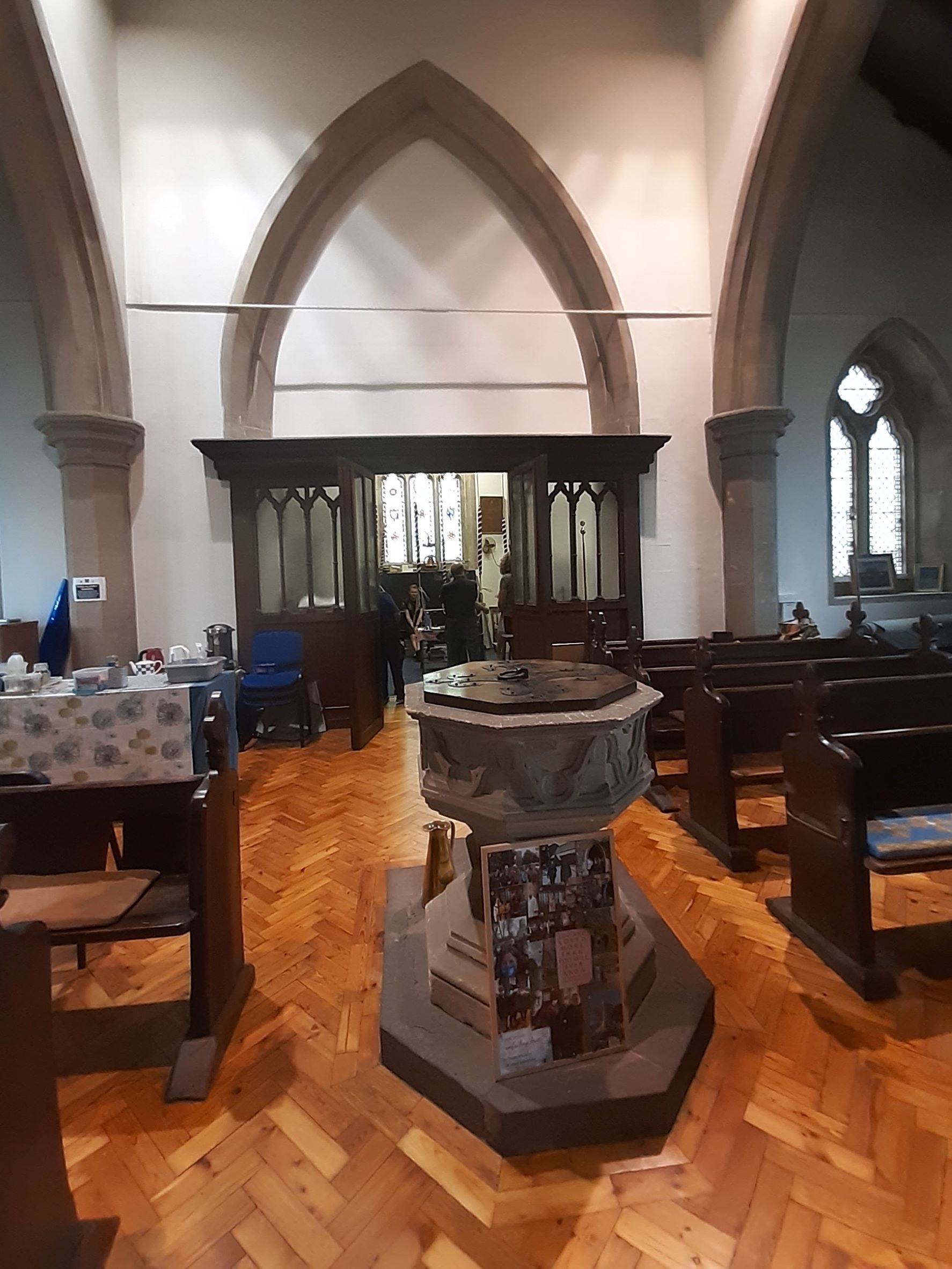
My final destination was St Saviour's Church in Coalpit Heath, the interior of which I'd tried to see on a previous Open Doors Day, only to find it not as open as advertised.  

The church is of interest to me having been built by William Butterfield, a Gothic Revivial architect and forerunner of the architects of the Arts and Crafts Movement.


After all the trying to get in, I was a bit taken aback by the interior. I think I must have been expecting something more ... well, Gothic, but it's actually pretty plain, and reminded me of my artistically constrained Methodist upbringing. The light fitting in the chancel has an Arts and Crafts vibe to it, though, as do the painted inscriptions on the wall.


By now the bell-ringers were getting ready to ring for the dead Queen and when I saw the bell-ringer from St Michael's advancing across the car park, I thought I'd better scoot off before I got another potted history, so I did. Things to do, places to be in these strange days.