About Me

My photo
Bristol , United Kingdom
Poet and poetry facilitator. Neurodishevelled. My sixth poetry collection, Love the Albatross, is available from Indigo Dreams or directly from me.
Showing posts with label Cameley. Show all posts

Saturday, 27 August 2016

To Cameley with Pameli

After an enjoyable evening's poetry at Bradford on Avon the night before, courtsy of Dawn Gorman's Words and Ears, Pameli and I were on the road relatively early for a morning jaunt to the Church of St James of Compostela in Cameley, North Somerset. 


As soon as we entered the churchyard we were met by its resident robin, who seemed quite unbothered by our presence.  


Maybe s/he was trying to draw our attention to various headstones, like this one to Charles Sage, who died in 1808. It has a coal wagon carved on it - a reminder of the North Somerset coalfield. 


Or this to a Quarman, who died on November 17thHis age - 67 - was left out and added with an omission mark. Damage to one side means key details are missing, though t'internet names him as James and gives his year of death as 1783.  


St James is one of those churches that got left behind when its congregation shifted, in this case to Temple Cloud, which developed in Victorian times around what is now the A37, just under a mile to the east. Its gradual decline meant  it escaped the attention of Victorian 'restorers'.  

No worries about getting into it as it is cared for by the Churches Conservation Trust and open daily in the summer. First, though, we admired some remnants of paint on the Norman doorway in the porch. 


Inside, a hotchpotch of ancient and not-so-ancient fixtures and fittings, murals and carvings 


John Betjeman called St James 'Rip Van Winkle's Church', and it's true, a history of the Church can be traced in its fabric and fittings.  Pre-Reformation wall paintings, discovered behind layers of whitewash in the 1960s, line up alongside seats of royal arms and the Puritan-approved Ten Commandments; the vestiges of mediaeval side chapels and the mediaeval door to the rood screen partly obscured by 17th and 18th century box pews and the 18th century and 19th century galleries. 


18th century hat pegs, far left


The last surviving pieces of the Church's mediaeval glass


The pulpit with its magnificent sounding board is dated 1637. This is where the sermon would have been delivered; the rest of the service being conducted from the reading desk. 


The 12th century font with its cover, which was made in 1634 at a cost of £1 12s 4d


An iron peg which could have been designed by C F A Voysey, though I suspect it's a fair bit earlier.  
And then there are the wall paintings: here, all that remains of what would have been a huge early 14th century St Christopher carrying the infant Christ, namely, a foot surrounded by little fishes and a fearsome crab.


The lower part of the royal arms of King James I (1603-25), most of which has been obscured by the gallery above.


A contemporaneous set of the Ten Commandments; above, the traces of a yellow sun or 'Glory'.


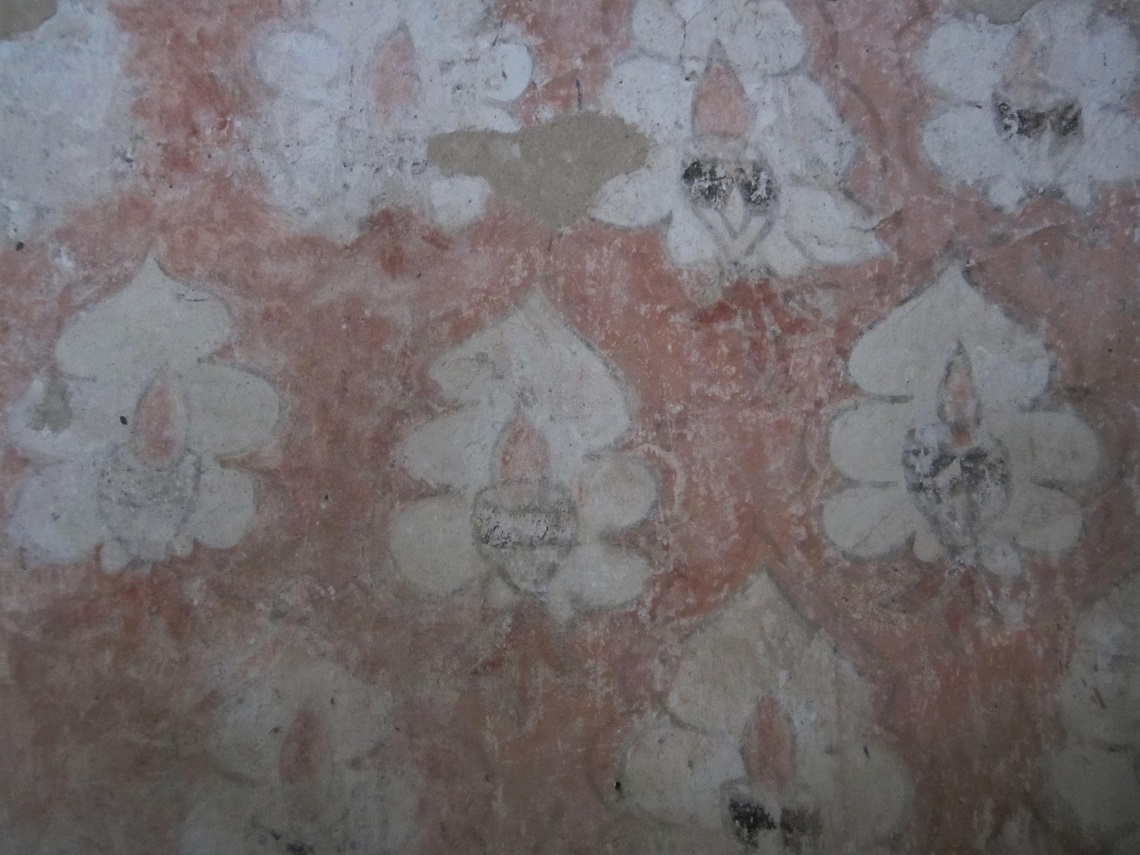
A damask pattern of what Pameli and I mistook for candles at first, but are 15th century acorns and oak leaves.

Red dash and scroll patterns from the 1200s on the chancel arch, and early 15th century black and yellow damask patterns in the former side chapel.  


My favourite - a mid-14th century jester with a forked tongue, holding a scroll. Apparently there's a possible St George in armour and on horseback behind him, but I couldn't really make that out. 


At the back of the church, carved into the seat of one of the narrow mediaeval pews, there's a design that looks very like the daisy wheels or hexafoils that protect the tithe barn at Bradford on Avon from the evil eye. While I snapped things in dim corners, Pameli and I swapped hex stories, mine being about the outlines of shoes  I've come across in various churches and churchyards.  


It was only when I uploaded my photos to my laptop that I realised St James has its own sole outlines.  


The guide to the Church describes these as 'three pieces of lead from the roof, where presumably those who laid or repaired it autographed it with their footprints and the dates 1733, 1757 and 1795.'  But like the lead outlines on the roof at Muchelney, and the other examples I've come across, I think they might well be examples of apotropaios


Outside, we came across a door that was the perfect size for Pameli ... 
... complete with miniature handle.

The robin was still knocking about too, and gave me quite a shock when I went to sit on the bench for a moment. 
There was just time to admire the poultry belonging to nearby Cameley Lodge (is that cockerel a Buff Orpington?) ... 
... and views so bucolic we seemed to have stumbled into an Eclogue.  All this a bare 11 miles from the centre of Bristol, our final destination. 


Friday, 24 July 2015

Apotropaios: Soul Outlines

Last week came the partial unravelling of a mystery that has foxed me ever since May 2011, when Dru and I visited St Michael's, Dundry, which, as its dedication suggests, perches high on Dundry Hill overlooking Bristol.


This is Dru's photo of an altar tomb dating from the 1730s in the churchyard. If you look to the right hand side you can see that there are outlines of shoes - or rather, soles - on the slab.  But why, dammit, why?

We pondered long and hard. Perhaps a lover had cut them while he was waiting for his sweetheart to emerge from evensong.  Except he'd have opted for a heart and initials, wouldn't he? 

Maybe it's a dancing lesson, Dru said. It's interrupted when father comes home from the quarry - there's his hobmail boot on the threshold, see?  

No, it's the footprints of a mother and her children dancing on Father's grave, I concluded.  And I wrote a rather poor poem and Dru drew a picture for a putative illustrated book of local poems that never got any further than that.  

I did make sporadic, rather lethargic attempts to find out a little more. 'Was it a cement top to the tomb?' asked David Williams, a then inhabitant of the village. 'Could they be prints rather than carvings?' But no, it was definitely the local yellow oolitic limestone that goes by the name of Dundry stone.  

And that was that until some desultory browsing on Facebook last week uncovered this photo taken in the porch of St Gile's Church, Bredon in Worcestershire in a group called Apotropaios.


Well, I knew about the practice of concealing (mainly well-worn) shoes in buildings since at least the early modern period, as magic charms to ward off evil and/or fertility charms, but I hadn't associated this with carved outlines or even realised that the examples at Dundry were anything more than an isolated phenomenon. 

There was more. A friend of Dru's, Philip Watson, posted these from the roof of St Peter and St Paul at Mucheleney, with the hasty postscript that he hadn't been up there for nefarious purposes.  


I tried a spot more googling.  June Swan, former keeper of the shoe and boot collection at Northampton Museum, writes 'Shoe and sole outlines may be found scratched on buildings and other structures, which confirms the significance of the shoe shape' but offers no further information or explanation.  

I found further examples in the form of an outline of  what looks like a matching pair of shoes carved into the lead on the roof of St Michael and All Angels in Edmondthorpe in Leicestershire.  Also in the graveyard at St Stephen's Chapel, which forms part of the ruins of Bordesley Abbey, Redditch, where the Curator believes them to be either acts of vandalism or an indication of profession, such as cobbler. Meanwhile the blogger who posted the photos suggests that they might be connected with the custom of giving clothes shoes to the poor by the monks - although this wouldn't account for other examples elsewhere, and in a non-monasterial setting.  

All of which poses more questions than it answers - for example, are they always associated with religious buildings? - and leaves me more intrigued than ever by these vestiges of lost souls.  


20th August 2015

Dru Marland has drawn another example to my attention, at St Melangell's Church in Welshpool. Again, locals seem to be blaming cobblers! 


5th March 2016

A shoe at St Mary's in Trostan, Suffolk, together with the head of a demon.

26th August 2016

Spotted these at the back of the redundant Church of St James of Compostela in Cameley. The guide to the Church merely describes these as 'three pieces of lead from the roof, where presumably those who laid or repaired it autographed it with their footprints and the dates 1733, 1757 and 1795.'