Some of the best poetry moments for me this year came during the series of poetry walks I did with my fellow Isambards at Bristol Botanic Garden.
So I'm really excited at the prospect of doing some more in 2020, this time at Arnos Vale, which is a Victorian garden cemetery and one of my favourite places to visit in all of Bristol.
We had a preliminary meeting with Public Engagement Manager Janine Marriott at the cemetery the week before last, to discuss possible routes and dates.
She also gave us a guided tour of part of the site, and talked about notable incumbents, the intricacies of consecrated ground, and the variety of wildlife found there.
I was astonished to learn that over 300,000 Bristolians are buried or have their ashes scattered her. (This number includes my paternal grandparents and my father's baby brother.)
That's over half the present day population of the city.
When I arrived home from this first visit, I realised I'd taken the same photo as I did on an earlier visit this year.
Of course, needing to write poems about a place is a good excuse for frequent visits, so I went back again today, this time with my dog, Ted, to walk some of the paths I'm not yet familiar with.
Being interested in death, I already have lots of poems on the subject, but the poetry walks are a good excuse to write some new, site-specific ones.
I already know that I want to write a poem about the corner of the cemetery where stillborns were buried in the middle decades of last century, without ceremony and more often than not without the knowledge of their parents either. My godmother's first baby was stillborn in the 1950s, and telling their story in a poem feels like something I can do for her and her lost son.
I also want to write about the wildlife in the cemetery ... although visiting late morning with a border collie in tow is a sure way of not seeing any. Apart from those other unsubtle creatures, magpies.
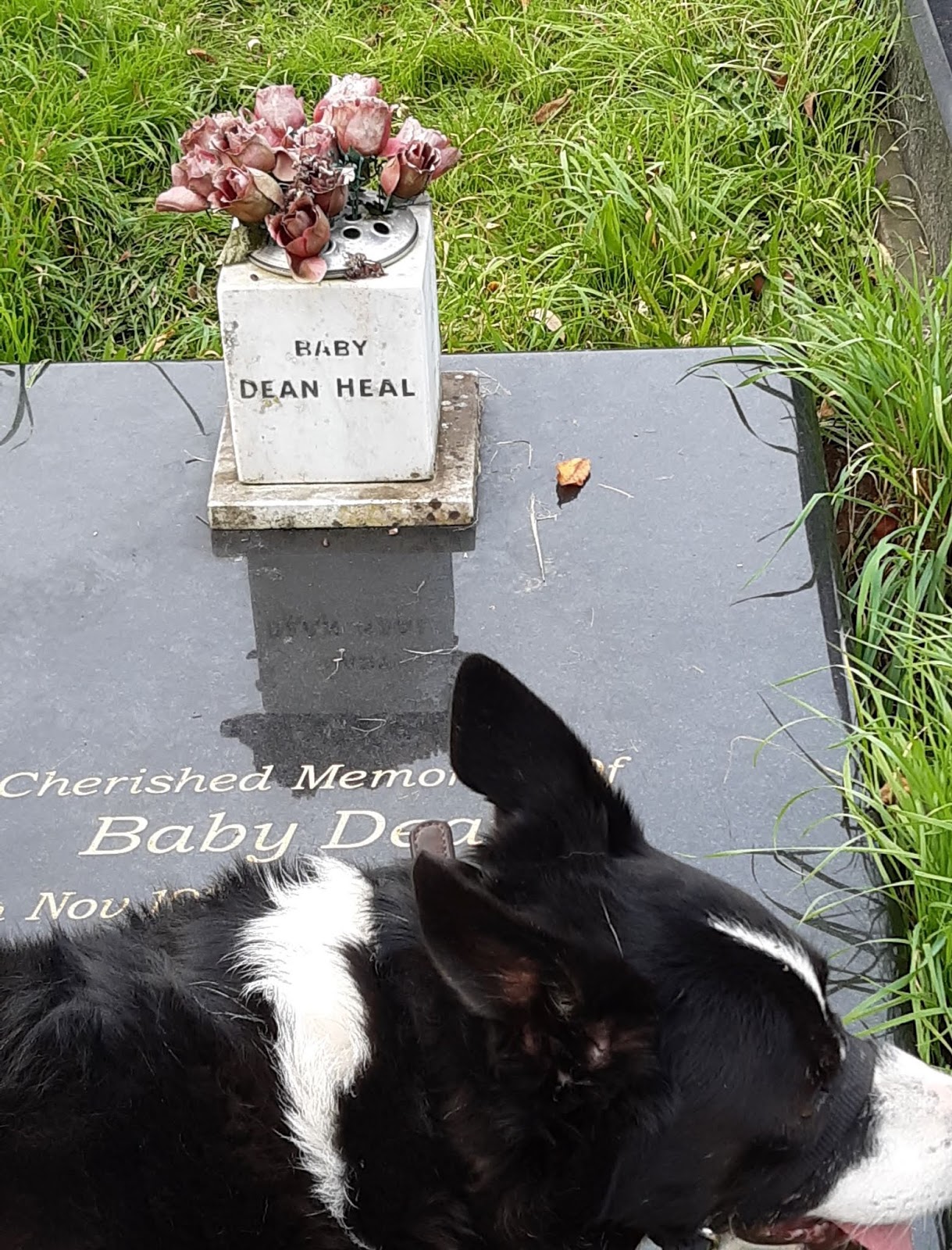
Here, at the grave of Baby Dean, I was reminded of U A Fanthorpe's Christmas poem, The Sheep Dog, the eponymous hero of which is left behind to guard the sheep while the shepherds heed the angels' bidding and go to the stable. I had to stay behind wi' t'sheep. Pity they didn't tek me along too. I'm good wi' lambs, And the baby might have liked a dog After all that myrrh and such.
Real roses on an old grave gave me pause until I realised I was at the graveside of George Müller, adopted son of the city and its benefactor.
For all that is it wild and beautiful, a delicate balance between nature and artifice, there's also a palpable atmosphere of anguish in the cemetery, and by now I was beginning to get the collywobbles, so I decided that was enough for one day.
According to this article I'd read, Lord Byron invented 'wild swimming' on 3rd May 1810 when he swam the Hellespont from Europe to Asia. Though our ancestors swam in rivers and ponds for centuries before tin baths became commonplace, to get clean and probably for fun too. 'Oh, Mum,' scolded Offspring the Eldest. 'Don't you know something only starts to exist when a posh boy does it for the first time?' The posh boys at hand were wetsuited and occupied the whole of the narrow river beach. We sat down by a patch of goldenrod and waited for them to move on or even just up a little. From time to time they looked as if they were getting ready to leave but then started to jump in and out again. Even their sploshes had posh vowel sounds. In the end we left before the whole afternoon was lost to resentment and ill-wishing.
On the way down we'd been diverted through Stanton Drew following an accident on the A37, and it transpired that Offspring the Eldest hadn't visited its famous stone circles, so we stopped off there on our journey back.
Stanton means Stone Town. The last time I'd visited was with my then neighbour, Cathy. I'd taken my Collected Poems by U A Fanthorpe with me and read the poem 'Stanton Drew' aloud, to her and the stones and the sheep.
Two days later U A died.
There's an argument to be made that you should always carry a copy of U A's poems with you, in case of unexpected happenings like an ad hoc visit to Stanton Drew. I'd overlooked this eventuality, however, and was poetryless.
In any event we weren't on our own. Instead of sheep, there were heifers in the field, and at the entrance, a father trying unsuccessfully to get his two children to smile for the camera.
As we approached the stones, the father caught me up. 'I'm so glad you're here,' he said. 'My two kids wouldn't walk past the cows till they saw you do it and live to tell the tale.'
We watched them running, laughing, climbing and striking poses. They don't know yetthat it's the stones that have the power. We were glad to have facilitated this first encounter, however ...
... since it's good to get up close and personal with the stones. Listen to the past's long pulse, as U A says ...
... even if you can hear the traffic on the B3130 and an aeroplane coming in to land at nearby Lulsgate Airport at the same time.
Maes Knoll
U A Fanthorpe's poem about Stanton Drew invites the listener or reader to remove everything from the landscape that wouldn't have been there when the circles were created.
Since I was there last, a couple of beautiful dead trees have disappeared.
More will grow up and grow old and the stones will outlast them.
And so to High Wycombe where Daughter no 2 was moving across town. I suppose the name of the place should have been an advance warning, but my poor arthritickal knees did find climbing flights and flights of stairs of houses built into steep hillsides whilst ferrying various boxes of possessions to and fro quite exacting. I think the new abode will be OK, though, as while the man from letting agency was going around with the inventory, I watched a red kite circling over the houses opposite. Has to be a good omen. Unless you are a vole or something. Driving off piste down country lanes in the early hours of this morning - two sections of the M4 westbound were closed completely for roadworks and no one had bothered with diversion signs, of course - I was struck by the fact that although I had no real idea where I was, even in the dark there were indications. Admittedly the banks of snowdrops could have been anywhere, but red brick and thatch (so different from Devon's cob) spoke loudly of rural Wiltshire, and when I saw how much gleamier the soil of the rougher tracks were, I recalled the etcher Robin Tanner's love of the old chalk roads of that county. Isn't it wonderful how places wear their vernacularity even in darkness. And if that word doesn't exist, it should do. Anyhow, it reminded me of the poem 'Earthed' by U A Fanthorpe, which she describes as a love poem to the various places she'd lived in England. I've blogged about before but I love it so here it is again.
I visited M Shed today with my cousins, Joy who lives in Thornbury and Sandra who flew over the week before last from New Jersey on a blizzard-defying visit prompted by the launch of my book, Dart. Neither had been to this comparatively new museum before, so it was quite high up their List of Places to Visit.
I like the upstairs part of the museum better than the ground floor, as it contains more about the lives of people living in this city. I have to say that as a novelist engaged in research, I need more detail than any museum could hope to include amongst their displays, but as a poet, there are plenty of telling details at M Shed that spark the imagination. For instance, I'd forgotten that we used to call the bits of surplus cooked batter which we often had scrumps; a story about Paper Sal, a newspaper vendor in the late 1800s and early 1900s, reminded me. Here she is.
Next we moved on to the exhibitions. There was one about the chocolate-making industry in Bristol, which made me feel very nostalgic (we used to get Frys misshapes very cheaply when I was a child, from someone my father knew) and one entitled Revealing Stories, about the experiences of lesbian, gay, bi and trans people living in Bristol. This second exhibition is long overdue and was by far the most interesting of the day's displays. It was good to see my friend Dru Marland's story included, as well as mention of two of my colleagues who are involved in Deafab, and two of my favourite local poets, U A Fanthorpe and her partner, Dr Rosie Bailey. There were also three pencil portraits by Malcolm Ashman of Bath Artists' Studio which made my heart jump a bit, not least because I met him on several occasions last year, when he drew a portrait of me as part of the Faces {Bath} collaboration with Bath Poetry Cafe.
In the M Shed shop I was pleased to see a poem on sale there by local poet, Miles Chambers.
And there was a moment of delight when we scanned a school photograph from the 1940s and my cousins picked out their mother, my Auntie Mavis, who died of breast cancer in 1979 when she was 48 and they were 19 and 17 years old, and who is much missed more than thirty years later. It was so good to see that she is still part of our city's story.
I had a two hour window of opportunity while Son the Elder was tea partying in Salisbury today, so I bundled him out of the car and belted up the road to Stonehenge.
The facilities at this World Heritage Site are as down as heel as ever, although work has apparently started on the inordinately long-awaited 'state-of-the-art Visitors' Centre'.
You do have to wonder about the wisdom of the prehistoric people who chose this site, however - I mean, why so close to the A344 AND the A303?
Actually, considering the stones are supposed to have come from the Preseli Hills, 180 miles away, they missed a trick. They could have just schlepped them down to Saundersfoot, sailed them across the Bristol Channel, then up the Rivers Torridge and Okement and they'd only have been a stone's throw (so to speak) from Dartmoor. Which already has lots of stone circles and rows of its own. You can go up there in August and not see a soul all day. How much more atmospheric would that have been? :-)
As it is, you're no longer allowed to touch the stones, or even go within twenty feet of them. I have a clear memory of climbing on them as a very young child, and being overwhelmed by their size and age. My kids never got the chance to do that, thanks to the intolerance and spite of the loathsome Margaret Thatcher, although since 1999 there is access at the solstices and equinoxes.
I wonder if Constable or Turner would have included a No Entry sign if they were painting or sketching Stonehenge today? And where would Hardy have Tess arrested for the murder of Alec d'Urberville? In the queue for the toilets?
U A Fanthorpe ends her brilliant poem about the stone circles at Stanton Drew with the following lines: Stand inside the circle. Put Your hand on stone. Listen To the past's long pulse. And I'm tempted to say, how can you get a feel of a place when you can't touch it? And yet ... there they were, crowds of people wandering; chatting in at least a dozen different languages; listening, rapt, to their audio guides and, less attentively, to their teachers; and posing for countless photos. Everyone, it seemed, wanted proof that they'd been there, and surely they wouldn't if they had no sense of the exceptional nature of this place.
And me? Well, I was totally beguiled, even though I've been there more than a few times. It doesn't seem to matter how much you are herded and monitored, Stonehenge still works its magic. Standing before those stones in their varying configurations is like jemmying open the door to the past and realising that you are standing on the edge of a precipice. Whooooaaaa! What's this about then?
Dru and I went off on another business trip last weekend to see if we could persuade any local-ish independent bookshops to take our wares. We were hoping for more success than the last time we tried in Clevedon. In the meantime, I'd acquired a nifty grey portfolio with pockets to hold my packs (consisting of my poetry collection, Communion; ordering information; a photocopied review; and a large postcard with contact details) rather than stuffing them haphazardly into my trusty brown bag. I felt almost professional. First stop, Sodding Chipbury (as it is affectionately known in these parts). An inordinate number of gift shops but no book emporium. Dru and I got the feeling that it was trying to slip under the radar and into the Cotswolds, but it would need A LOT MORE antiques shops to do that. And at least some of those wonderful slate tiles like fish scales instead of ridged clay ones.
On then to Wotton-under Edge, stopping off en route at Hawkesbury Upton. We liked the look of the Church there with its solid fortified tower but we couldn't get inside because it was locked. Never mind, the churchyard was interesting. I loved the grave above, with new life and the Shadow of Death. Or rather Dru. And the Morris Traveller looking oh so picturesque. (There - in front of the church, cunningly disguising itself as a yew hedge.) Joy of joys - a bookshop in Wotton (which, incidentally, is one of my favourite small towns in the area - a proper place with proper shops, the only blot on the landscape being the inevitable Tesco Express on the high street. If I never get to move to Dartmoor, a cottage in Wotton would soften the blow a little). Only the bookshop was shut for lunch from 1pm to 2pm. We looked at our watches. Five past one. We would have to return later.
Our next stop was Nailsworth, en route to which we passed more snowdrops, these as tall as wild daffodils. We knew there was definitely a bookshop in this pleasant little town and yessssss, it was open. The woman inside was very friendly. She told us that Jenny Joseph lived locally and was a frequent visitor - definitely old enough now to wear purple, but in fact she generally dressed in tweed. And she was interested in my poems except the shop owner, a man called Hereward Corbett, was in the sister shop (also called The Yellow-Lighted Bookshop) in Tetbury and maybe we should go up there. 'He's very nice,' she added, as I lugged my still heavy portfolio back out to the car.
Tetbury had been on our list of places to visit anyway, so it was back into the Moggy and off south-east to Poshville. Once there, one of the first things we saw, parked outside the ladies, was a four-wheel drive belonging to a window-cleaning business. It was emblazoned with the name 'Suty and Sweep', with the addition of a picture of a man in blackface. Dru and I were affronted and appalled, and made a lot of sweeping generalisations about rich bigots in the countryside. But the shop was lovely with wooden shelving and a squashy sofa to read on and no Costa Coffee outlet at the back, just more books. Hereward was indeed very friendly and he took two of my packs, one for Tetbury and one for Nailsworth, and said he would display the postcard prominently, which was very kind of him. (I reckon it was the commendation from Hugo Williams on the back cover that swung it.) Unfortunately he didn't feel that there was a market for the books Dru had brought with her, which were all to do with Bristol. Seems Tetbury isn't that local after all.
We had time to spare so we popped into the church, a 18th century rebuild on the site of an earlier mediaeval church. It felt very light and airy inside, thanks to the large expanses of window and the incredibly slender steel coloumns clad in painted wood. It had no darksome mystery, though. (I like darksome mystery.)
Outside, however, we saw this amazing gravestone, the lettering inlaid with moss as precisely as marquetry. Can't quite believe it didn't have a helping hand from a member of the congregation. Very beautiful. Returning to the car park, we saw the owner of the offensive window-cleaning vehicle clambering back in, looking very cheerful. He was black. Back, then, to Wotton and the Cotswold Book Room, which was now open. Again the woman behind the counter took a pack, although she said it was her sister who decided which books to stock and they didn't sell much poetry. 'Not even U A?' I asked, aware that the late, much lamented U A Fanthorpe had lived in the town. 'Oh, we do stock her,' the woman conceded. 'In fact, we sell a fair bit.' I should think so too. Then the drive home via Charfield and Winterbourne. An altogether more successful day for me than the last time we ventured forth. I'm really looking forward to when Dru has drawn her map of the three hares churches on and around Dartmoor - what a perfect excuse for more and rather longer jaunts in my favourite landscape,




.jpg)
.jpg)


