Normally, when people ask me what I did on the weekend - polite younger colleagues, mostly, who actually get up off the settee and go places - I can't think of anything much to say, or worse, can't remember. Erm, walked the dog? I suggest, hopefully. Not so this weekend. It's been busy and memorable.
.jpg)
Saturday was a Twelve Red Kite Day. This is number 11, which flew over my daughter Jenny's friend Jenny's wedding to Michael in Swallowfield, Berkshire. (Lots of red kites up there.) (Have I mentioned before how much I like them? I think I probably have.) Even without taking the kites into consideration, it was the loveliest day.
Today it was back to poetting in public again - not something we've been able to do much of these last couple of years. This morning's poetry walk with the IsamBards through some of the more hidden parts of old Bristol was part of this spring's Lyra Poetry Festival. Unfortunately, Pameli Benham couldn't join us as she had to self-isolate prior to a medical procedure that had been brought forward unexpectedly, but between us, Dominic Fisher, David Johnson and I managed to read her poems as well as our own, so that she was with us in spirit.
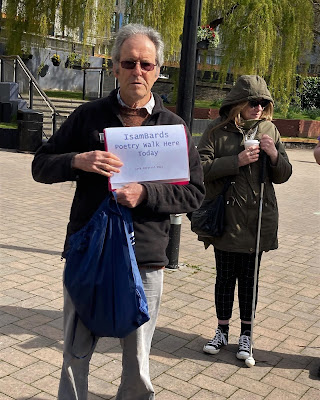
Our starting point for the walk (and the poems) was the Haymarket, in the sunken roundabout that has been known since the 1970s as the Bear Pit (not that there was ever one there - you need to have visited Bristol Zoo before the end of the 1960s to have seen one of those in these parts).
Here David regaled us with what did happen here in past centuries - notably, St James's Fair, which, come to think of it, almost certainly would have involved a bear or two - while Dominic meditated on the subject of lunchtime drinking, and I observed how cities change all the time, even if it's just people taking down their bean sticks.
We then proceeded to St James Barton, which was rather more peaceful.
David read Pameli's poem about The Bristol Giant, who was actually Irish and called Patrick Cotter, while Dominic read his poem about Charles Wesley, whose wife, and the five of his children who predeceased him, are buried near here.
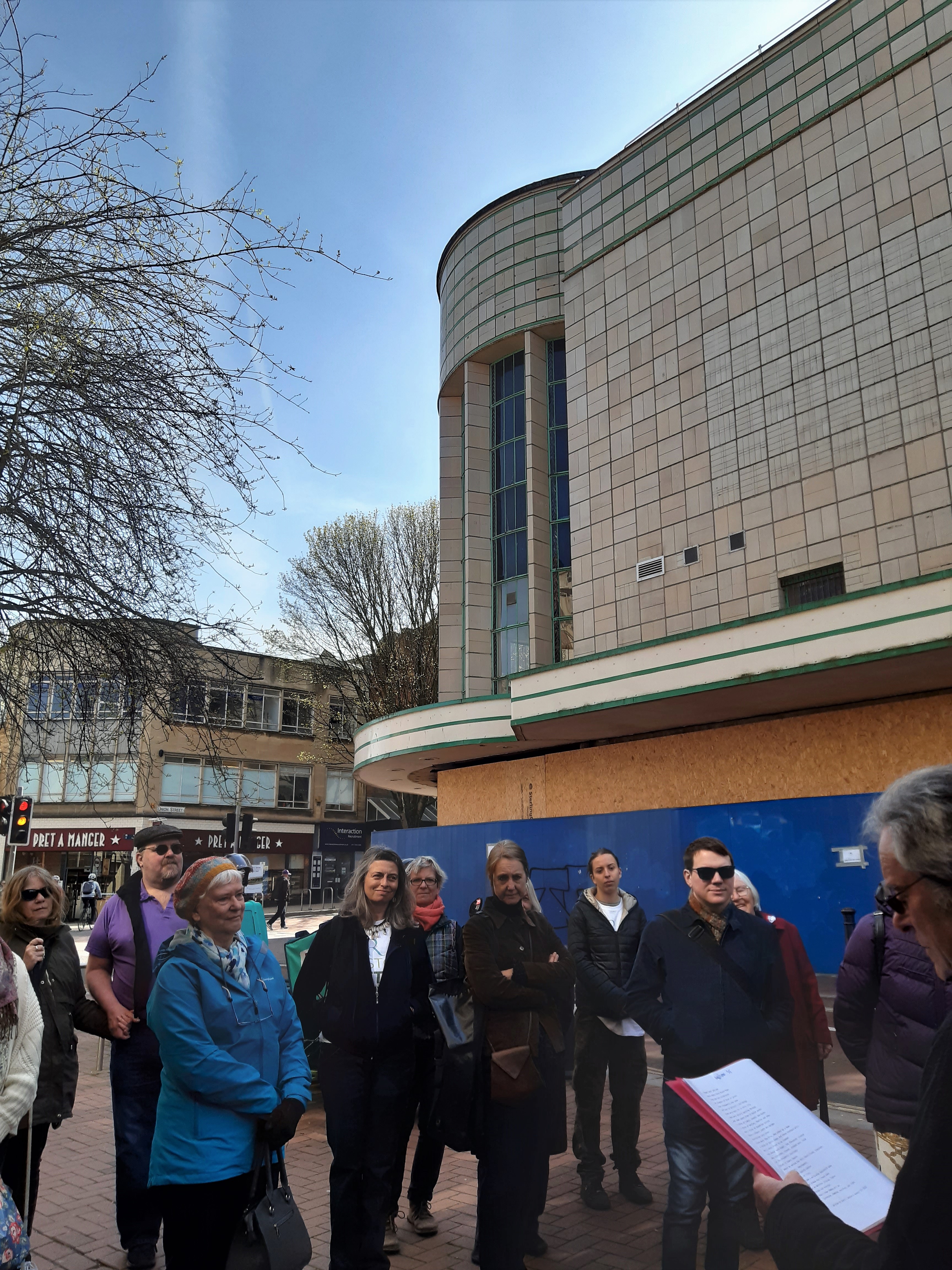
By the Art Deco Odeon, I read Pameli's poem about entrepreneur Oskar Deutsch, a Hungarian Jew who opened 258 cinemas around the UK in the space of 10 years, and David pondered/contemplated/mused/ruminated on why Peter Mark Roget's stay/sojourn/residence/stop over in Bristol from 1798 - 1799 isn't yet commemorated/memorialised/remembered/observed with a blue plaque.
At the junction of Nelson Street and All Saints Street, we paused again in the doorway of what used to be a bank but is now something involving bowling. Being a Sunday, it wasn't too noisy, but even so there was a need to project and gesture a bit too.
Here, we learnt about the people, and the river, buried beneath our feet, courtesy of Dominic ...
... and I read my poem about the 15th century topographer, William Wyrcestre, and how his record of Bristol offers up occasional glimpses of a much older city.
The next section of our walk took us up St John's Steep and along John Street to Hasardysgarden, the churchyard that belonged to St John the Baptist's Church, also known as St John on the Wall. Here I read a poem about the tailors who used to play dice there before it was consecrated in 1409. We then moved on to Broad Street for poems about Edward Everard Printing Works, the steeple of St John's and the street art of two Civil War-era duellists.
My favourite bit of the walk was through the lanes that hug the ancient city wall, very little of which remains. Having traversed Bell Lane, we paused again in Small Street for poems from Dominic about Coleridge on the hunt for his publisher friend, Joseph Cottle, and St Leonard Lane, and one from me about the Flemish weaver, Edmund Blanket, who died in 1371 and is buried in St Stephen's Church.
We were now a short step from the city centre, where David mused on the changing city and I told the story of my great-great-grandmother Mary Block and the day her ship came in.
Our walk ended at the empty plinth where the statue of Colston once stood, and I'm pleased to say, there was absolutely no nostalgia for him or regret about his long over-due removal from anyone present.
I read my poem about this righting of this shameful wrong, and a second about Pero Jones, the slave for whom the footbridge spanning St Augustine's Reach beyond the Centre is named.
All that was left was for David to read the final poem, Pameli's 'In the centre of the city', and a little chit-chat and book-selling before we returned home, full of the sunlight and salt air of the city we're passing through during this lifetime.

.jpg)




.jpg)


