About Me

My photo
Bristol , United Kingdom
Poet and poetry facilitator. Neurodishevelled. My sixth poetry collection, Love the Albatross, is available from Indigo Dreams or directly from me.
Showing posts with label Celtic cross. Show all posts

Tuesday, 6 June 2023

Major fun in Llantwit

Solidarity with everyone on strike, especially the rail workers. Last week it meant driving several return trips to Cardiff to get the Northerner to work, and on Wednesday I decided to stay in Wales and make a day of it. 

I'd already walked a fair bit of the Glamorgan Heritage Coast, betimes with Son the Younger and our old collie, Ted, more recently with Cwtch. This time Cwtch and I decided to explore the area around Llantwit Major, starting at Cwm Col-Huw beach. 


Looking west towards St Donat's


Looking back to where the river flows through a gap in the cliffs onto the beach

I'd checked before our trip and found the beach described as dog-friendly; it was only when I got back home that another website informed me dogs were banned from May to September; anyhow, we didn't get told off or escorted from the area,  and we definitely left no trace.


After we'd wandered down to where the River Col-huw meets the sea, we made our way back to the steps at the start of our walk, looking for fossils on the way, but the best one we saw was far too large for our mantelpiece.


Our walk started with a climb up the steps to the path that leads inland, along the high valley side of the River Col-Huw to Llantwit Major ...


... with views looking back to the coast.


Speckled wood butterfly


The first obstacle we encountered was a picturesquely bent kissing gate, which I had a job squeezing through with my backpack on my back. There then followed a series of stone stiles the length of the walk, but which I'm posting pictures of now. Needless to say, Cwtch is now a dab paw at scrambling over them. 
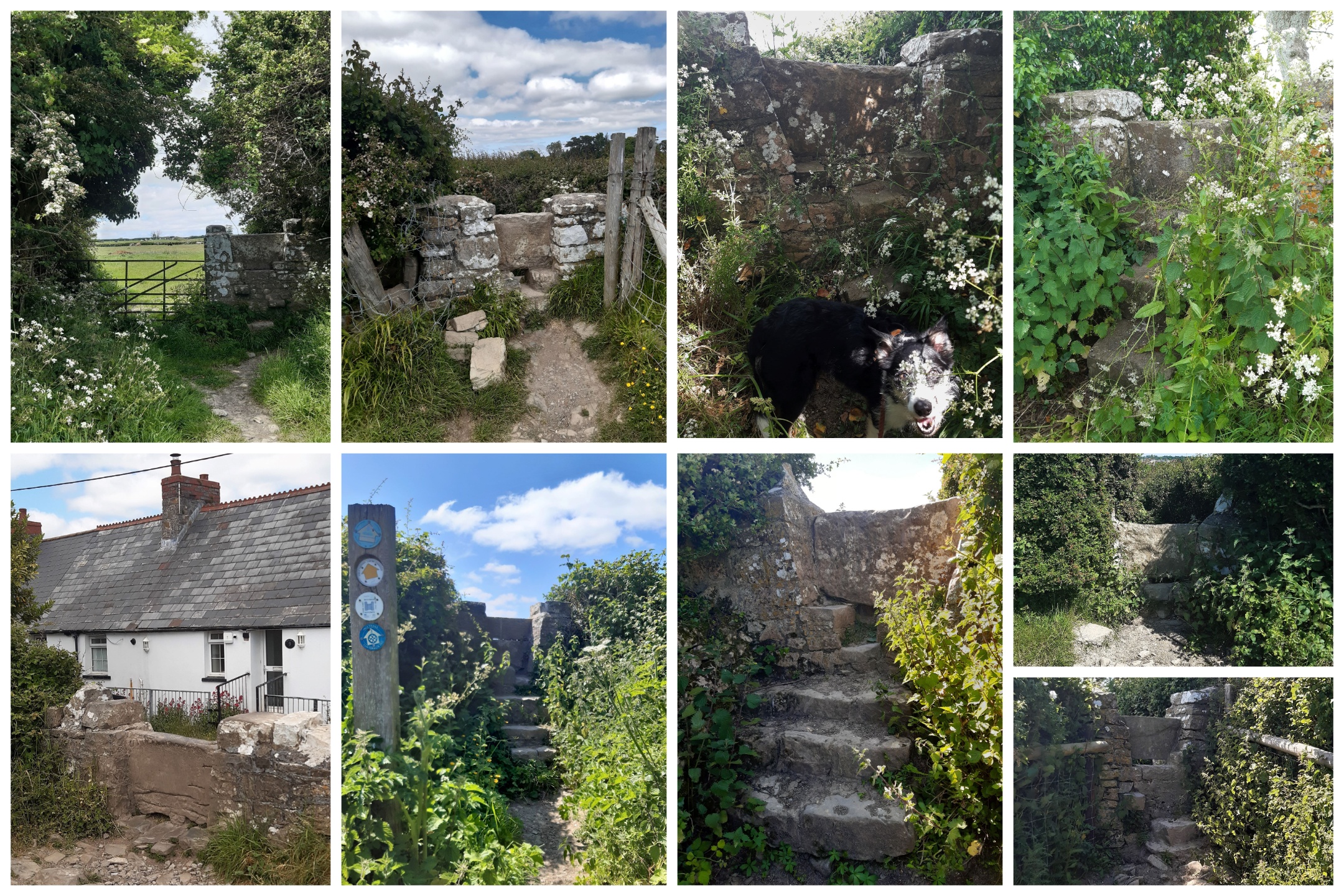


We then walked along the narrow and appropriately straight path called Church Lane. Cwtch was very interested in some sheep we passed. They remained unimpressed. 


A 13th century dovecote


I'm making an exception for this stile and posting a larger picture of it because I love how worn the stone steps are, how much use it must have seen over centuries.


Ogney Brook by St Illtyd's Church


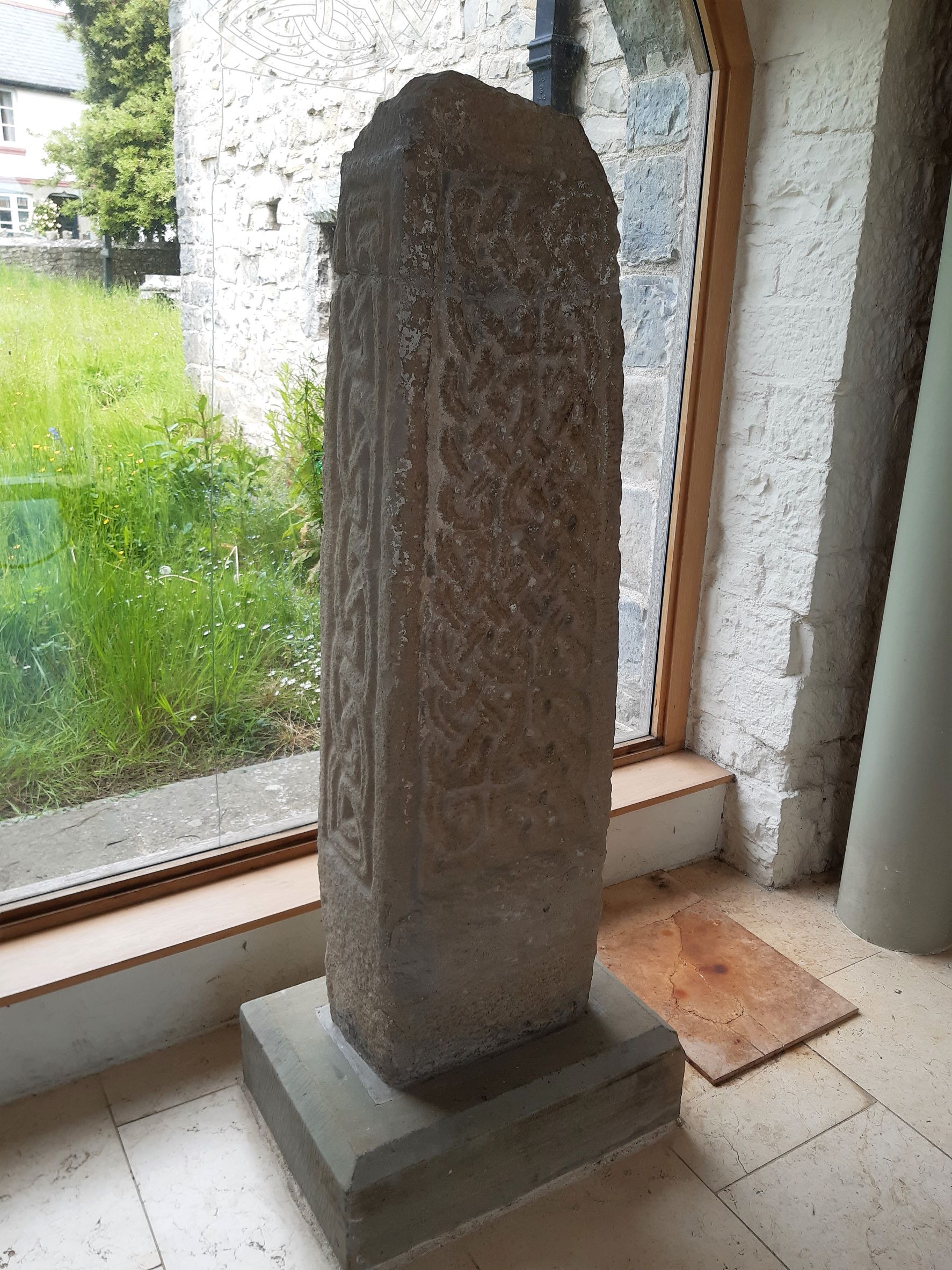
The 9th and 10th century Celtic Stones housed in the Galilee Chapel


Unfortunately, the floor of the church was being stripped, so it wasn't possible to get right inside and have a proper look at all of its treasures. I did get a glimpse of some of its mediaeval wall paintings ...  


... the Norman font ... 


... and a couple of its effigies, but I'm really going to have to go back for a proper look, maybe when the dog beach ban ends in October. (Sadly, I expect the railway workers and train drivers will still be on strike, unless we get a change of government.) 


Incidentally, Llantwit Major has been targeted recently by far-right activists trying to foment discord over a nearby refugee facility. Good to see the town resisting by offering them Welsh cakes. Seems like a sound place.


Mediaeval preaching cross in the churchyard


Leaving the church, we retraced our steps to the mediaeval grange, which included the dovecote we saw on our outward journey. The grange belonged to Tewkesbury Abbey from the early 12th century to 1539. 


Our route then took us back to the coast over a series of stone stiles between fields. At one point I heard a roll of thunder, which turned out to be a herd of very curious, very persistent cows. 


chamomile


Back by the sea there were more sheep, these waiting to be sheared in the ruin of Sheeplays Barn.


After a short stretch skimming a wood, our path took us back along the edge of the cliffs to the beach, where we were careful not to get too close to the crumby edge or tread on this Lackey moth caterpillar.


Back at the car park, a final glance up the beautiful Col-Huw valley and it was time to head for the horror show of the M4 and Cardiff on strike day. We'll be back.


Tuesday, 18 February 2020

Tail Feathers from Storm Dennis

The plan had been for Son the Younger and I to drive separately to his garage in Newport, leave his car there for servicing and head to Llantwit Major for a walk, but Storm Dennis put paid to that. It also nearly put paid to me when my windscreen wiper motor failed during a ferocious squall on the M4. It took me about five minutes to prise my hands from the steering wheel once I reached my destination.

The worst of the rain having passed, I ordered a new wiper motor from eBay, booked my car into the garage on Friday, and drove to Llandaff with Son the Younger giving the wipers a helping hand, as necessary, through the passenger window. We detoured around a few places from our past, and then visited the Cathedral. Unlike me, it was the first time StY had been back since his grandmother's funeral 14 years ago.


The Rossetti triptych


Sir William Mathew (d 1528) and his wife, Lady Janet/Jenet


The Celtic cross is the only surviving remnant of the first church built on the site in the 6th century. It was rediscovered by the then bishop of Llandaff in 1870, 'embedded in the back wall of the shed over the Dairy Well'. 


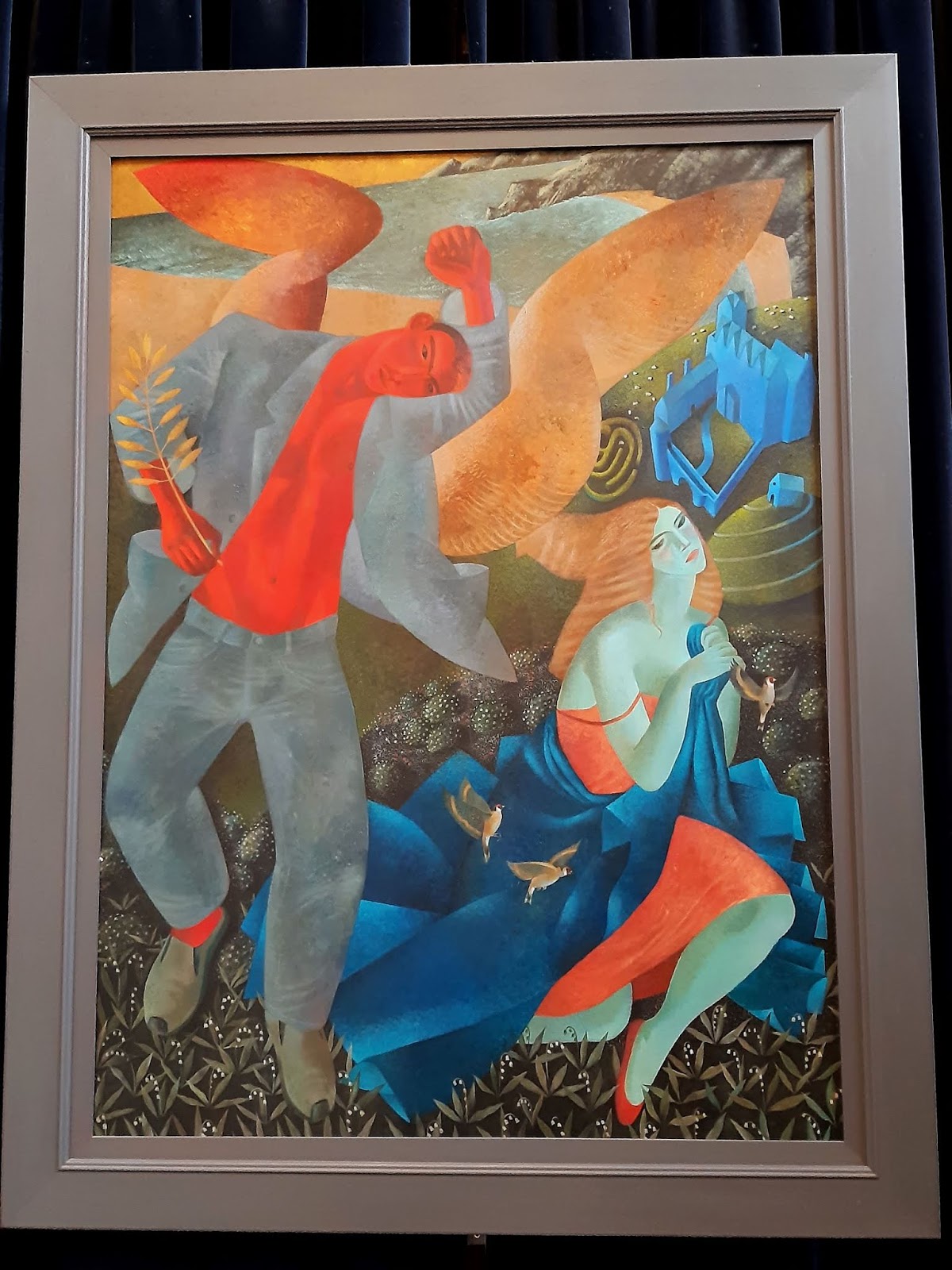
I really like the newly installed painting 'The Virgin of the Goldfinches' by Clive Hicks-Jenkins, though Son the Younger said it reminded him of 'The Green Lady', a copy of which used to hang in his great-aunt's house.


The font at Llandaff has had a chequered history. The one in service during the civil wars was appropriated as a trough for pigs by a local Puritan, who also set up a tavern in the Cathedral and penned his calves in the choir. The predecessor to this one, which was designed and sculpted in 1952 by Alan Durst, was destroyed by the parachute mine which caused such damage to the cathedral in 1941. 


We headed on to the newly revamped Welsh Folk Museum at St Fagan's, which neither of us had visited in years. (That's not what it's called any more, but old habits die hard.)
I was excited as they'd moved and rebuilt a mediaeval church, complete with wall paintings, since I'd last been, but first we stopped off at my favourite of all the buildings there, the Kennixton farmhouse from Llangennith on the Gower, which was built in 1610 and re-erected at St Fagan's in 1955.

Red paint to ward off evil spirits


I've always wanted a bed like this. Well, maybe I'm too old and arthritickal for one now but I would have loved one years ago. 


Outside it was raining again. We headed for the reconstructed Iron Age hut but the path was closed,  so we visited a couple of other places and then made for St Teilo's, upon the wall of which a robin was singing loudly. 


The exterior is amazing. You have to boggle at the feat of planning that involved numbering every stone so that it could be reassembled correctly, over a period of 20 years. 


Forty percent of the original wall paintings were discovered under plaster, and I'd been looking forward to seeing them in situ, since miraculously, they were able to be moved, but apparently they are in storage. Instead, the interior has been painted to recreate how it might have looked pre-Reformation. 


I can understand why the curators might have decided to do that, but I was left longing for the atmosphere and authenticity of St Cadoc's Church in nearby Llancarfan.

13th century font


Over a lunch of Welsh rarebit in the cafe above the hardware store, we studied the weather forecast. Another belt of rain was due to pass over the area at 3pm, so we decided on a quick skip around our other favourite buildings and a leisurely return on a more auspicious day.


Llawr-y-glyn smithy


One of the terraced cottages from Rhyd-y-car


The communal bread oven from Poplar Place, Georgetown


The cast-iron urinal from Llanwrtyd Wells

We still have three of these in Bristol, Grade II listed and no longer in use but still in situ.


I like the prefab from Gabalfa and wondered aloud if a modern version that complied with building regulations might be an affordable solution to the housing crisis, but the guide explained that a prefab takes the same amount of land as two three storey town houses. 


The library of Oakdale Workmen's Institute has exactly the same computer system as our local library when I was a kid. 


The toll house from the southern outskirts of Aberystwyth


Maestir school, complete with stove and canes 

A traditional slate fence, reminding me of Ernest Gimson's Cotswold stone slab fence at Kelmscott


Two minutes of the softest drizzle smudged the windscreen as I drove back through Almondsbury interchange and I flicked on the windscreen wipers more in hope than expectation. They managed just one curmudgeonly sweep, but that was enough to see me home in crystal-clear style. Roll on Friday.