About Me

My photo
Bristol , United Kingdom
Poet and poetry facilitator. Neurodishevelled. My sixth poetry collection, Love the Albatross, is available from Indigo Dreams or directly from me.
Showing posts with label Mells. Show all posts

Sunday, 11 February 2018

A Jaunt to Nursery Rhyme Land

February is a rather exacting month for church-hopping, what with the cold and the dark and the general deathliness of it all, but there I was in north-east Somerset with a few hours to kill (ahem) so that's what I ended up doing. 


First stop, Leigh-on-Mendip, at the eastern, less familiar end of the Mendip Hills. The church there, St Giles, was originally a Chapel of Ease for nearby Mells and was completed around 1350. 


Its dimensions are narrow and high, but it also feels cosy and intimate, even on a drizzly grey day. 


I loved the scraps of mediaeval glass in the windows (this the Great West) ... 


... and the original, late 14th century bench ends ... 


... and oh! that magnificent tie-beam roof, with its beautiful carvings.  


This was my favourite thing, though. 


Leaving Leigh-on-Mendip, I headed four and a half miles up the road to what was perhaps the main attraction of my morning's itinerary, Holcombe Old Church.


Because how could I resist visiting an ancient church, far from any village, with the sobriquet The Plague Church? 


Though actually there would be no going inside, as I didn't have time to seek out one of the several keys being held in the rather distant village of Holcombe.  

But it didn't matter. I was interested in the story of the old village which was buried and abandoned in the 1660s when the Great Plague arrived.
It's under these humps here, apparently. 

There are assertions online that Holcombe is where the nursery rhyme 'Ring a ring o' roses' originated. 


Hmmm. My book of the origins of folk rhymes has debunked the debunking of the song as having anything to do with plague - there are pneumonic forms too, you know - but it would be good to have even a shred of evidence linking the rhyme to the village.


Maybe, thought I, the villagers claim this because the nearby village of Mells is supposed to have a connection with the rhyme Little Jack Horner. Anything they can do. Yes, that must be it. 


The Norman arch and worn steps of the porch


Upsidedown? Back-to-front? Partially Greek?   graffiti with serifs in the doorway


This is the grave of Widow Joan ? who was buried in April 1666. I wonder if she died of the plague.


Grave of Bessie Pole, aged 10; Clifford Pole, aged 8; Thomas Pole, aged 7; Eveline Long, aged 11 and Ewart Long, aged 8, who were drowned in a pond in this parish 'by the insecurity of the ice, Dec 20 1899' ...


... also of Harcourt Morely Long, who was drowned at Kilmersdon Common, July 27 1894 aged 14 months, and was buried in this churchyard. 


It was raining quite hard by now, so I gave up my attempt to find the family grave of Robert Falcon Scott and headed instead for the Church of St Peter and St Paul in Kilmersdon ... 


... which boasts a lych gate by Sir Edwin Lutyens. And very lovely it is too. 

Unfortunately the man who'd been doing in something in the church was leaving just as I arrived, so I didn't get to look inside. 
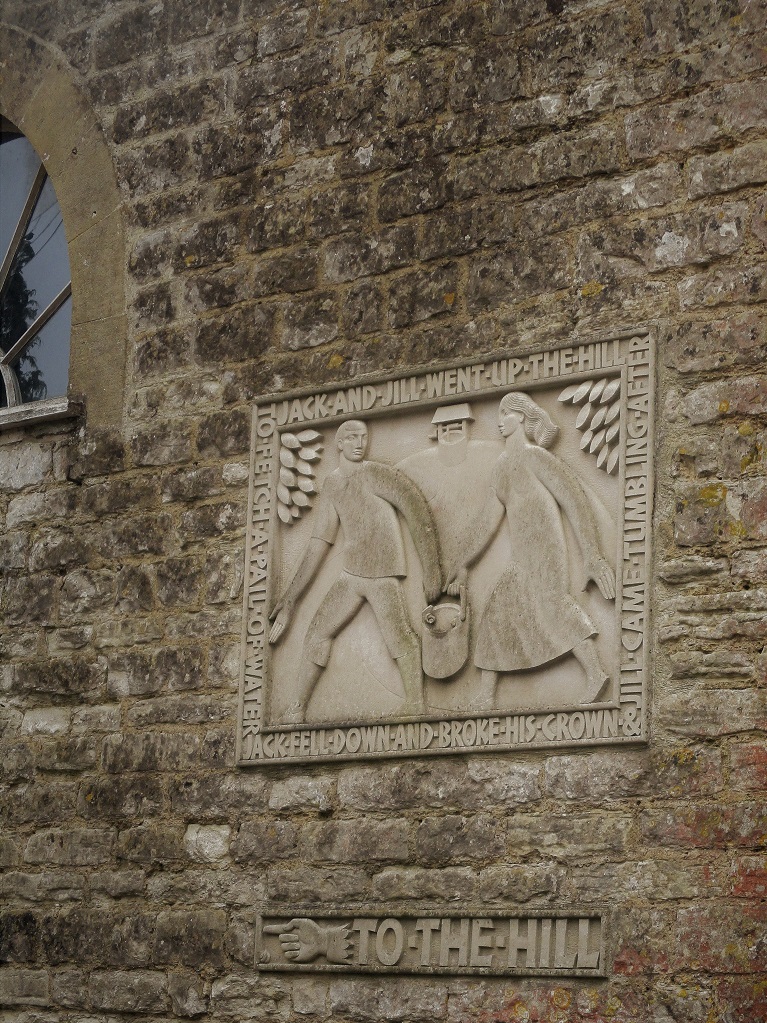
No matter. I'd spotted something interesting set into a nearby wall ... 

Blimey! Another nursery rhyme!


So, the story here is that in 1697 a local unmarried woman (Jill) fell pregnant. Shortly afterwards, the presumed father (Jack) was hit by a stone from Badstone Quarry (Very Badstone for him) and died. Jill had her baby but naturally she died not long afterwards too, the harlot, and the child was raised by villagers. It's said this is where the common local surname Gilson comes from. 


Being short of both time and vinegar and brown paper, I decided not to climb the hill. That can wait for another day. 


Sunday, 7 April 2013

Love is Metaphysical Gravity

And so to the lovely Somerset town of Frome to deliver leaflets for the fast-approaching Bristol Spring Poetry Festival.  But first a stop off at Mells, for a  spot of obeisance at the Edwin Lutyens-designed bus stop and the tomb of poet Siegfried Sassoon.  The Burne Jones embroidery which was away being restored the last time I visited the Church of St Andrew was back in situ and looking resplendent.  

Amongst the beautiful and achingly tasteful headstones of various Horners (of Little Jack fame), Asquiths and Bonham-Carters, I noticed for the first time a couple belonging to the O'nions family.  Couldn't help smiling.  I'd much rather be earthy, multi-layered and really rather pungent Mrs Onions any day.  

In the Walled Garden there was poetic delight in this quote from a poem by Pablo Neruda: I want to do with you what spring does with the cherry trees


Next, a quick tour of Frome, taking in the Merlin theatre and then the town centre - always a delight, but even more so on a beautiful sunny day when disseminating news of the forthcoming poetic feast just up the road in Bristol.

Finally, a leisurely lunch in  the George Inn at Norton St Philips. Nice work if you can get it. 


Friday, 11 January 2013

A New Year Jaunt Part II: Mountains and Molehills

Stepping back out of St Ishow's Church into the churchyard, you are again swept up in the magnificence of the Grwyne Fawr valley.  It hasn't changed while you've been inside, it's just that you were so beguiled by the artifice of human beings, you forgot Nature's genius. 

Here's a reminder.


I loved this sheep with a black spot on its bum. 


The Churchyard was stuffed full of interesting gravestones.  I particularly liked this fallen angel with molehill ...
... and this spelling mistake, spotted by Dru.  
Oh, and this headstone also: A Man is born to dye
One thing that struck me was the number of plain yet beautifully lettered graves which resembled those in Mells in north-east Somerset.  It's almost as if the churchyards are twinned ... 


Robin Truelove, Partrishow                      Siegfried Sassoon, Mells


        gravestone, Mells                              gravestone, Partrishow

... or maybe both villages tend to attract well-heeled arty corpses.

After a good fossick around the churchyard, it was time to return to the well, the site (so the story has it) of St Ishow's martyrdom in (it is believed) the 6th or 7th century.  It's a peaceful spot nowadays.


Of course, springs were sacred long before the Christians came, as were yews.  I took a small chunk of wood from the yew stump up in the churchyard to lay with all the other votive offerings.

This is the well itself, with a pannikin hanging on one side and niches for offerings.    


Heading for Crickhowell, we stopped to see if we could capture a photo that replicated the vision of Dru's picture.  By scrambling over a barbed wire fence, Dru just about managed it.  Meanwhile, a pair of ravens chatted to each other over head.  Perfect.