About Me

My photo
Bristol , United Kingdom
Poet and poetry facilitator. Neurodishevelled. My sixth poetry collection, Love the Albatross, is available from Indigo Dreams or directly from me.
Showing posts with label European Green Capital. Show all posts

Saturday, 6 August 2016

A Whale of a Time

After half a century plus of living in Bristol (give or take a few years of exile in the middle), it's always a bit of a thrill to find somewhere new to visit, especially when it's a nature reserve right in the middle of the city.  So off it was to one of the most affluent parts of the city, Snide Park.

OK, so it's Sneyd Park really. Snide Park is what we used to call it when we were kids, living on the wrong side of the B4054 Henleaze Road. The name has stuck - and so have I.


Look, you can tell it's dead posh by its oak-framed information board.  


The moment you leave gracious suburbia, you're in Bishops Knoll, once part of a mediaeval deer park and later, in the 19th century, the gardens of a (now demolished) mansion, complete with terraces, an arboretum, orchards, lawns and paddocks.  We stuck to the footpath through woodlands to get down to Bennett's Patch and White's Paddock, alongside the River Avon, being inspected all the way down by a persistent Southern Hawker


Being next to the river means it's also alongside the Portway, one of the busiest and fastest roads in the city, and the Severn Beach line - between the two, in fact, and very noisy. But I have a handy trick for dealing with that, which is to pretend the traffic is the ice-age torrent that originally carved the Gorge. That way it doesn't impinge after a while. 

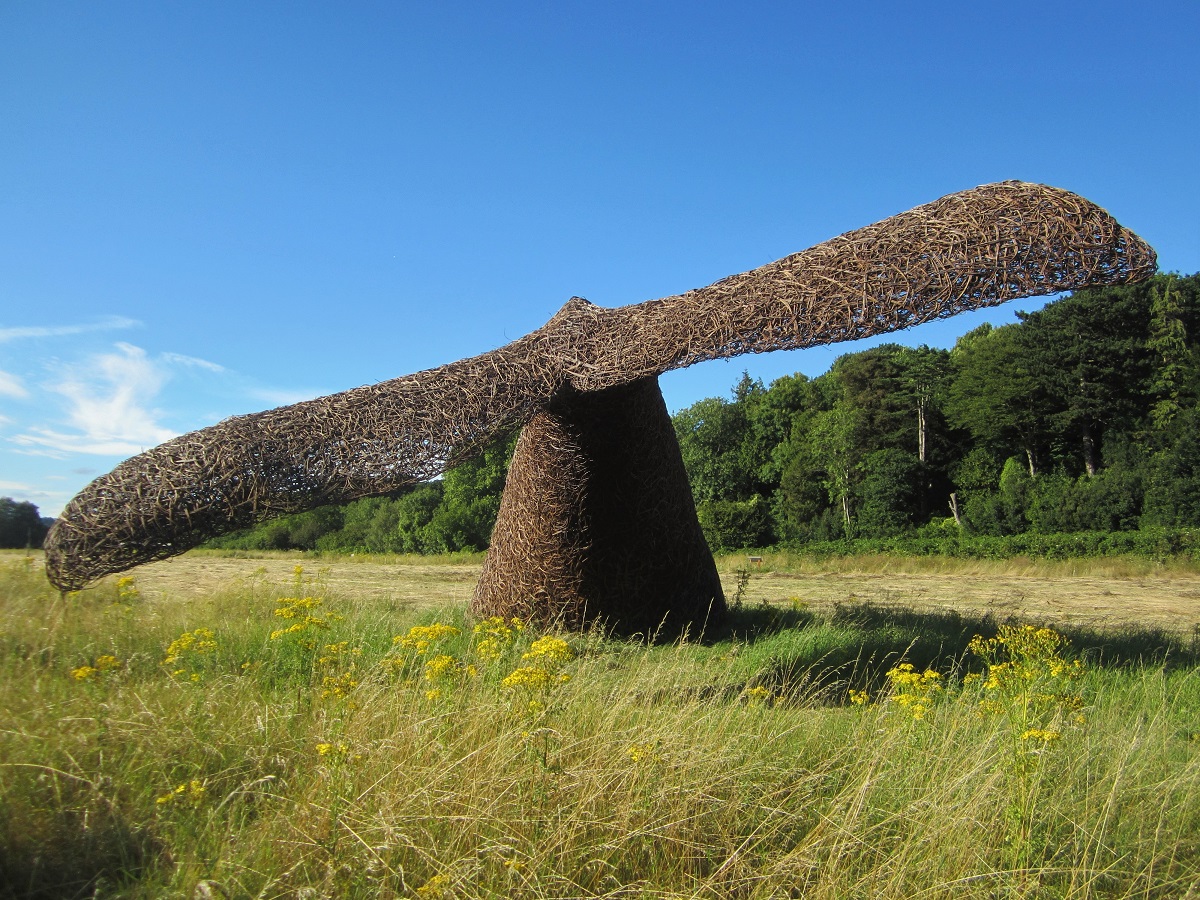
Our reason for coming here was to see the whales in their new home. Well - not real ones, obviously; rather, the wicker ones designed by Cod Steaks, which graced Bristol during the city's stint as European Green Capital (back in the halycon days before our ex-Prime Minister asked a stupid question and got a very stupid answer). 


Here they are in their sea of plastic bottles in Millennium Square, exactly a year ago.


And now they are surfacing in the city's newest nature reserve. 


It's an appropriate place for them to find a home because in 1750, the ship Adventure brought back two whales, which were rendered to blubber just up the road at Sea Mills Dock. The venture into the whaling trade continued for almost 50 years.


They remind me quite a lot of the beached barges at Purton near Sharpness, which we went to see just over three years ago.
Instead of going back over the railway bridge, we walked down to the tunnel that goes under the track. 
Being a geek, I was excited to spot a brick from the old Cattybrook Brickworks near Almondsbury - one of those names I hope to fit into a poem one day. 
Then one last glimpse of the whales through the trees and home. 


Wednesday, 30 September 2015

Highlights of Bristol Poetry Festival 2015 (so far ... )

A review for the local paper: 

Kei Miller/Liz Berry/Fiona Benson
Hailing Foxes/ Waterwoven/Rachael Clyne                       Bristol Poetry Festival


As I write, Bristol Poetry Festival is drawing to a close following a glorious fortnight of readings at venues in and around Bristol.

From the hugely popular Bristol Poetry Slam, where the cream of the West Country’s performance poets battle it out on stage, to smaller, low-key gatherings in cafés and the back rooms of pubs, poets and lovers of poetry have been coming together to celebrate our national art-form.

The flagship event of this year’s Festival was the reading at Arnolfini by three of our best contemporary poets, Fiona Benson, Kei Miller and Liz Berry. Colin Brown, the Director of Poetry Can, the Bristol-based organisation responsible for organising the Poetry Festival said: ‘there were three essential poetry books published in 2014 and we are lucky enough to have the authors of those books here in Bristol tonight.’ Each poet was very different but equally distinct. Anglo-Scot Fiona Benson read poems that showed how hearts can be broken by language; Kei Miller made language sound like music; Liz Berry took us gently by the hand and led us to the place where poems come from, and it was both thrilling and beautiful – but you can’t describe poetry, you can only experience it. ‘That was wonderful,’ said one audience member as we emerged into the September night. ‘As soon as it started, it was like we were all together inside a miracle.’


Photo © Dru Marland

A special mention too for the event at Bristol Central Library, where local artist Dru Marland launched her latest illustrated anthology of poems, Hailing Foxes, a celebration of Bristol and its wildlife during the city’s tenure as European Green Capital 2015.  This delightful evening, which also included performances from Wells Fountain Poets and Rachael Clyne, saw many of the featured poets coming together to read their work. Hailing Foxes is available from Gert Macky Books and good independent bookshops, price £5.


 John Terry 


                                                            Pat Simmons

Dru Marland

                                                          Dominic Fisher


Wells Fountain Poets and Colin Brown


Sunday, 8 March 2015

The Romantic Poets and Bristol: A New 'Lyrical Ballads'

Since I broke my leg, I've only got out of bed - or at least off the settee - for poetry.  A marathon 12 hours yesterday at Bath Poetry Cafe's annual event, Voices In The City, was preceded the night before by a remarkable gathering of poets at @Bristol, under the auspices of the Festival of Ideas.  

Both Samuel Coleridge and William Wordsworth had links with Bristol, and so to celebrate Bristol's year as European Green Capital, 23 of the UK's most prominent poets were invited to respond to poems from Lyrical Ballads, for this reading and a two-part Radio 4 documentary.  

The evening began with a series of introductions including one from Mayor George Ferguson, who spoke about how the evening would celebrate Bristol and the richness of its urban wildlife.  He also mentioned the city's commitment to promoting and developing poetry, especially for children.   Then it was the turn of the poets, the great majority of whom had been able to travel in person, to read their particular poem, each introduced by honey-tongued Ian McMillan, who also read a poem of his own.  

Gillian Clarke, the National Poet of Wales, remarked that it had been a long time since she had taken an entire reading from her pocket, and indeed it was odd to see such luminaries as Makar Liz Lochead, Sir Andrew Motion, 
Don Paterson, Alice Oswald, John Burnside, Paul Farley, Fleur Adcock, Jean Sprackland, Ruth Padel and Sean O'Brien shuffle on and off the stage as if they were at school assembly.  As much as I was delighted by the opportunity to hear so many of our best contemporary poets, I wished the event had been divided into several throughout the year, so that the poets had a chance to introduce us to some of their other work, to give these new poems some context.  My guess is that it was done like this partly to create a one-night extravaganza and partly to facilitate recording, but after a while I began to feel slightly sick, as if I'd opened a big tin of Quality Street and eaten all the orange and strawberry creams, one after the other.

My favourite poem was Alice Oswald's elegiac description of a dead swan, which she'd passed on her daily walk for a month earlier this winter, as a counterpart to the rotting albatross strung around the neck of the Ancient Mariner.  It was a beautiful, startling piece and I am in awe of her fearless nose.


Other quibbles - no, actually, these are complaints - include the description of the evening as a celebration of Bristol and its urban wildlife.  In fact, the city was largely overlooked, and when it was mentioned, it was in reference to the natives' 'somnolence' or as being a place where its inhabitants 'slur their words like drunks'.  Of all the poets present, none were born in the city and only one lives locally.  As for Thomas Chatterton, our own Romantic poet, Wordsworth's 'marvellous boy', he was completely ignored.


Finally, that far from promoting poetry, as the Mayor claimed in his introduction, the city council has this year ceased its funding for Poetry Can, the lone poetry development agency for Bristol and the south-west, thus jeopardising not only its programmes of work with school children and resident, council tax-paying poets, but also the biannual poetry festivals and the agency's very existence.  I saw quite a few seething local poets exit the reading, their faces almost as red as Mr Ferguson's infamous trousers.  


  Bristol urban wildlife

Photo montage © Dru Marland