The Malvern Hills surge out of the Severn floodplain and dominate the skyline to the south and west of Worcester. For me, being hauled south on the M5 by the westering pull of my homing magnet, they are Almost Home But Definitely Not; a piece of the southernmost Midlands more mysterious and mystical for being so near and yet far far away.
Time, maybe, to make a first visit.
First, though, a quick dap around Great Malvern Priory. And before that, coffee in a convenable spot.
The bookshop is closed on Mondays and Tuesdays. Probably just as well.
The priory has a 'larger display of 15th century stained glass than any church in England', we are told. This foxed me a bit at first, on account of Fairford Church in Gloucestershire's 'only complete set of 15th century stained glass in England'. Can you get bigger than complete?
I suppose it all comes down to the size of the respective Churches.
The glass survived the Dissolution of the Monasteries because townspeople managed to raise the huge sum of £20 to buy the Priory from the Crown.
It survived the Cultural Revolution that was the Civil War because it was still surrounded by forest at this time and relatively isolated.
It survived World War II because the windows were removed and stored in zinc-lined boxes in a mine in Wales.
It didn't always survive the depredations of ivy.
Great Malvern's mediaeval glass is impressive, but for reasons of exuberance and imagination and picturesque demons and devils, I prefer Fairford's.
I fell in love with the modern, millennium windows, however, which were made by Thomas Denny and installed in 2003.
Inspired by Psalm 36 they are imbued with nature and, for me, almost pagan in feel.
The detail is exquisite ...
... and I loved the way the design merged with the surviving mediaeval glass in the uppermost lights.
But it wasn't just about the glass. I loved the mediaeval wall tiles too ...
... the wildly glamorous eagle lectern, seemingly feathered with leaves ...
... the rather severe-looking daughter kneeling at the feet of John and Jane Knotsford, where one might have expected a small dog or pet lion ...
... and the choir stall and misericord carvings.
Outside, the hills were making their presence felt. Time to get out on them ...



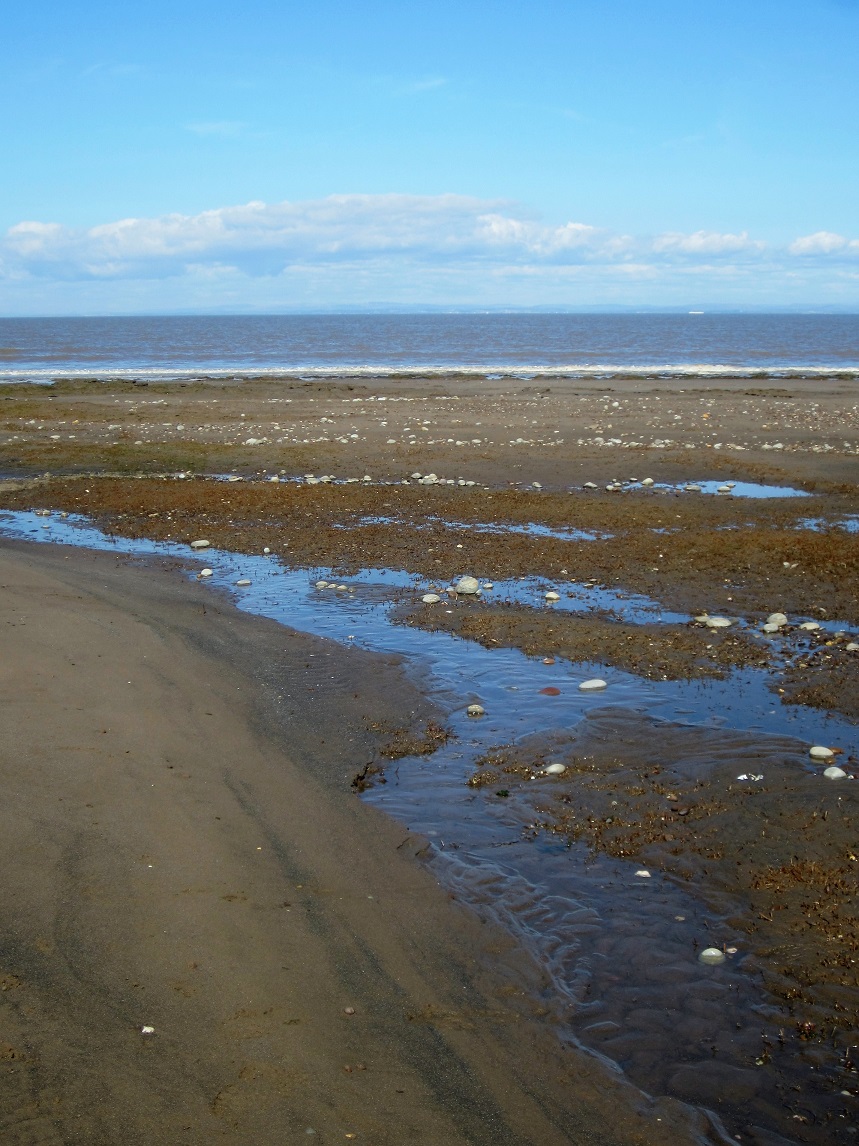
 Warning signs have been a bit of a feature lately. Steart Marshes, along with the rest of the Severn estuary, have their fair share of mud.
  Birds, too - but as usual, I'd forgotten the binoculars, and as usual, we had a barky dog with us.


 What we did see, always on the horizon, was Hinkley Point nuclear power station, soon to be joined by Point C. The madness of building such a dangerous thing on an estuary with the third highest tidal rise and fall in the world.
  For one thing, there's all that renewable energy which could be tapped.
  For another, tsunamis.
  Looking in the opposite direction, the dark bulk of Brent Knoll, with the distinctive profile of Crook Peak behind it.
  And further along the coast Brean with Brean Down beyond it.
  While ahead lie Steep Holm, Flat Holm and South Wales.
  The blackthorn blossom's been amazing this spring. As striking as whitethorn.
  By now the tide was falling and we had to get home before the tip closed - where there was still a queue to get in. But we'd enough sun and sea to feel as if we'd been on a week's holiday, and that makes even waiting to dump carpet OK.


 First, we had a poke around in one of the crypts, where lots of redundant grave paraphernalia had been stored.


