Another sunny, frosty morning in Stapleton. I decided to take a wander down by the River Frome.
So it was down Cut Throat Lane again ...
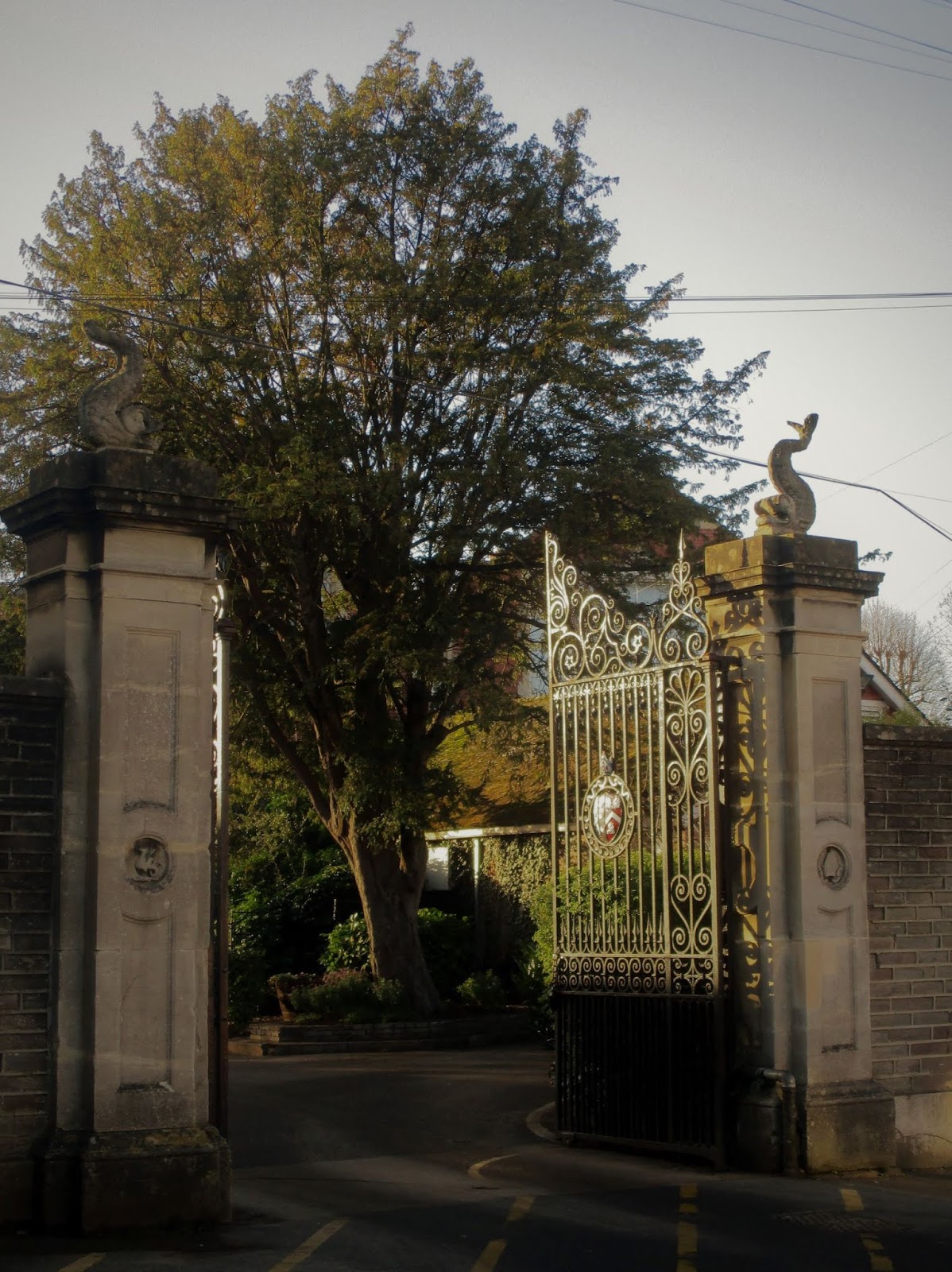
... and past Colston's School, with its carving on the gatepost of a bishop's mitre, for this once was the Bishop's Palace.
I'd hoped to get down to the river via Fry's Close, which runs around the back of the school, but it was plastered with keep out signs, so I went down Colston's Hill instead and doubled back along the boundary wall of what is presumably part of the school grounds.
There was a good, clear view through the trees of the weirs ...
... although the sun was so low and bright, it was hard to see who was about up ahead. (I had my trusty Ted with me, though.)
Our progress was slow, partly because the aforementioned dog had to pee on everything, and also because I had to take photos. It's much the same impulse, I decided. Just another way of saying I WUZ YER.
The Frome has a sensible concrete walkway along this particular stretch.
We opted for the unsensible muddy track, and I was reminded of how all the rivers of North Bristol - the Frome, the Trym and the Avon - had to cut gorges in stone at the end of the Ice Age in order to reach their destination.
This spot is called Black Rocks.
Instead of early 20th century picnickers, there were some women in neon lycra being hectored into moving.
One of the few times thanks to the gods of arthritis seemed to be in order.
We were now up by Wickham Bridge, which is variously described as mediaeval and substantially rebuilt in the 17th century.
One thing's for sure, the river crossing is much quieter these days than it used to be.
We wandered upstream.
On the far side of the allotments I could see Wickham Court, where Oliver Cromwell famously held a meeting with General Sir Thomas Fairfax on the eve of the New Model Army's attack on Bristol on 11th September 1645.
No time to go up there today, though. I crossed back over the Frome via the road bridge ...
... and headed up the evocatively named School Lane.
Even back up on the main road, between gaps in the traffic, you could easily imagine yourself in a very close past.
And so I found myself on Cut Throat Lane. No, not the St Werburghs one ... another one, little over a mile away in Stapleton. Which is a bit alarming until you realise that probably most ancient byways have had murders committed in them, and drunken fisticuffs, first kisses, proposals of marriage, sexual transactions, sudden deaths.
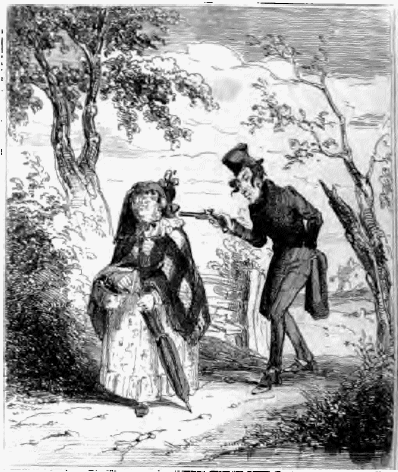
The murder attached to this place is of Mary Lewis, killed by her son-in-law, Charles Bartlett, on 10th September 1863. There's a lively account of the event and Bartlett's trial here. The most obvious problem with this attribution is that Bartlett shot Mary in the back of the head. Also, this lane doesn't lead to the River Frome, as stated in the account linked to above.
All I had to kill was a bit of time, so I followed the cat that might have been a fox or a wildcat or a dreamt thing through sunlight and frost, delighting that I was in a very familiar part of the city, yet in a spot I'd never trodden before.
Can you see it?
There it is, that dark speck disappearing down hill.
I'd decided the previous evening to visit the Church of Holy Trinity at the top of Bell Hill. It's one of those places I've passed all my life without ever entering. Time to put that right.
I wasn't expecting marvels, it being modern (1857) in comparison with the ancient churches I like poking around in ...
... but I'd done my homework and I knew there was an Arts and Crafts stained glass window in there and a venerable old font, both of which needed visiting.
First a wander around the tiny island of land the church sits on these days.
No graves remaining, apart from this one.
A reminder that the nearby Colston's School used to be the Bishop's Palace?
Inside, a few Christmas cards that had failed to get themselves collected ...
... and some nice slanty sun, and yes, that must be the Charles Kempe window over there, the greenish one in the middle, I'm getting good, I've spotted it straightaway ...
... but first some orientation.
Ooh and the font - no, not this Victorian interloper ...
... this one. Dating from 1000AD and tucked away in the west porch with a laminated sign blu-tacked to it. (I removed the sign briefly to take a photo but couldn't pick off all the tack)
What a shame. I can't help thinking they might as well have left it in the Bell Inn, where it was re-discovered at the turn of last century, being used as a plant pot for geraniums.
Anyway, here's the Kempe window, which dates from c1888. At least I assumed it was, as I couldn't find any guide books or helpful laminated signs.
It depicts Saint Margaret of Antioch with Satan in the form of a dragon on a chain; Saint Catherine of Alexandria with her wheel, the grain of which is beautifully executed (sorry); and St Agnes of Rome with her lamb.
There was another window next to it depicting Saints Giles, Augustine and Lucy, which threw me for a moment, but this was forty years later in date and nowhere near as subtle in its colour and detailing. Plus there was a cobweb in the corner, denoting it as the work of Geoffrey Fuller Webb, a mere disciple of Charles E Kempe.
No, I had found the one true Kempe window!
Except ... oh bloody hell, here's another window with the Angel Gabriel sporting peacock feathers! How gorgeous - and how typical of Kempe's work - is that?!
Dammit. Which is the Kempe window? Which? Which?
I fell into conversation with a parishioner who came into the church. He told me about the roof appeal, and we agreed it's awful that the burden of funding such renovations is left to congregations by a Church whose estates are said to exceed £2 billion in value. Especially in these straitened times. But he didn't know anything about the windows.
I left, feeling confounded. Cheered up on noticing that whenever you think you've stepped through a portal and are in some bygone time, something pops up to disabuse you.
There were still 20 minutes or so before I had to pick up Son the Elder, so I decided to wander down towards the Frome.
This is Colston Hill, named after the city's most infamous - and inexcusably still commemorated - slave-trader. The aforementioned school he founded moved to Stapleton in 1861, after which, presumably, the lane acquired its regrettable name.
As I wandered past cliffs of blood red Pennant sandstone, so typical of this part of Bristol, I wondered what it was called before. The lane mentioned in the account of the death of Mary Lewis is Tebbutt's Lane, which doesn't seem to feature on modern maps.
And we're only a five minute walk from the Mason's Arms, which exists to this day, where Mary and her son-in-law, Bartlett, had been seen drinking together earlier.
Hmm. The moving of the school predates the murder by two years, but it would be a while, wouldn't it, for locals to stop using a familiar name for a place in favour of the new one? Assuming that it was renamed immediately.
Could this be where poor Mary Lewis met her end?
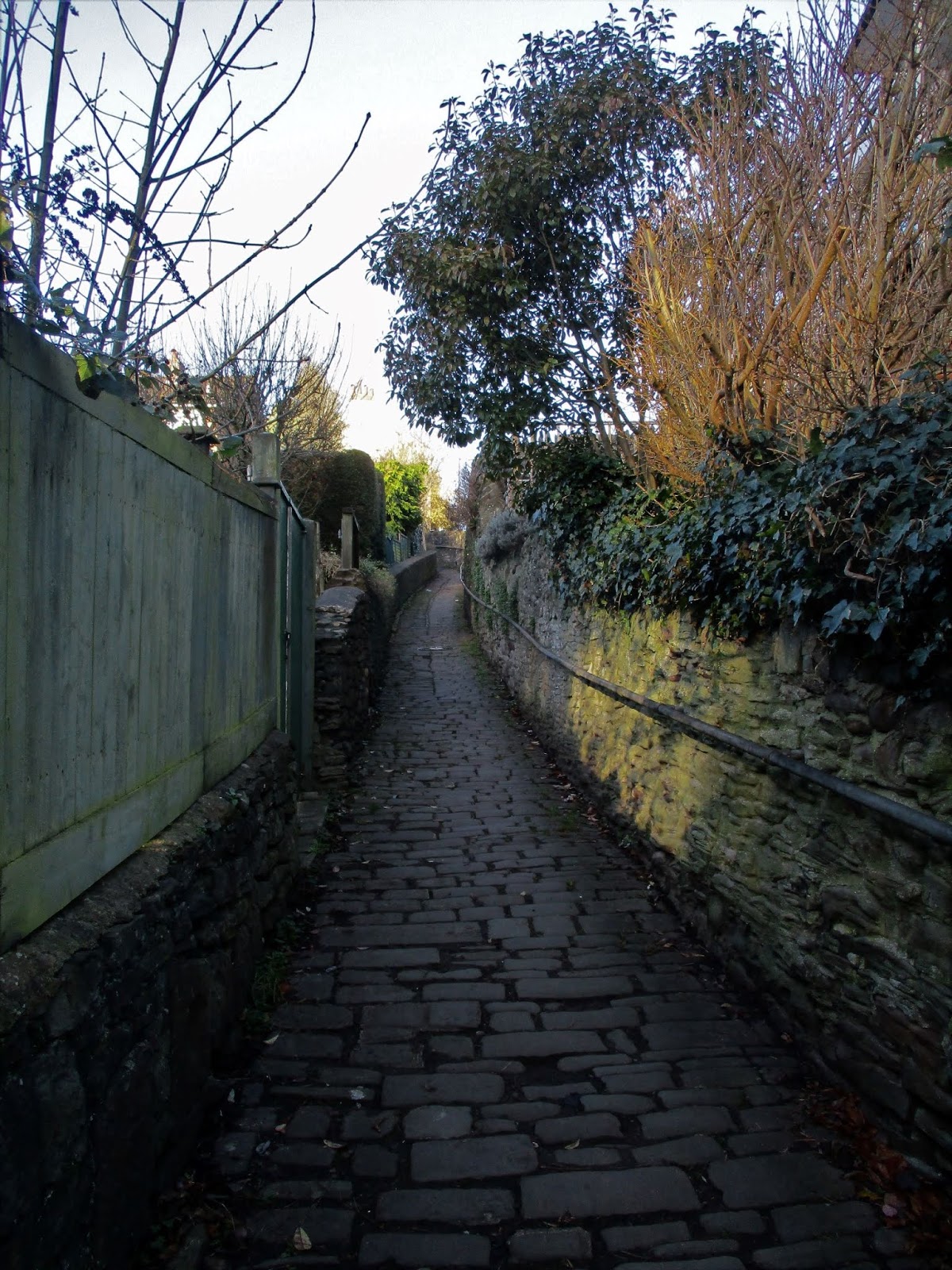
 I had to be getting back, so hurried up Wickham Glen.
After depositing Son the Elder at his place, and a quick trip to the tip and the library, I hit google. Two Charles Kempe windows in the church, if I had bothered to do my homework in a less desultory fashion.
No much more information about the location of the murder, however - just a long shadow.







 I had to be getting back, so hurried up Wickham Glen.


