About Me

My photo
Bristol , United Kingdom
Poet and poetry facilitator. Neurodishevelled. My sixth poetry collection, Love the Albatross, is available from Indigo Dreams or directly from me.

Monday, 25 April 2016

Into the Black Mountains Part II : Capel-y-ffin and St Martin's, Cwmyoy

I last visited Capel-y-ffin - well, a little less than 50  years ago, and being very young, remember little other than my parents telling me, maybe as a sop, that there were artists there. It worked. I spent the whole trip with my eyes on stalks, on the lookout for anyone sufficiently exotic-looking to pass as a painter or maybe even a writer, as if I might somehow bask in their Ready-Brek glow as they passed. Much later, I learnt that Eric Gill and his entourage had lived in the monastery there 40 years earlier, and that the poet and artist David Jones had been a frequent visitor.  But I saw no one who might have fitted the bill that day.

I'm not even sure which hill we climbed, though this one looks familiar.  If it is the one, I suspect the fact I remember being told it didn't have a name might well be because it's called Lord Hereford's Knob.  

The chapel of St Mary the Virgin, in the shadow of said Knob,  is delightful, and its diminutive size reminded me of Culbone Church on Exmoor.  

The Rev Francis Kilvert described it as 'owlish', which makes Dru's discovery of owl pellets in the churchyard fitting. 


'I shall lift up mine eyes unto the hills from when cometh my help'

A copy of David Jones' Sanctus Christus de Capel-y-Ffin


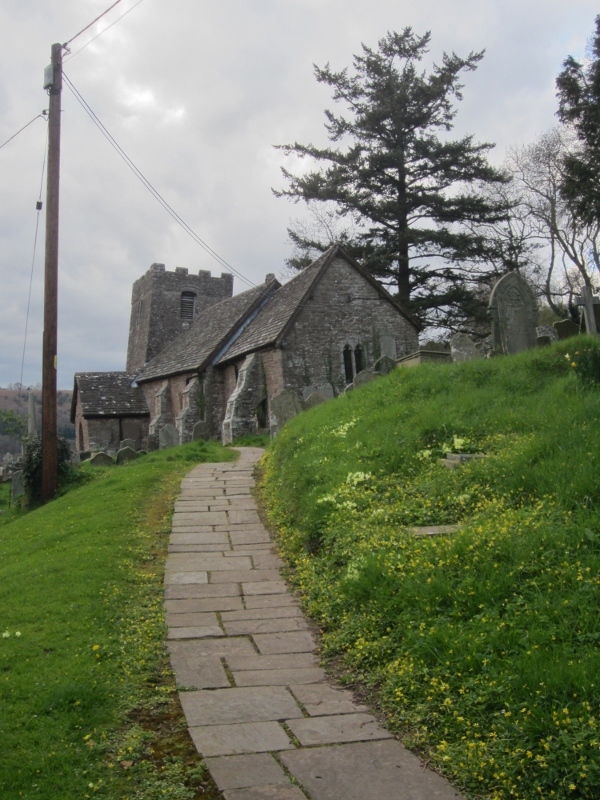
Leaving Capel-y-ffin, we headed back down the valley. Up on a hill to our left, I glimpsed a church that looked as if it were melting into the ground. Dru explained that the whole village of Cwmyoy was built on a hillside subject to slippage, so in a way it is. 


I don't think I've ever seen so many toppling graves before. 


The tower of Pisa is 4.7 degrees out of alignment; the tower of St Martin's 5.2 degrees.   

As for inside, Dru's assertion that there wasn't a straight line in the place turned out to be true. 


I started to wonder if the only thing keeping the windows in place was the ivy. 


Back outside, we came across a tastefully lettered headstone to one Arthur Denys Gill. Ah, has to be one of Eric's clan, we thought, but a bit of (admittedly desultory) research has yet to reveal a link. This Gill, it turns out, was a racing driver.
The sky snagged in a tree
Off then for a swift drink at the Skirrid Inn, which could comfortably accommodate a whole blog post all by itself, what with its tales of the days - well, centuries, actually - when the first floor served as a Court of Law and 180 locals were hanged from the beam in the stairwell. For sheep stealing, mostly.  


Sunday, 24 April 2016

Into the Black Mountains Part I : Llanfrechfa, Abergavenny, Crickhowell and Llanthony Priory

As soon as they saw us at the edge of the churchyard, the whole flock came charging across two fields and shouted at us for five minutes before deciding that we probably weren't about to feed them and wandering off again. 


The Church  of All Saints in Llanfrechfa was the first stop on a jaunt into the Black Mountains, culminating in an art event at the Grade  listed farmstead, Llwyn Celyn near Llanvihangel Crucorney.  

For now, though, we were fending off hungry sheep and pushing ineffectually at the (locked) church door. 


Not that it mattered, as this is where my companion, Dru, spent several childhood years, and just taking in the view from the high churchyard while she gave me the historical and geographical information I needed was a fine start to our journey. 


A quick stop in Abergavenny for a mug of tea and a toastie in the market cafe and we continued on our way to Crickhowell, which I'd only ever driven through before.  I could have spent a small fortune I don't have - mainly on the Kay Leverton's stunning scraperboard prints - in The Tower Gallery, but instead confined my extravagance to a pack of poetry cards and this photo of Crickhowell's Mari Lwyd, a rather more macabre feature of wassailing custom than anything Somerset has to offer.  


I love the way there seems to be a hill at the end of every street in Crickhowell.   


Just as we were debating whether the People's Republic of Crickhowell was the preferred holiday destination for the inhabitants of the People's Republic of Stokes Croft, the owner popped out for a little chat. Turns out Tim Rossiter is an artist originally from Bristol.  (Dru's photo.)

Another thing I like about Crickhowell is the children's play area right next to the Castle ruins ... 


... and the way visitors ignore the path the authorities provide for climbing the Castle motte and make one of their own. 


A quick consultation of the map and we were off again, this time to Llanthony Priory, with me relieved that it was Dru driving the Moggy up long, single-track lanes rather than me.  
Dru had visited Llanthony Priory many times before, and told me how once she had stayed in a room in one of the original towers with no plumbing and a chamber pot.  


I was struck by how it is spring in the valley and still winter on the hills.  All the same, it was pretty nippy, so we went into the abbey crypt - now a bar - for a drink.
Then over the road and into the terraced church I'd nearly missed, being so bedazzled by the ruins and the trees and the hills. 

Originally the infirmary of the priory, St David's was converted into a church in the early 18th century. I think it's one of the plainest I've seen. 
After that we headed on up the valley to Capel-y-ffin. More about that anon. 


Monday, 18 April 2016

In Praise Of Filton Library

Filton Library has been part of my life all of my life. When I was small, it was one of my favourite places in the world.  Even now, if I close my eyes, I can smell the strong scent of floor polish that assailed my nostrils the instant we opened the entrance door into the tiny vestibule, and picture the 1950s formica reception desk which wouldn't have disgraced the Tardis or Starship Enterprise.


My father would take me and my sister there every fortnight.  When I was very small, I would pick out books for my mother to read to me at bedtime.  I remember my father encouraging me to choose several squat Thomas the Tank Engine books every week because they were quite long and my mother hated reading them.  (I dutifully did as I was told even though I didn't like them much either, apart from Henry the Green Engine - and years later, fate had its revenge as Thomas was to feature heavily in my own autistic son's predilections.)  Marmaduke the Lorry was another early choice.

Later, I had custody of eight treasured brown cardboard library tickets that constituted my quota of books.  Stories for Six Year Olds was one of the earliest I chose to read myself. I read it when I was five but it was a struggle, as it was a hefty book of not always very exciting tales, and it had an orange cover.  (I didn't like orange then and I don't much now either.)  I remember my parents joking that if I didn't get a move on, I'd be seven before I finished it.

From then on, it was a point of honour always to have read all of the books by the time the two weeks were up, unless the book was a particular favourite in which case I would renew it and renew it for as long as I was allowed.  Books I discovered there included The Adventure series of novels by Willard Price; Monica Edwards' stories set on Romney Marsh; Ruby Ferguson's novels about Jill Crewe who had two ponies AND a mother who wrote novels (even though Jill thought they were rubbish);  and Pat Smythe's oh-so-sophisticated tales of the Cotswolds horsey set, which mentioned things I knew even then would never be for the likes of me, like sports cars, off-the-shoulder dresses and daiquiris.

And then there was The Red Pony, which I took out when I was about seven or eight, thinking it would be about gymkhanas and rosettes and fictional heroines living my pony dream.  I got as far as Gabilan dying and that buzzard dipping its beak into his eye and marched straight back to the library with it, outraged. It was the only book I recall not finishing.  Later, as part of my coming of age, I read the major Steinbeck novels and short stories but never glanced to the bottom of the list of published works – or if I did, I didn’t twig.  I think I was in my 30s before the penny dropped and I read it to the end and cried and cried for the boy and the old stable hand and the child whose life was to be so haunted by a half-read book.


Giving a poetry reading at the library with Hazel Hammond in March 2012

Years later, in 1999, the library moved to a purpose-built home in the new Shield Retail Centre. I remember my first visit.  I was quite impressed by the building, but disappointed when I reached my favourite sections - poetry and local history - to discover that there were no new books on the brand new shelving at all.  Still, it was a much needed focus for Filton in a shopping complex that included specialist shops such as Snow and Rock and a bathroom fittings outlet, a KFC, an estate agents and Farm Foods - hardly meeting points for a community. 


And it has proved to be the hub of the town, hosting many events, cafes and meetings, as well as providing its core services of lending books and computer/printing access.  It is a particularly important resource for the elderly, the poor, the unemployed and the disabled, all groups which have suffered the most from government cuts, including the closure of day centres, massive redcutions to Direct Payment budgets, etc - and this is why the proposal to cut our library's opening hours to two days a week, or even close it altogether, is so distressing.


At a well-attended demonstration outside the library on Saturday, we learnt that a majority of Tory-controlled South Gloucestershire 
councillors voted to reduce the green bin charge by £6 per year (from £36 to £30), instead of saving libraries and youth services, thus proving, yet again, that they are prepared to keep penalising the same groups of people without the least remorse; also, that they have proposed increasing the number of volunteers in a library with already the highest number in the area, rather than staff it with trained library staff.

The library was all-important to me as a child and I doubt I would have grown up to become a writer myself without exposure to all those books at such a young age.  I urge you please to sign the petition to keep the library open. 


Sunday, 17 April 2016

Cameron Must Go! National Demonstration - March for Health, Homes, Jobs and Education

Very proud to share this report my daughter, Jennifer Drewett, put together following the demonstration in London yesterday. (You won't have seen anything like this on the news, of course.)

Over the years Jen and her brother, who were both effectively written off at the ages of four and three respectively by a diagnosis of severe autism with learning disabilities, have benefited from disability allowances, Statements of Special Educational Need which provided them with access to the education they required, and years of speech therapy from the NHS. One senior registrar once said to me that their progress was a miracle, but I say it was in large part down to our welfare state.


All this is now being swept away by the Tory government. Meanwhile, the rich get richer, the poor pay a hugely disproportionate burden of tax, and the Daily Mail tells its idiotic readers that we should leave the EU and lose the tattered remnants of our human rights. It does my heart good to see that there are still those who will stand up and protest.


Saturday, 16 April 2016

On the Edge I: The year so far in sunrises

25th January 2016

My new home is on the edge of things, which suits me well. 

It has a sweeping, eastward view from my bedroom window, and since the New Year there have been some staggering sunrises.

Sunrises - and sunsets even more so - are widely regarded as one of the great clichés of art. I remember learning a passage from Turgenev's 'Fathers and Sons' by heart - in Russian - for my final in Russian 19th century literature, in which the sunset represented the demise of Tsarist autocracy, which would be swept away by the revolutions of 1917.  I was also once set the challenge of writing a poem that described a sunset without resorting to banality.  The poem made it into print, but I'm not entirely sure I was successful.  

11th February 2016  

On the whole, though, I'm with E M Forster, who said 'What is the good of your stars and trees, your sunrise and the wind, if they do not enter into our daily lives?' 


16th February 2016

Although that's as in daily up till now.  I don't think I'll necessarily be rising ever earlier throughout the summer to catch a glimpse of Apollo boy-racing his chariot across the Cotswolds.  


Leap Day 2016


4th March 2016


7th March 2016


So - see you in September, Helios.  In the meantime, here's a few more favourite skies.  

April Fool's Day 2016


13th April 2016


14th April 2016

Saturday, 2 April 2016

Psychogeography and Poetry in Old Bristol

Now that Project Breadcrumbs is nearing completion, I'm starting to think about what I want to focus on next as a poet.  Landscapes - both rural and urban - have always fascinated me, which is fortunate because I can combine that interest with another passion, which is walking about a bit. And as writers from Wordsworth, Coleridge and Blake, to Thoreau and Dickens, to Woolf and Rowling have attested, the two drives - to walk and to write - are often inextricably linked. 

Having recently moved house to an area I knew well as a child, I've been enjoying wandering around the lanes that run along the back of almost all the houses, though they contain little more than dilapidated garages, brambles and puddles.  There's something secret about them, and they also hotwire my childhood in a way that the streets and roads I've been familiar with consistently, throughout my life, don't. 


And there are other, more exciting lanes to be explored in the centre of the city.  Much of  old Bristol that survived the slum clearances of the Victorian era and post World War I was either obliterated in the blitz in 1940-41 or subsequently demolished by a council intent on building a wholly 20th century city.  But down by the Church of St John on the Wall, the last remaining stretch of the ancient city wall, the city remembers itself in the shapes of the lanes that echo the walls and the River Frome, now culverted and buried under tons of concrete.   


I've known these lanes all my life.  For many years, my mother worked as a legal secretary in nearby Albion Chambers. My father would pick me and my sister up from our grandmother's house in Bishopston on a Saturday lunchtime and we would drive to town to meet her from work, before stopping at the chippy to pick up dinner. 


He would park in Small Street outside the tobacconist and confectioners and point out things to me like the old stone step into the Chambers, worn by the feet of countless Bristolians over centuries - and since replaced, probably for reasons of Health and Safety.  


Years later, I also worked in the area, in an office in St Lawrence House (now fashionably graffitied and converted into student accommodation), the windows of which looked out directly onto the tower and clock of St John's.  

However, despite being in thrall to them since earliest days, it was only when I went on A Guided Walk Around Mediaeval Bristol a few years ago that I really started to get a feel for their history.  On that walk I was introduced to the 15th century topographer, William Wyrcestre, and learnt that back in 1480, Nelson Street was known as Gropecunt Lane; that in the middle of the crossroads that marked the centre of the settlement, where the High Cross stood in Wyrcestre's day, there was once a waymark hawthorn tree (now a traffic bollard);  that a ship with an oak mast and a stripy sail was found buried in mud under the tower of St Stephen's Church during 15th century renovation work, thus indicating the original course of either the Frome or one of its subsidiary streams in the marshy delta that existed before wholesale drainage and re-routing of the river took place;  that the concrete car park off  Bell Lane was the site of the Jewish Temple prior to King Edward I's Edict of Explusion in 1290.  (Almost 200 years later, Wyrcestre, a man of learning, was so ignorant of Judaism that he repeated a rumour he'd heard, namely that Jews worshipped an idol named Apollo.)

William Wyrcestre also gave me a poem, reprinted below. 

Here are some photos showing the shape of the now lost city walls.


Leonard Lane


John Street


Because its contours are, like the Frome, buried under layers of rubble, concrete and tarmac, it can be quite a surprise to discover how significant the hillock upon which the city was originally founded actually is.  This becomes most evident on Leonard Lane, where a doorway will suddenly take you down 22 steep steps to the next street, St Stephen's Street. 

Yesterday, while I was maundering about in town, I also decided to find the site of an etching by John Skinner Prout, which used to hang on my grandmother's wall when I was small. I remember being fascinated then to discover that this romantic (romanticised) scene was of somewhere in Bristol, now long vanished.  It says on the back that it is the Frome ... but where is the bridge?  


Oh, look ... could it be? ... Fairfax Street with Union Street above it?

Of course, when I got home, I looked online and someone else had already beaten me to it, and in colour. Even so, unearthing buried rivers under buried roads is what I want to do next.

Here's my poem about walking around Bristol in the company of William Wyrcestre.  It's from my collection, Map Reading For Beginners, published by Indigo Dreams.


William Wyrcestre Dreams Of Bryggestowe

Ditchers, digging through silt
to strengthen foundations, discover a relic.

‘A boat,’ William tells us in Latin,
‘with sails of striped canvas,
a main mast lofty as a tree.’

His Bristoll’s a modern-day port,
yet the names of its streets
conjure mudflats and creeks,
long after its rivers were tamed
and rewritten in mortar and brick.

William’s a wanderer like me
though topography, not stories, is his passion.

He’s obsessed with measuring space,
pacing quays and sizing buildings,
plumbing drops with knotted rope.
He fathoms every well and drain,
reveals the length of Gropecunt Lane,
not what goes on there.

When my attention wanders too,
he stops at the crossroads and relents.

‘Dynt the Pumpmaker,’ he says, ‘heard tell
how once a hawthorn flourished
where now stands this splendid Cross.’

But all I see’s a traffic bollard,
yards of tarmac, withered grass.

‘And here,’ he adds by a concrete car park,
‘in deep vaults beneath these walls
the Jewry made a heathen temple
to exalt their tin-pot Lord, his name
Apollo, folk do say, or some such idol.’


©Deborah Harvey 2014


Friday, 1 April 2016

Breadcrumbs poems published in Clear Poetry

Here's a link to Ben Banyard's Clear Poetry website, where three poems from my forthcoming collection, Breadcrumbs, have just been published.  

When you put together a collection in which the poems work together to tell a story, it can be difficult to know how well they stand up on their own.  But they have to be able to do that too, otherwise they'll slide down the front of settee and nosedive into the carpet.  So it's been encouraging to get some positive feedback.

Oh and here's a picture of The Strid in the Yorkshire Dales.  A scary scary place to be. I can hear it even down here in Bristol.  


Breadcrumbs will be published by Indigo Dreams this spring.