About Me

My photo
Bristol , United Kingdom
Poet and poetry facilitator. Neurodishevelled. My sixth poetry collection, Love the Albatross, is available from Indigo Dreams or directly from me.

Thursday, 28 May 2015

Arthurian Mists

Rain was scheduled for the morning, clearing later from the west, so we headed west to Cornwall to make the most of the day. 

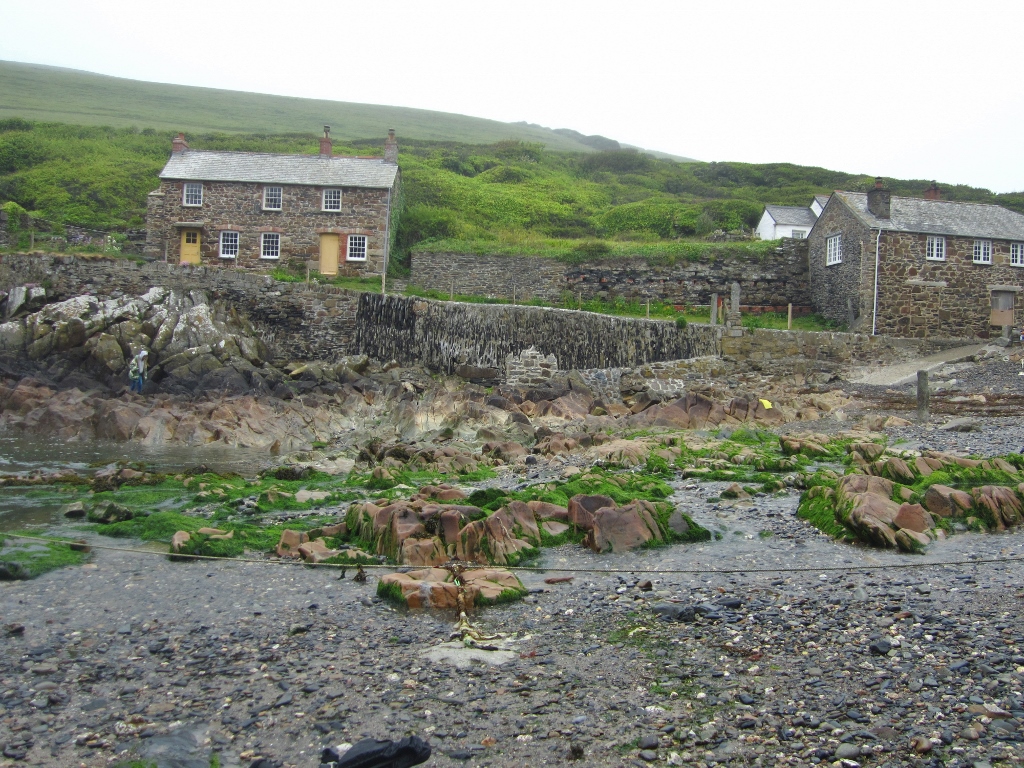
My partner was keen to visit Tintagel, but first we stopped off at Port Quin, which I love for its solitude, and its sad story of all the men of the village lost at sea in a terrible storm, and the surviving fish cellars which give such insight into the hard lives of past inhabitants ... 

... or would do if they hadn't been turned into luxury holiday lets since the last time I was there. What cavalier treatment of our social history. How disappointing.


And so the National Trustification of the place is complete. Apart from this door - quick, someone paint it a tasteful shade of Cotswold green! 


In Tintagel, the familiar was swallowed in mist.  My partner in poetry set off for the castle. I wanted to revisit the Church of St Materiana, otherwise (possibly) St Madryn, a 5th century Welsh princess (though I suspect they made her up). 


Ooh but it was atmospheric walking up the lane.


Eventually the Celtic cross that is the war memorial loomed from the churchyard, followed, as I drew closer, by many graves and finally the Church itself. 


It was like being in a Radio 4 afternoon drama.


I did get to spot some old friends, however, like this the altar tomb by the south door which commemorates, in beautiful lettering, Thomas, the son of John and Tamsin Heming, who was killed by lightning in 1702:


'The body that heere buried lyes,
By Lightning fell death's sacrifice.
To Him Elijah's fate was given
He rode on flames of fire to Heaven.
Then mourn no more Hee's taken hence
By the just hand of Providence.
O God the judgements of thy Seat
Are wonderous good and wonderous great.
Thy ways in all thy works appear
As Thunder loud, as Lightning clear.'

And this life belt which serves as a memorial to Cantanese Domenico, a 14 year old cabin boy who died on 20th December 1893 when the vessel he worked on, the Italian barque Iota, was wrecked on Lye Rock. Two other members of the crew also died, the remaining nine having been rescued by stalwart locals. 

The church is lovely, dark and deep ...

... and it has just about my favourite font of all time. Far less fancy than some, it is massive, Norman and carved with four heads at each corner and serpents in between, their heads and tails curved upwards representing, so the guide book says, the evil spirit expelled by grace. So there. 


By the time I met up with my partner, we were both so wet we decided to give Boscastle a miss and head back to Devon - no real hardship since he'd been totally beguiled by the castle and had already decided he wanted to revisit it on a fine day.

No sooner had we crossed the top of Bodmin moor when it stopped raining and the sun came out. But we'll be back soon, armed with a copy of the collected poems of Thomas Hardy, on another foray into poetry.  


Wednesday, 27 May 2015

Sheepstor and Yellowmead Down

Two and a half months ago, newly back on my feet following a fall and a fractured ankle, I didn't think I'd be doing this ...

... at least not so soon. But here I am, walking in my walking boots (which are perfectly comfortable despite the mass of metalware in my lower leg) on Dartmoor.  And although we chose an easy, short walk, it's still far more than I dared to hope I'd be doing so soon.  

Our starting point was Joey's Lane, an ancient packhorse way that leads from the lane that circumnavigates Burrator Reservoir up to Maiden Tor, an outcrop on the flanks of the much larger Sheepstor.  


As we climbed views opened out beneath us, including this of the reservoir.  


The other side of the tor we could see Yellowmead Stone Circle which was our destination - an easy ramble over rough grass after the exertion of climbing the tor.

If it looks a little cluttery, that's because Yellowmead is - to get a bit technical, like - a rare fourfold concentric stone circle of the early Bronze Age, of which there is only one other example on Dartmoor, on Shovel Down
Within the innermost circle is a hollow where the burial kistvaen once lay.


From the circle, we walked back up to the corner of the newtake wall, and along the top to the lane which led back into the hamlet of Sheepstor. On the way Ted paused for a drink at St Leonard's Well.

St Leonard is very lucky, he has a churchyard full of bluebells at the moment as well and some great 18th century headstones. 
My favourite things, though, were this 17th century foliate skull atop an hourglass, with ears of corn sprouting from empty eye sockets ...   
... and the swallows nesting in the porch. 

After a little revisit to the church itself, we went back up the lane to the car, passing a magnificent vista of the eponymous tor en route.  Joy out of all proportion to distance covered, but no matter - Dartmoor, I'm baaaaaack!


Tuesday, 26 May 2015

A Poetry Pilgrimage through the Wild West


To Devon via the scenic route. And since my partner in poetry hadn't been there, a visit to the cottage at Nether Stowey where Samuel Taylor Coleridge and his family lived from 1797 to 1799 seemed apt. 

I'd been there before, so while he fossicked about inside, Ted and I sat outside the pub and birdwatched.  A squeal of brakes and the slamming of car doors announced the arrival of a gang of swifts from distant climes. I wonder what the resident birds make of the new arrivals each May.  Probably not too different from the villagers when Samuel, Sarah, William Wordsworth and Dorothy descended on the area. 


After lunch. a drop of Rich's cider and a delve in Lyrical Ballads in the garden of the Hood Arms in Kilve, we popped down to the beach to let Ted stretch his legs. I love Kilve's delightful shore, as Wordsworth called it, though this time, post broken ankle, I found its stony terrain challenging.

Kilve has found its way into a couple of my poems too.  I love scrabbling about in the hope of finding a fossil or two.  I did see a selection, all on hefty pieces of rock.  I always wonder how many people have struggled to get them back to their car, only to give up en route.  Much better to leave such impressive specimens where they lie - they've been there for millions of years, after all.


After a good scramble about, we made our way to Watchet to see the statue by Alan B Herriot of the Ancient Mariner (which also pitches up in a poem of mine).


Salty sea dogs


Our final stop, via a quick dash through Dunster, was Tarr Steps, an ancient clapper bridge over the River Barle in pretty much the middle of nowhere. Unfortunately for us, we arrived there gasping for a cup of tea five minutes after they's stopped serving tea and coffee and fifty-five minutes before the pub opened, and da yoof behind the counter was not inclined to pop the kettle back on. 

The bridge, which has been rebuilt following flooding twice since I last saw it, was looking good ...


... though I have to say, it's the Second Severn Crossing of clapper bridges. Impressive in a burly sort of way, but lacking the grace of, say, the clapper at Postbridge on Dartmoor. 


The Barle, and then the River Exe escorted us off the moor and as far as Tiverton, beyond which we rejoined the motorway and completed our journey south and west, all poetried up and ooh! what's that feeling? ... happy.  


Friday, 15 May 2015

Inspiration : The Poet And The Boatman

I was recently approached by Neil Howell, who keeps a blog called Teignmouth in Verse. He'd come across my poem The Poet And The Boatman, about John Keats' stay in South Devon during 1818.  I gave permission for him to post it, found myself explaining to ex-pat actor and Romantics aficionado Ian Frost how I came to write it, and decided the story might make another post in my Inspiration series.  

My immediate family's connection with Teignmouth and Shaldon on the South Devon coast goes back many years.  My parents first 'discovered' Shaldon the year before I was born. My father said he walked onto the beach and had the sensation he had 'come home' - quite odd, really, since he is not at all given to airy-fairiness, as he would doubtless regard it.  They returned year after year with my elder sister and me. 


At first we stayed in Chez Nous B&B on The Strand with Mr and Mrs Cordon and their Jack Russell terrier, Jo-Jo.  (The house is now a bastion of UKIP, alas.)  And sometimes we stayed in the shabby grandeur of Manor House, two doors up, or the flat above the Clipper cafe or, more often, one of the caravans or chalets at the site by the bridge which now has mock-Georgian cottages built on it. When I was about 11 my parents bought a caravan at Smugglers Caravan Park in Holcombe and there we have holidayed ever since. (Obviously not still with my mum and dad - I grew up and had kids of my own, and now it's mainly just me and my partner and my border collie, Ted.) 

When I was about seven, I remember my father pointing out a yellowy house across the estuary in Teignmouth,  'That's Keats' House,' he said. 'Who's Keats?' I asked. 'A poet who stayed here,' my father answered cryptically.  


Any mention of poets, authors or artists filled me with great excitement as a child and I would walk very slowly past the house whenever I saw it, in case I glimpsed a shadow or a ghost in a billowing white shirt.  Although once back in Bristol, I would have trouble remembering who exactly had lived there - was it Keats or Yeats? Both, I knew, were poets, but apart from being dead, I knew nothing about them and had no idea what distinguished one from the other.  Eventually the idea of John Keats coalesced in my mind and when, as a teenager, I first read 'La Belle Dame Sans Merci', it was with the sense that we somehow had a connection.

Anyhow, about 20 years ago, my aunt who is married to one of my mother's many brothers but is actually a blood relative of my father (we'm a bit like that in Bristol, mind) received some documents from a cousin of hers who is into genealogy, and she forwarded to my father the information pertaining to the Harveys. In it we discovered that my great-great-great grandfather, James Harvey, a Somerset man from Weston-Super-Mare, worked as a boatman all around the peninsula in the 1820s and 1830s, marrying a woman from St Marychurch on the way and settling for a couple of years in Teignmouth, where two of their children were born.  It was, indeed, 'home'. I was wildly pleased by this, partly because of my love for Devon in general and the River Teign from source to sea in particular, but also because of the Keats connection.  I harboured a brief fantasy that James Harvey might have rowed John across the river to Shaldon or maybe my great-great-great grandmother laundered his shirts or served him a beer in a pub or even just greeted him in the street one morning.  Of course I soon discovered that this could never have happened as they didn't coincide in time, Keats having left Teignmouth in 1818, perhaps when it was clear that the sea air was not benefitting his brother, Tom, who was to die of tuberculosis just a few months later. 

I had it in mind to write a poem about this missed meeting - between Keats, James Harvey the boatman, and me - for some years.  When I finally found my way in, I decided not to be explicit about who the boatman was, mainly because his exact identity is really only of interest to me. In fact, people tend to think he might be Charon, which never occurred to me when I wrote it, fixed as I was on my ancestor. 

As for the poet, I didn't want it to be immediately obvious who he was either, although most people with an interest in poetry would realise within the first two lines.  Teignmouth has the reputation of being a rather stolid town - certainly Keats' skinny-dipping met with considerable disapproval - and it doesn't have a huge number of literary associations.  And even if you haven't rumbled who he is by then, well, the foreshadowing in the references to blood and drowning soon make it clear.  


The Poet And The Boatman

Tidal here and salt
the final turn of Teign
before its fretful merging with the sea
creates a harbour in the lee of land,
this curved blood-coloured beach.

Through mist that lifts like linen wraiths
I glimpse the poet stripping off
his white ballooning shirt and britches,
bathing in a manner
far from gentlemanly

the water’s cold, he’ll catch a chill

while over here a boatman’s sanding smooth
a newly mended hull. 
He’ll check the caulk is watertight
before he ventures out to rescue souls
condemned to watery death.

Both men are bright-faced,
close in age,
yet they’ll never share a jar
for by the time the boatman’s posted here,
John Keats is twelve years dead.

no one could have saved the poet
from drowning in his blood

Instead the boatman heads for breakfast,
and John is gone with a flap of his red-stained shirt
to flirt with the sleep-soft girls
stirring in their beds
above the bonnet shop.


© Deborah Harvey 2014


'The Poet And The Boatman' is published in my 2014 collection, Map Reading for Beginners, published by Indigo Dreams and available from their website. (Or from Amazon if you must, or all good independent bookshops.)


Saturday, 9 May 2015

Leonora Carrington at Tate Liverpool


Liverpool on Friday was as grey as any city which had just witnessed the re-election of a party with an official 1980s policy for its 'managed decline' would be.  


I love Liverpool and was glad to be there with my Firstborn (here having an impromptu Marilyn Monroe moment).
We'd travelled over from Leeds specifically to see the exhibition in Tate Gallery of art by one of our favourite artists, Leonora Carrington, the English surrealist who lived and worked in Mexico for most of her long career.


Carrington is possibly more famous for her colourful life than her art and this is a travesty as her work, which draws on the collective unconscious as well as Celtic and Mexican legend and folklore, is rich and endlessly fascinating.  

Giantess (The Guardian of the Egg), c1947


The Pomps of the Subsoil, 1947

The House Opposite, 1945

In her 2010 interview with her cousin, Joanna Moorhead, Carrington warns against intellectualising her work in an effort to understand it - it should only be approached, she believes, through one's feelings.  

I sat in front of this huge canvas for a long time. I reckon if I'd stayed there all night, I'd still keep seeing something new and intriguing, and in fact, this was the joy of seeing so many familiar paintings for real instead of in books - those tiny, often amusing, always provocative details.  (Here on my blog they are frustratingly small.)


The Magical World of the Mayas, 1964


Do you know my Aunt Eliza?, 1941


There were also masks and costume designs for Much Ado About Nothing and the Tempest, amongst others, and this amazing cradle painted for the daughter of José and Kati Horna. What a lucky baby to sleep in this!

La Cuna, c1949


After a time the concentration of colour and image became dizzying, and we were both reminded of when I'd taken a 12 year old Firstborn to see Chambers of the Imagination, an exhibition of work by William Blake at the then newly renamed Tate Britain in 2000. Such was its impact that my girl had woken up screaming in the night and been physically sick.  Thankfully there was no repeat of this on the two hour plus return journey over the Pennines to Leeds through unremittingly torrential rain.  It felt like the whole of the north was crying for another five years of bullying misrule, and we felt lucky to have had the respite of a blissful few hours of sumptuous colour and intrigue and fun.    


The Artist Travelling Incognito, 1949