About Me

My photo
Bristol , United Kingdom
Poet and poetry facilitator. Neurodishevelled. My sixth poetry collection, Love the Albatross, is available from Indigo Dreams or directly from me.

Saturday, 7 June 2014

Ghosts of the Past In Stratford-Upon-Avon

Off to Stratford-Upon-Avon to see Gregory Doran's production of Henry IV Part I, the play I studied for my O-level in days of yore and still one of my favourites.  First, though, a wander around town where the ghosts of the past loom as large as Hamlet's father's ghost on the battlements of Elsinore.  


One of our favourite games is 'What Would Shakespeare Have Seen?' and this time I spotted ... 


... the 14th century sanctuary knocker in the porch of Holy Trinity Church, where he was baptised and buried ...  


... some graffiti with serifs from 1575 ... 


... sunlit cow parsley ... (He's got to have seen the sunlit cow parsley, right?) ... 


... the Garrick Inn (although apparently not a pub in Shakespeare's day) ...  
... and the ancestors of these swans. (Sorry, no bread for you today.)    


Here's another ghost (albeit not a very spectral one) from the past, Ms Angela Prior-Kimball, who recognised me as I shuffled through town despite the fact we hadn't seen each other since she graduated 31 years ago.   


 I suppose this must mean we've hardly aged at all ...    :-)


Then it was off the the theatre.  Here's the review I've written about the production for a couple of local journals.  


Henry IV Part I, National Theatre, Stratford-Upon-Avon

Shakespeare reveals a fascination for doubles in his plays, and in Henry IV Part I the audience is invited to compare the dissolute Prince Hal, future King Henry V, with another Henry, namely Hotspur, the honourable son of his father’s former friend, the Earl of Northumberland, who is now fomenting rebellion. 

Early in the play King Henry expresses sorrow that Northumberland is ‘father to so blest a son … who is sweet Fortune’s minion and her pride’ while ‘riot and dishonour stain the brow of my young Harry’, and for the play to work properly, we must see the development of Hal as he begins the process of breaking away from Falstaff’s negative influence to become the equal of Hotspur in valour on the battlefield and, later, the victor at Agincourt.    

The problem with this production lies not with Alex Hassell’s portrayal of Hal, which, aside from a rather flippant interpretation of the famous ‘I know you all’ soliloquy, is spot on, but Trevor White’s Hotspur, who, far from being an dutiful and heroic foil for Hal, is a maniacal liability.  He is almost cartoonish in his aggressive impetuosity, with the result that all the tenderness in the scenes with his witty and patient wife Kate is lost and you can’t help thinking that the King might want to reconsider his wish that some night-tripping fairy had swapped the infants at birth. 

Elsewhere, Antony Sher is a gloriously ebullient Falstaff whose assertion that his recruits are ‘food for powder’ as they limp and shuffle across the back of the stage, prompts a look of incredulous horror from Hal and reminds us of the ruthless and predatory side of the dishonourable knight’s nature.  Perhaps the better comparison in this production is that of the young prince and Old Jack.  I look forward to seeing Hal’s inevitable rejection of his companion in Henry IV Part II, which is being broadcast live at Cinema de Lux, Cabot Circus, Bristol on 18th June.    


Monday, 2 June 2014

Snow in May

One of the things I missed most during last year's miserable spring was the almost complete lack of may.  It was just wrong wrong wrong and I blame the unseasonably late snow that we had in March, for depriving the land of later drifts of blossom.

Not so this year - in fact, my drives to Yorkshire towards the beginning of the month and to Manchester and Liverpool the following weekend were more like bridal processions.  It made me wonder if the oak isn't the wrong choice for our national tree.  After all, we don't name a month after it, do we? (The first person to say Oaktober will get a hard stare.)  And whilst there's no doubting the larger tree's magnificence,  the sight of tracts of landscape covered in white, with the occasional, more isolated thorns to mark the old ways really brings home its significance to our ancestors.

Here are some photos I took on my phone when I was up on Purdown on 14th May.  When I semi-glanced at the road sign you can see in the first one, my brain  short-circuited and I read it as SNOW instead of SLOW.


Within a week all this glory in Bristol had disappeared, yet when I went up on Dartmoor a full nine days later,  it was to find that the may there had yet to blossom fully.  It reminded me of how, in the absence of instruments to measure it, time was not as well regulated for our ancestors as it is for us. 

 
Of course, I would be failing in my duty as a card-carrying Libran if I weren't to backtrack at this point and mention how beautifully the oaks of Purdown were doing at the same time ... 
... but I think the final word on the matter should go to William Wyrcestre, who heard tell from Dynt the Pumpmaker back in 1470s that it was a whitethorn, not an oak that marked the centre of Brygstowe once upon a time, long before the first coming of Bristol High Cross.  


Saturday, 31 May 2014

A Three Hares Pilgrimage

Though I've done it already - visited all the Three Hares churches in Devon, that is.  Plus the stained glass in the Castle Inn, Lydford and the roof bosses in the chapel of Cotehele, over the border in Cornwall, and in Selby Abbey, Yorkshire.  Yup - been there, done that, written the poem.  


However, now that Dru has relocated onto NB Eve on the Kennet & Avon, space is at a premium and she's decided that some of her work must tie up its goods in a red and white spotted handkerchief and go out into the world to earn its keep.  So I offered to drop some of her beautiful Three Hares postcards into each host church in and around Dartmoor, while I was on holiday in Devon, as a free-gift-cum-advertsing-campaign rolled into one - or card-bombing, if you prefer.  


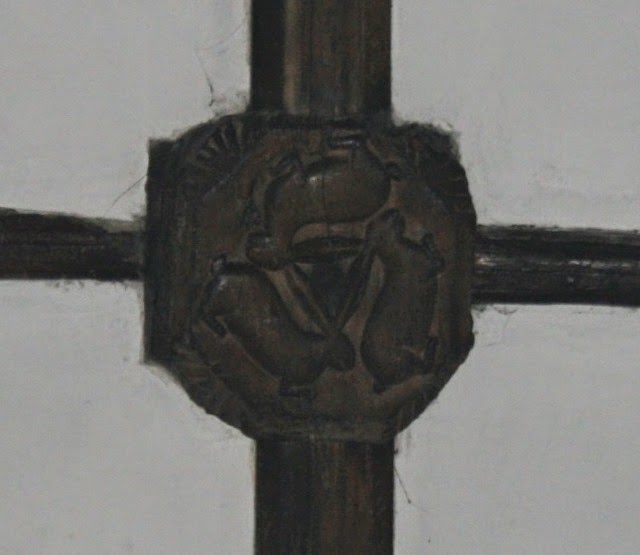
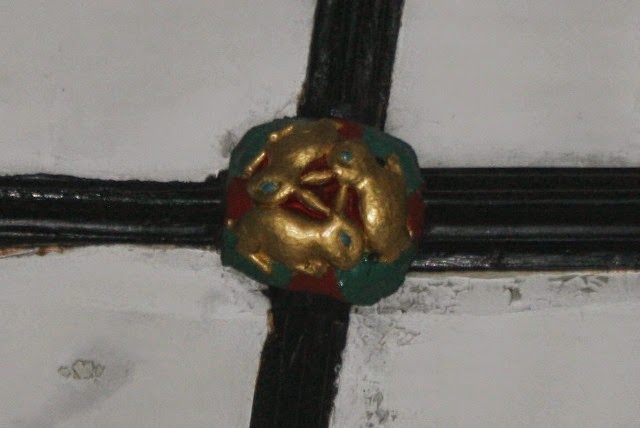
 There are 17 churches with mediaeval carved roof bosses depicting three hares running in a circle, each sharing a single ear with their neighbour so that it looks as if they have two apiece, and they are fairly widespread, from Ashreigney in the north to Paignton in the south and from Kelly in the west to Broadclyst in the east.   So visiting all of them does constitute a pilgrimage, and allowing for pub time, the most you can really expect to do in a day is half a dozen.  

Conversely, you can stop off at any you might happen to pass, and this is what I did at St Michael's, Ilsington, a minor diversion en route for the bluebells of Holwell Lawn.  

Ilsington is a lovely village on the edge of Dartmoor, but turning its gaze towards the smaller and less celebrated Haldon Moor.  It has a decent pub and the church, with its dark and mysterious interior and weathered churchyard, is typical of the area.   


Having found a suitable spot in which to deposit Dru's cards, I set about locating the three hares roof boss, remembering belatedly that the last time I'd undertaken this mission, I was younger and sharper-eyed and had four positively eagle-eyed offspring with me.  Alack, now I was reduced to squinting and craning and trying to recall whether this was one of the churches with the boss in the centre aisle or to the north or south? In the nave or the chancel?  Painted (and easy to spot) or merely carved?  


Ah, there they are!


Two days later I crossed several churches off my list in one go. First, Widecombe's St Pancras, which must have one of the best churchyards in the country (though I suspect the me in the parallel universe where I live on   
Dartmoor and enjoy wild literary success will end up mouldering with all those Harveys in Manaton).


The Widecombe hares are also favourites, partly because I love their naturalistic colouring, but mainly for being The First Hares Of My Childhood, when they were believed to be tinners' rabbits and their mystical significance had been mislaid.   


Also, it's next to one of three amazing Green Men. Look at this one!  He's just scored a penalty against Germany!


And in the porch, a couple of swallow nests.  


On to Tavistock, graced by the River Tavy in unwontedly sober mode.


The Church of St Eustachius - they made him up! - with its hugger-mugger graves ... 


... and the last remaining arch of the Abbey cloister in its grounds.


More baby bunnies than hares here, I think ... 


... but a fantastic monument to Judge John Glanville, who fell from his horse and broke his neck in 1600, and his wife, Alice.  


Next, St Andrew's in South Tawton, with its lovely Church House, and just opposite the Seven Stars pub too.  


More swallows in the porch and Dru's cards looking very much at home ... 


... presided over by possibly the best carved of all the hares, with their lovely fluted ears.  


Finally to Chagford, where I had a bit of a shock because the Church of St Michael the Archangel has been improved mightily since I last ventured inside in - ooh - probably 2005, because England were playing Australia in the Ashes in one of those nail-biting games that went right to the wire. 
A Church has to serve the needs of its community and be useful as well as beautiful, and that often this means making changes to the fabric of a building, but it has lost some of its darksome mystery.  


Plus, with the doors of the screen chained shut, presumably for reasons of security, I had to perform gymnastics to espy the hares.  (Did it in the end, though.)


So. Five down and a dozen to go, I'm going to enjoy the rest of my mission, whenever the next instalment falls. 


Friday, 30 May 2014

Getting A Cobb On (Or Going For A Burton Bradstock)


And so to Lyme Regis, so that my companion could stand on the Cobb and pretend to be the John Fowles' French Lieutenant's Woman - even on a bank holiday Monday in May and without a hooded black cloak or a storm to go with it.  

I love the Cobb, the first mention of which is in a document dated 1328 (although it has been reconstructed many times since). What a feat of engineering, though.  


The literary character I was keenest not to emulate, whilst balancing on its slanty walkway with an always excitable Ted, was Louisa Musgrove in Jane Austen's 'Persuasion' who famously falls from it (or at least from its steps) and sustains a serious concussion. 


But look, here's a lovely view over to the distinctive outline of Golden Cap ... 

... and here's some boats on Monmouth Beach upon which the Duke of Monmouth landed at the start of the ill-fated Monmouth Rebellion ... 

... and here's the Cobb and harbour seen from the Jane Austen Gardens on the John Fowles Walk. (I sense a bit of a theme developing here.)

But it's a bit too crowded down on the front, so let us away to Burton Bradstock instead ... 

... where the crows are disreputable ...


... there are fossils for the picking up ... 


 ... and  rather more room for a dog to frolic.