Look, my most talented friend Dru Marland has translated her fascination with pictorial maps and the three hares symbol into a limited edition of 100 A4 sized giclée prints, or if you prefer, either an A2 or A3 sized poster on glossy paper (with added pomery by me!) All are now available for you to buy, price £25, £10 and £5 respectively.
So bound along to her Etsy Shop and get some Christmas Shopping done before the rush and without having to leave the warmth of your laptop - or better still, treat yourself. You know it makes sense!
About Me
- Deborah Harvey Poetry
- Bristol , United Kingdom
- Poet and poetry facilitator. Neurodishevelled. My sixth poetry collection, Love the Albatross, is available from Indigo Dreams or directly from me.
Friday, 12 October 2012
Thursday, 11 October 2012
Michael Wood at Bristol University
Went to see the lovely Michael Wood give a lecture at the university tonight on behalf of Bristol Museum. It's always a treat to hear him speak - and I always come away with at least one idea buzzing around my head. Last time I saw him, a couple of years ago to the day, it was the ending of a poem which had eluded me for some years, this time the idea for a whole new one and a jaunt to Llancarfan. Because how could I not go to see this ...
Wednesday, 10 October 2012
Carol Ann Duffy and John Sampson - Poetry and Song : A Celebration
Had a brilliant hour and a half this evening listening to Carol Ann Duffy reading a selection of her poetry from works spanning the last decade, accompanied by John Sampson, a virtuoso musician who played a wide variety of pipes (including, at one point, two recorders at the same time!) The event was billed as Poetry and Song: A Celebration, and it was good to hear Duffy's beautifully crafted poems interacting with the sometimes playful, sometimes elegiac playing of Sampson.
The (free - hooray!) event was to launch the brand new Bristol Poetry Institute, a venture dreamed up by the University to bring together 'scholars, students, poets and poetry-lovers across the University of Bristol and the wider community.' Bristol has a very lively and varied culture of poetry outside of the hallowed halls of academia, so it will be interesting to see how successful this outreach is. If it means more freebies like tonight, count me in!
I've long been fascinated by the way poems by different poets converse, but over the last year I've become increasingly interested in the interaction of poetry with other arts also. I was lucky enough to be able to launch my collection, Communion, with accompanying songs by maestro Reg Meuross, and more recently, one of the most enjoyable parts of last month's Bristol Poetry Festival was the encounter between Hazel Hammond's poems and Alison Wills' beautiful nocturnal photos, entitled 'The Woman Who Slept With Bones'. Still to come is the evening celebrating the collaboration between poets associated with the Bath Poetry Cafe and three portrait artists from Bath Artists' Studios, entitled Faces {Bath}, which is due to be held on November 3rd at the Bath Royal Literary and Scientific Institution.
One of the most moving parts of this evening was when Carol Ann Duffy read her recent poem about Hillsborough and the findings of the Inquiry, while John softly played Abide With Me in the background. After the event I had the opportunity for a few quick words with her, and told her how grateful I was that we had a Poet Laureate who was writing about 'the things that matter, rather than ... you know ... Prince Harry'. Then, having thought for a moment, I added that actually there were probably lots of poems in that lad, and she confided 'Yes, I've written quite a few rude ones!'
Tuesday, 9 October 2012
Stripey like a Tiger : Ightham Mote Part 1
After an excellent gig the preceding evening in the company of Woody Guthrie - via Will Kaufman and Reg Meuross - I felt as if I were bound for glory yesterday morning as I drove up the M4 first thing, the sun rising over the horizon and the fields filled with dragon's breath. Then, as we left the West Country, the mist became murk and I remembered that actually I was heading for Maidstone to drop Son the Elder off to see his beloved robots in action and the forecast promised driving rain. (That's why it's called 'driving rain', because it always falls when you have miles to drive before you sleep.) But by the time I reached my destination - Ightham Mote, near Sevenoaks - it was glorious again and that was just the weather. What a house!
'It's stripey, like a tiger,' announced one tot as his dad pushed him along. And it was, except that 'like a quagga' would have been more accurate. Some bits are stripey, some aren't. Some are 14th century stripey, others - ie the South face - 1904 stripey and 'fake' except that the National Trust decided that pretend modern stripey is as valid a part of the house's history as genuine ancient stripey and so preserved it when they carried out their 10 million pound renovation of the property between 1989 and 2004. Which is excellent. In fact, it is moments like these when I feel inclined to forgive the Trust even their pot pourri and trowels covered in Morris and Co fabric designs, for crying out loud. (Well, actually, no, not the latter, but if the pot pourri has cinnamon sticks in, it might be OK.)
Before entering the house - which I'd wanted to visit for decades, and which for many years I thought I would never see - I had a good wander around outside. It was so romantic! I loved these bricks, like a sort of crude ladder up the wall to the mullioned window. Was it a secret way for a lover to get in and out, I wondered, thinking fondly of Romeo and Juliet. However, the explanation when I discovered it was rather more prosaic. Ightham is very unusual because it has a free-flowing moat, fed by an underground stream which eventually debouches into the Thames. The moat was not constructed principally for defensive reasons, however. No, it was a sewerage system, and the bricks are the remains of the garderobes. Pity any poor bugger - or should I say, shithead - making the same assumption as me, then!
The grounds are lovely too, with ancient outbuildings turned into cottages, a formal garden, an orchard, stew ponds, a cuttings garden and so on. Postcards in the shop showed that the orchard in spring is a mass of daffodils.
The topiary feature was originally the well-head, and the kennel is the only Grade 1 listed kennel in the country, apparently.
The West Range with the entrance tower, the lower part of which dates from 1330-40, the upper floors from the early 16th century.
'It's stripey, like a tiger,' announced one tot as his dad pushed him along. And it was, except that 'like a quagga' would have been more accurate. Some bits are stripey, some aren't. Some are 14th century stripey, others - ie the South face - 1904 stripey and 'fake' except that the National Trust decided that pretend modern stripey is as valid a part of the house's history as genuine ancient stripey and so preserved it when they carried out their 10 million pound renovation of the property between 1989 and 2004. Which is excellent. In fact, it is moments like these when I feel inclined to forgive the Trust even their pot pourri and trowels covered in Morris and Co fabric designs, for crying out loud. (Well, actually, no, not the latter, but if the pot pourri has cinnamon sticks in, it might be OK.)
Before entering the house - which I'd wanted to visit for decades, and which for many years I thought I would never see - I had a good wander around outside. It was so romantic! I loved these bricks, like a sort of crude ladder up the wall to the mullioned window. Was it a secret way for a lover to get in and out, I wondered, thinking fondly of Romeo and Juliet. However, the explanation when I discovered it was rather more prosaic. Ightham is very unusual because it has a free-flowing moat, fed by an underground stream which eventually debouches into the Thames. The moat was not constructed principally for defensive reasons, however. No, it was a sewerage system, and the bricks are the remains of the garderobes. Pity any poor bugger - or should I say, shithead - making the same assumption as me, then!
The grounds are lovely too, with ancient outbuildings turned into cottages, a formal garden, an orchard, stew ponds, a cuttings garden and so on. Postcards in the shop showed that the orchard in spring is a mass of daffodils.
Inside the courtyard, the exquisiosity continues in the eclectic nature of the building work that make the house look as if it has sprouted somewhat eccentrically rather than been added to.
The topiary feature was originally the well-head, and the kennel is the only Grade 1 listed kennel in the country, apparently.
The West Range with the entrance tower, the lower part of which dates from 1330-40, the upper floors from the early 16th century.
There are lots of cool stories about the house, so more about them another time.
Saturday, 6 October 2012
Devil's Spit
I went down to the woods today - Badock's Wood, to be exact. It's just over a mile from my home and one of my favourite places in Bristol, for although it's on the edge of a council estate, it's sunk in its own mini ravine which the sound of traffic rarely penetrates. Ted loves it too.
I used to visit the wood a lot during the last couple of years of my damaging marriage, and it always made me feel a little better. I'd take photos of the wood from certain spots in all seasons, whether there was snow, fog, rain, frost or brilliant sunshine, though the thing that strikes me now is not the changes in the weather and seasons but in the quality of light. The darkest time of the year is deepest summer; the brightest those short dark days of winter when snow lies on the ground.
My season is autumn, my month October, and I think I like the wood best now, when there is still a lot of summer greenery to contrast with the show-offy foliage of trees already forging into fall. (That is, apart from high autumn when it's all fireworks and glory. And that beautiful slide into winter, the last few branches still clinging to their glad rags.)
Even the blackberries tasted good, despite the Devil having spat on them a few days ago now.
'Stop maundering and throw the ball' says Ted.
Thursday, 4 October 2012
A Poem for National Poetry Day 2012
The Last
of the Russian Stars
All we know
is that right at the end there was
shooting and falling.
Deborah Harvey © 2012
My poetry collection, Communion, is published by Indigo Dreams and is available from their website, Amazon, The Book Depository (with free p&p anywhere in the world - yay!), and good independent bookshops.
Wednesday, 3 October 2012
Hell Fire and Sherbet Lemons
So, it was off to Buckinghamshire today for an outing with Daughter No 2, whose birthday it is. She had heard about the Hell Fire Caves near High Wycombe and wanted to visit, what with there being ghosts there and all, so we did. What are the Hell Fire Caves? you might wonder. Well, they're a series of tunnels (originally mine workings) under West Wycombe Hill, carved out by hand for Sir Francis Dashwood in the 1750s. They were used as the secret meeting place for the notorious Hell Fire Club, aka the Order of the Friars of St Francis of Wycombe - a front for a group of aristocrats who wished to take part in 'immoral acts', their motto being Fais ce que tu voudras.
Who was in this salacious club? I hear you cry. Members included minor poet, Paul Whitehead, and possibly William Hogarth, major artist. And a lot of posh knobs. Oh, and Benjamin Franklin, who, in a distasteful note stuck to the wall, is quoted as advising a young man looking to take a mistress to choose an older woman as 'they are more prudent and discreet in conducting an Intrigue to prevent Suspicion', and, after all, 'in the dark all Cats are grey'.
Hmmmm. So what is there to see in these caves? The answer to that is ... not a lot. Some motheaten mannequins behind metal grilles, the odd notice ... and that's it. Not even cutting edge in 1965, let alone now. But they do host children's parties there, should you decide it's a suitable and/or interesting place to take your child.
Singularly unimpressed, we made our way to the top of the hill to visit the Georgian Church of St Lawrence. The churchyard gate was locked so we scrambled through the hedge to find that the Church was also padlocked. I was beginning to feel that my dislike of most things 18th century was justified, today at least.
There were, however, lovely views from the top of the hill, of scenery just tipping into autumn. Then it was on to West Wycombe, now a quaint outpost of High Wycombe. Lots of photogenic buildings - I'd forgotten my camera so had to master my new much-smarter-than-me phone quickly - and a few nice shops including one selling lovely Christmas stuff which I couldn't bring myself to buy as it's early October, dammit. Will have to go back when I'm feeling rather more seasonal.
I was interested by the 16th century Church Loft with its original Clock, which used to serve as a pilgrims' rest house and lock up. In particular, it has some beautifully weathered timber.
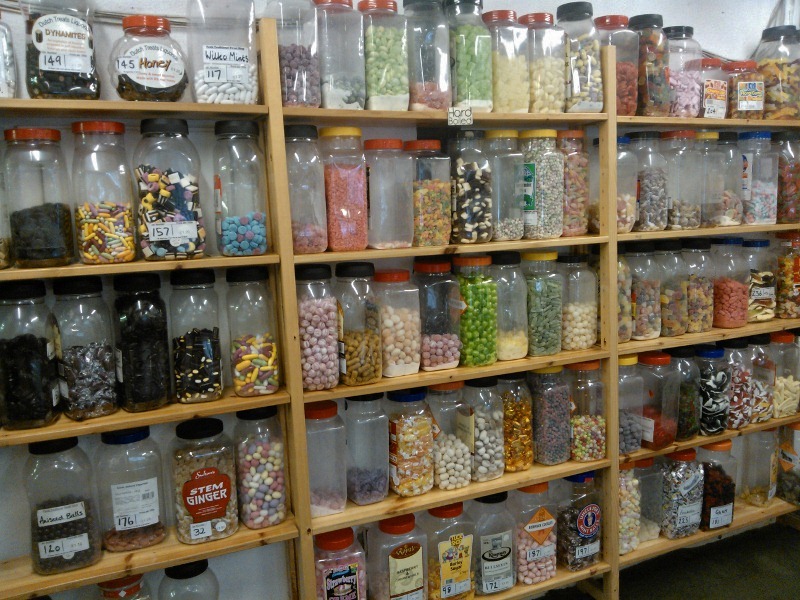
Jenny's favourite shop was at the far end of the village - the Sweet Shop, which provoked much reminiscing on my part about Mrs Jeffries' sweet shop which used to stand on the corner of Cambridge Road and Clevedon Road in Bishopston, opposite the high red-brick walls of Horfield Prison, and whence my cousins and I were frequently dispatched by our grandmother with a handful of coppers between us. I managed to resist the sherbet-filled flying saucers, but succumbed to 100g (had to make such an effort not to ask for a quarter) of sherbet lemons, which did a good job of keeping me awake all the way back down the M4 to Bristol..jpg)
Subscribe to:
Posts (Atom)


.jpg)
+(2).jpg)
.jpg)

.jpg)
.jpg)
.jpg)
.jpg)
.jpg)
.jpg)
.jpg)
.jpg)


.jpg)
.jpg)
.jpg)
.jpg)