About Me

My photo
Bristol , United Kingdom
Poet and poetry facilitator. Neurodishevelled. Co-founder of the Leaping Word Poetry Consultancy, which provides advice for poets on writing, editing and publishing, as well as qualified counselling support for those exploring personal issues in their work - https://theleapingword.com. My sixth poetry collection, Love the Albatross, is now available from Indigo Dreams or directly from me.

Thursday, 14 September 2017

Landscapes for Life with Samuel T Coleridge and Ted the Border Collie

The defining feature of my life for the last 30 years has been the amount of caring involved: for disabled children who, although now adults, still need daily input, a daughter and ex-husband with Type I diabetes, and these days for very elderly parents too. 


Going on forays into the country for a few hours lifts me above the frustrations involved in having to set aside my own interests, and replenishes my not-always-very-deep reserves of patience.
When I go out on a jaunt, more often than not I find myself in either an Area of Outstanding Natural Beauty or a National Park. We are spoilt for them here in the south-west. 


Which is as well, because as far as my mental health is concerned, these places are life-savers. 


So I am always thrilled and delighted when one of my poems pops up in connection with the bodies overseeing these special places on our behalf. 


My poem Coleridge Changes his Library Books, which is from my first collection, Communion, is currently gracing the AONB's Landscapes for Life blog. This is particularly apt as many of the places it mentions are under their guardianship. It can be read it here


Meanwhile, today's caring duties will take me to one such area, the Mendip Hills. I think I'll take the dog along and make an afternoon of it. 


Saturday, 9 September 2017

Bristol March: End Austerity - Fund Our City

You wouldn't think anything had happened at all if you watched Points West, but 8,000 protesters marched against austerity and Tory cuts in Bristol today, despite stormy showers and occasional lightning. Here are some photos.

Assembly and speeches on College Green


Marching


Getting very wet


Back on College Green, waiting for more speakers


BSL interpreters with ... Bristol poet laureate, Miles Chambers

... Mayor Marvin Rees


... Kevin Courtney from the National Education Union

... NHS consultant, Lauren Gavaghan

... People's Assembly spokesperson, John Rees

... journalist and activist, Owen Jones


Friday, 8 September 2017

I Can See Clearly Now

Having delivered a box of poetry festival brochures to Weston library, we went on to Uphill for our annual walk.

There seemed to be a particular clarity today. Everything looked so close that I wondered if it was going to rain.


Then I remembered I was wearing my new lensed sunglasses. 


The preacher kept right on saying all I had to do was send ten dollars to the Church of the Sacred Bleeding Heart of Jesus located somewhere in Los Angeles, California [said a voice in my ear] and next week they'd say my prayer on the radio and I'd be able to see!


Though, in fact, I couldn't see the oystercatchers I could hear, just black headed gulls in their winter garb and a few crows hanging about, wondering if there was a mythological role for them today. 

Gotta poem we can be in, missus?


They were in turn upstaged by a gang of young, excitable ravens surfing the stiff onshore breeze over the dunes, but I'm only allowed one poem a year with a raven in it and I've already had my quota for 2017. 

It looked a bit stormy over the Quantocks as we headed for the pub. I couldn't help thinking about other islanders a long way to the south and west who are a lot less secure than we are right now. 


Friday, 1 September 2017

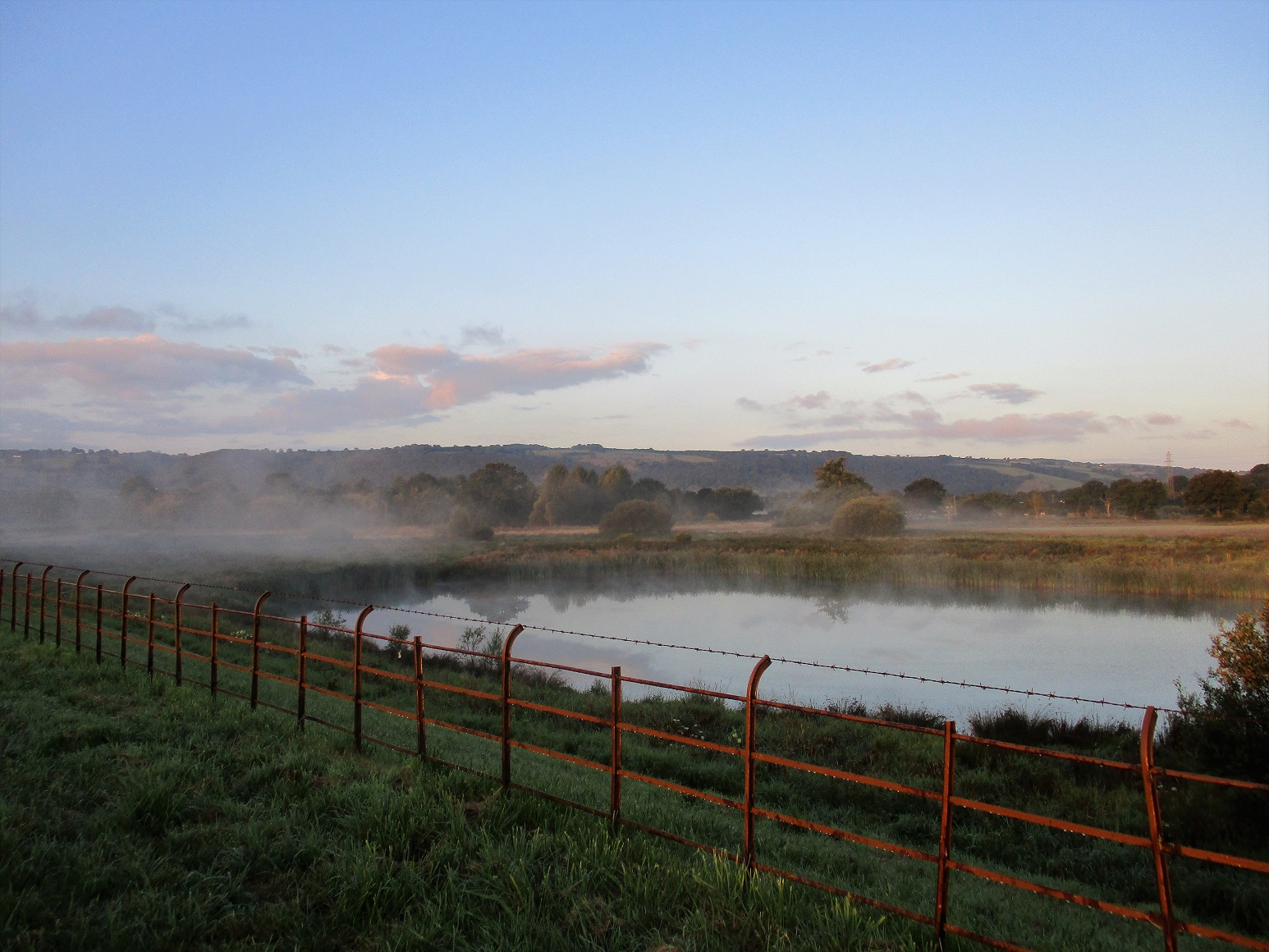
Sunrise at Chew Valley Lake


Sometimes there are compensations to lying awake half the night because you know you have to get up way before sparrow fart to drive your extra-special son to some film set in the middle of nowhere.


This was yesterday. Call-time for extras was half an hour earlier today, so my stop-off at the lake on the way home was half an earlier too. 


It was a lot mistier this morning. Dragon's breath! 


It was even dense on the road.


I decided to stay and watch for a while. As I said to the guy who paused alongside me, if you have to be up this early, you might as well make the most of it. 

'Life is beautiful, isn't it?' he answered.


A rag-tag of crows flew by ... 


The mist thickened and my toes grew really cold in my sandals. I wondered about driving on home. And then sunrise started to happen ..


... and I quite forgot I was shrammed.


Tuesday, 29 August 2017

Remembering Robin Tanner and Old Chapel Field

After twenty-one months and a lot of redecorating, I finally hung my Robin Tanner etchings in my not so new house a few days ago, and it has felt like coming home, but to a place that is tranquil and safe. 


I've been thinking about Tanner and his wife, Heather, a fair bit - how they aimed to live William Morris's dream, and the symbiosis of their shared lives. (See video below.)


I've also been recalling a visit my friend and I made almost a decade ago now, to the village Bristol-born Tanner grew up in, and which he and Heather immortalised as Kington Borel in their book, Wiltshire Village. I blogged about it at the time on a now obsolete platform, so I've reproduced it here. 


17 May 2008: A visit to Old Chapel Field

Today's trip to Wiltshire with my friend Julie was primarily to explore the village and surroundings of a hero of ours, the etcher and teacher, Robin Tanner, who lived in Kington Langley with his wife, Heather, and their adopted son, Dietrich, from the 1930s until his death in 1988. With pleasing synchronicity, his house stands on Old Chapel Field where the ancestors of Francis Kilvert lie buried, so we would be paying homage to the great Victorian diarist too. 

After an abortive trip to Devizes Museum to see their set of Tanner etchings which turned out not to be on display, we made for the village, clutching the Robin Tanner Heritage Walk we'd downloaded from North Wiltshire District Council's site.  It soon became clear, however, that both map and directions were so incomplete as to be useless.  We couldn't even find our starting point, Jacksom's Lane.

The common was packed with people celebrating the annual Scarecrow Festival, so we made our way through the Morris dancers and the funfair and what can only be described as a crucifixion of scarecrows to make enquiries at the plant stall in the churchyard.  'I'm not really local,' one of the stallholders told me. 'That is, I live here but we don't really know the area. Probably drive past it every day, though.'  'Well, could you could point us in the direction of Robin Tanner's house, then?' I asked the other woman. 'You know, the artist.'  She looked blank. 'Sorry,' she said. 'Robin who?'

Eventually we located the beautiful 17th century Greathouse at the eastern end of the village and managed to orientate ourselves, but as we wandered back down the main street it soon became apparent that Tanner's much loved village was now largely populated by well-heeled commuters unfamiliar with its surroundings or its former noteworthy inhabitants.  It seemed ludicrous that in a place only a stone's throw from the M4, we would have been better off equipping ourselves with an OS map and compass than relying on local knowledge to find our way around.


At the opposite end of the village we found a gate which, by process of elimination, we decided must be the Poet's Gate, so called because Kilvert used to lean on it to admire the view, but it was difficult to be sure because the plaque dedicating it to him was missing.  

We then eagerly sought out Robin Tanner's house, but all we could see was its gate and the tiniest, most tantalising flash of tiles between the trees.

Thwarted, we made our way down through Bird's Marsh, a lovely wood boasting fine oaks and beeches. As we went, we consoled ourselves with the knowledge we were following paths Robin and Heather walked over decades to sketch stone stiles, old chalk roads, and majestic elms, all fast disappearing from the locale. 

Sadly, the wood had also been planted with at least four different species of rhododendra which, unchecked, were crowding the native trees and smothering any undergrowth that might have flourished. They looked outrageously out of place and were the cause of so much fulminating on our parts that we forgot to watch where we were going and lost our way.  Finally we met a woman walking a dog and asked her for directions back to the village.  'I come here every day,' she said, 'but I've no idea where you mean. You could try that way.  Or maybe that way? – Yes, go that way!'

It was with a sinking feeling that we eventually drove back home.  The Tanners had been acutely aware of the loss of countless features of the Wiltshire countryside, and had sought to record and commemorate them through their art, but today it was apparent that there had been another loss – that of the connectedness of people to the landscape in which they live.  It might just have been coincidence, but I found it bewildering that every person we encountered seemed to lack even the vaguest acquaintance with their surroundings, let alone the intimate knowledge that comes from walking its tracks and woods and fields.  I know it's a cliché, but if I'd bothered to count the number of shiny 4x4s that thrashed past us, they'd have amounted to several dozen.


Back at my house over tea Julie leafed through my copy of 'From Old Chapel Field', which contains a selection of Tanner's letters, and tried to make the best of a disappointing day.  'At least, when we reread this we'll have a better idea of where he's talking about,' she said. 'Listen to this. "Never was rain so light nor leaves so green nor buttercups so yellow nor hedge parsley so white as now". Just like today! Only written on 17th May 1931.'  She paused. 'What date is it today?'


Some things have endured then.  And maybe one day nature might prevail.