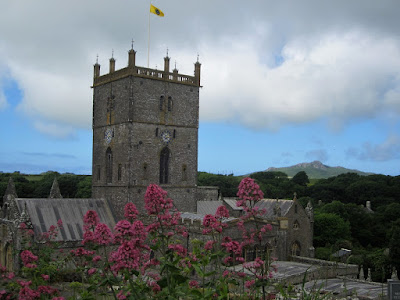
Last full day on holiday. Clearly, despite the downpour, we had to go to St Davids.
By the time we arrived in the far west, the rain had lessened. We emptied our pockets and found just a little blue sky. Enough to be going on with.
From a scene reminiscent of the Dartmoor borders ...
... we proceeded over fields to Porthclais Harbour, which reminded me strongly of a mini Boscastle. At the same time as being very definitely, unmistakably Wales.
We then turned left onto the coast path to skirt St Non's Bay - the most spectacular section of our walk. I had to keep stopping every few steps to take photos.
Then I spotted a pair of black corvids sitting together on a rock below the path.
Luckily, we'd remembered the binoculars and could verify that they were choughs.
Further on we came to the ruined Chapel of St Non, a local nun who, tradition holds, was raped by Sanctus (or Sant, or Sandde or Xantus), King (or Prince) of Ceredigion. This chapel marks the spot where she gave birth to her son, St David.
This stone was found in the same field as the ruins, and is believed to be an altar or gravestone. It can be dated to the 7th to 9th centuries.
There's a well too - a holy one, natch.
A
s we climbed, the hilly terrain of Ynys Dewi (Ramsay Island) came into view ...
I don't know anything about this stone at the side of the path above Caerfai Bay except that I love it.

We'd lingered a fair while and had to hurry back to St Davids to be on time to meet with friends for further explorations.
By the time we'd had something to eat, there was enough blue sky for my photos of the Cathedral and ruined Bishop's Palace to look like 1960s tablemats.
I did wonder why the Bishops Palace was in such a state. It turns out that in 1536 the Bishop, one William Barlow, stripped the lead from the roof to pay for the dowries of his daughters. (He had five.)
He accrued so much money from this that it was reckoned it would take more than a dozen years' revenue of the bishopric to cover the cost of replacing it, and so the building fell into disrepair.
The fabric of the Cathedral shows how it has changed over the centuries. I love the stonework of this window, the double porthole effect resulting from the heightening of the nave aisles to accommodate larger windows.

It's the wooden ceiling that's famous, however. It turns out that there was an earthquake in these parts in the 13th century. This, coupled with inadequate foundations and the fact that the ground slopes and is a bit squidgy, means that the walls at the west end of the nave lean out a bit. For this reason, the cathedral has never had a stone vault - at least as far as historians can tell.
The ceiling was built in the late 15th and early 16th centuries, and cost about £90 - a vast sum of money.
In 1538, the same Bishop Barlow complained that the canons were using up all their money re-edifying the body of the church which was ruinous. Cheeky git.

The tower lantern
This is the presbytery ...
... in which you'll find the very-difficult-to-photograph tomb of Edmund Tudor, father of King Henry VII ...
... and the very recently restored shrine of St David.
I like the humbler stuff best ...
... graffiti with serifs ...
... sixteenth century tiles ...
... and look, a rare three hares outside of Devon. This one inspired the first known literary reference to the symbol, in 'A Survey of the Cathedral of St Davids', published by Browne Willis in 1717:
'In one key stone near the west end are three rabbits plac'd triangularly, with the back sides of their heads turn'd inwards, and so contriv'd that the three ears supply the place of six so that every head seems to have its full quota of ears. This is constantly shewn to strangers as a curiosity worth regarding.'
The carved misericords in the choir are famous too ...
... though I was intrigued how the choir boys managed to graffiti the backs of the seats so heavily without being spotted and stopped.
After an ice cream by the Cross, we headed for Whitesands Bay, which looked lovely but was completely out of bounds for us, as during the summer months, no dogs are allowed on any part of the beach at all, on pain of a £500 fine, so we moved back down the coast to Newgale instead, which we had almost completely to ourselves.
It was heaven, especially for a certain border collie.
Final entertainment of the day was watching the Northerner (though three of our party fitted that description) trying to catch Ted, who really didn't want to get in the car and drive back to base ...
... and this hovering jackdaw, clearly after something it could see in or above the pebbles alongside us.
It had been great to see the choughs earlier in the day, but Corvid of the Holiday Award had to go to the chaws.


 ... but having taken four hours to drive the 110 miles to our base in Pembrokeshire the previous Saturday - and with the final of the Champions League being held in Cardiff that evening - we decided to avoid the traffic and take the scenic route back.

 Just under three years ago, I came across an article about a yew in the churchyard of St Cynog's in Defynnog, Powys. It had just been estimated to be 5,600 years old, and thus the oldest tree in Europe.
 And then Cheryl died.