When we got to the tip on Sunday morning to dump the stair carpet and underlay, the queue was half way down the road so we went for a meander at Steart Marshes instead.
 Warning signs have been a bit of a feature lately. Steart Marshes, along with the rest of the Severn estuary, have their fair share of mud.
 Birds, too - but as usual, I'd forgotten the binoculars, and as usual, we had a barky dog with us.
This didn't stop the larks from battering our ear drums with their 'Git orf my land!'s. Or the shrieking pheasants in the reedbeds. Or even the raven flying past filled with silent purpose.
The tide was too high to see the sunken forest that the noticeboard lays claim to.
Though perhaps this is part of it.
 What we did see, always on the horizon, was Hinkley Point nuclear power station, soon to be joined by Point C. The madness of building such a dangerous thing on an estuary with the third highest tidal rise and fall in the world.
 For one thing, there's all that renewable energy which could be tapped.
 For another, tsunamis.
 Looking in the opposite direction, the dark bulk of Brent Knoll, with the distinctive profile of Crook Peak behind it.
 And further along the coast Brean with Brean Down beyond it.
 While ahead lie Steep Holm, Flat Holm and South Wales.
 The blackthorn blossom's been amazing this spring. As striking as whitethorn.
 By now the tide was falling and we had to get home before the tip closed - where there was still a queue to get in. But we'd enough sun and sea to feel as if we'd been on a week's holiday, and that makes even waiting to dump carpet OK.
Last Saturday there was an exhibition of Victorian medical photos of largely undiagnosed conditions at our local Victorian garden cemetery. A must see for my retired nurse friend, Cathy, and me. Or so we decided.
Upon our arrival at our designated parking spot, we stopped to enjoy the great views from the other, less familiar side of our home city, including the Clifton Suspension Bridge in the distance ...
... and Vale Street, Totterdown, which is apparently the steepest residential road in the country.
We didn't have to walk up it, however. Our route took us along here.
 First, we had a poke around in one of the crypts, where lots of redundant grave paraphernalia had been stored.
Outside, I learnt what Dru Marland's Morris Traveller wants to be when it grows up.
There was also a Chevrolet with swagged curtains and a coronet of funerary bling in incredibly bad taste welded to the roof.
This is the Reverend John Adey Pratt checking the shower is warm enough.
Not Ted.
After a cup of tea and a shared slice of lemon drizzle cake in the sunny garden of the cemetery cafe, we finally came across the exhibition.
It was rather small, which was just as well, as I'm not sure how I feel about it, really. Of the ten photos on display, one or two people appeared to have conditions which would be easily rectified today - extensive varicose veins and webbed fingers. Another seemed to be suffering from hyperthyroidism.
The rest were more difficult to contemplate. Obviously the subjects are all long dead, but looking at photos of them did feel prurient. I won't share them here.
Apparently, Halnaker means half-naked. (Just thought I'd get that out there.) Or rather, that's what the hamlet, which lies four miles north-east of Chichester, was called in mediaeval times. Upon reflection, it might well mean something else altogether, but I've no idea what.*
Anyhow, we were there because a) the traffic on the coast was still too heavy to bother pressing on to Selsey, and b) Halnaker holloway had popped up in my Facebook newsfeed by chance the evening before, and I'm suggestible enough to think that means we were supposed to go there.
So we did.
What's a holloway? Well, it's a path that has been worn down by rain, feet, hooves and wheels for so many centuries that it's sunk down into its landscape. This one is probably getting on for ten feet below the surface of the surrounding fields. (Some are twice as deep.) The best - this one included - have trees that arch and meet over the top, so that in the summer they're like green tunnels.
It was also the chance for Bryony to make paint from somewhere historically very resonant. (Luckily, I had some dog poo bags handy.)
The holloway leads up a hill to Halnaker windmill, from where there's a good view down to the coast and over to Chichester. On the way up we passed a chalk pit ...
... and the fields gave the impression of being frosted with the stuff.
Bryony took some more samples.
When we got to the top of the hill, it was too hazy to see the sea ...
... and the windmill's sails had been removed for restoration.
Even so, it was worth the climb to take in lungfuls of still quite wintry air and listen to the relentless krikking of pheasants.
I'd assumed the octagonal brick enclosure near the windmill was a WWII anti-aircraft gun emplacement, like Purdown Percy on Purdown, but it turns out it was one of several High Frequency Direction Finding Stations in the vicinity.
(What? ... Oh, I dunno - something to do with determining the position of aircraft by exchanging high-frequency radio signals, apparently.)
The sun was setting, though, and it was time to make tracks back to the car and home along the M4 with enough inspiration to write a half-decent poem.
The holloway was getting darker but a clump of distant daffodils provided light at the end of the tunnel. It's getting more spring-like by the day.
My friend James Giddings adds: ‘Halnaker’
does mean half-naked in modern Swedish, but I didn't think Scandinavian words
were common in the South Country. ‘Bær’ would be the most common word for naked
in Old English, but ‘nacod’ was also used, with the implication of ‘too poor to
afford clothes’. A compound adjective with ‘healf’ would be what you'd expect: ‘healfnacod’.
‘Hal’ would be a noun meaning a secret place or hideaway, but with an accent,
it could be an adjective meaning ‘healthy’. ‘æcer’, meaning ‘acre’ might be the
second part of the word, and ‘hel’ (to hide or bury) as a verb has an ‘n’
ending in some grammtical forms, so it could mean ‘hidden acre’, ‘helenæcer’.
In order to write a poem for her exhibition of landscapes, I needed to visit sites where Bryony had taken earth to make paint. Our original plan was to visit Church Norton and Selsey, before heading to the holloway at Halnaker.
The traffic had other ideas, however. Still, at least there was a good view over flat fields to Chichester Cathedral.
Time was already getting on when we reached Church Norton, so we hurried through the salt marsh of Pagham Harbour to the beach.
My sort of bleak. It seems to fit into my eye comfortably, somehow.
Bryony pointed out the spots where she had taken sand and mud to make her paints.
The beach itself was lonely and lulling ...
... and with a tidal range far smaller than that of the Severn, we could loiter happily on Church Norton spit, unlike the causeway at Sully Island in South Wales a couple of weeks earlier.
There was sea kale and yellow horned poppy sprouting in the shingle ...
... and fossils to be photographed.
Heading back to the church, we passed the site of Norman castle, the earthworks of which are still visible.
I was a bit puzzled about the Chapel. It too proclaimed itself to be Norman, but the dimensions were wrong. It looked more like a Saxon Church to me.
Then I learnt that what we see here today is actually just the chancel of the original Church, the rest having been transported to, and rebuilt at, Selsey. It seems that with the transference of the Church's HQ to Chichester and the building of the Cathedral, there was simply no need for a large church here.
 The Chapel is now in the care of the Churches Preservation Trust.
There's a gruesome plaque on the tomb of John and Agnes Lewis of the martyrdom of St Agatha. Who, in a twist (ahem) of that peculiarly Roman Catholic propensity to take things literally, is the patron saint of breast cancer patients.
There's also pleasing, modern stained glass in there, of St Wilfrid 'teaching the locals to fish' and of the salt marsh and its inhabitants. More landscapes made out of sand ... but it was time we moved on to our last destination of the day.


 Warning signs have been a bit of a feature lately. Steart Marshes, along with the rest of the Severn estuary, have their fair share of mud.
 Birds, too - but as usual, I'd forgotten the binoculars, and as usual, we had a barky dog with us.


 What we did see, always on the horizon, was Hinkley Point nuclear power station, soon to be joined by Point C. The madness of building such a dangerous thing on an estuary with the third highest tidal rise and fall in the world.
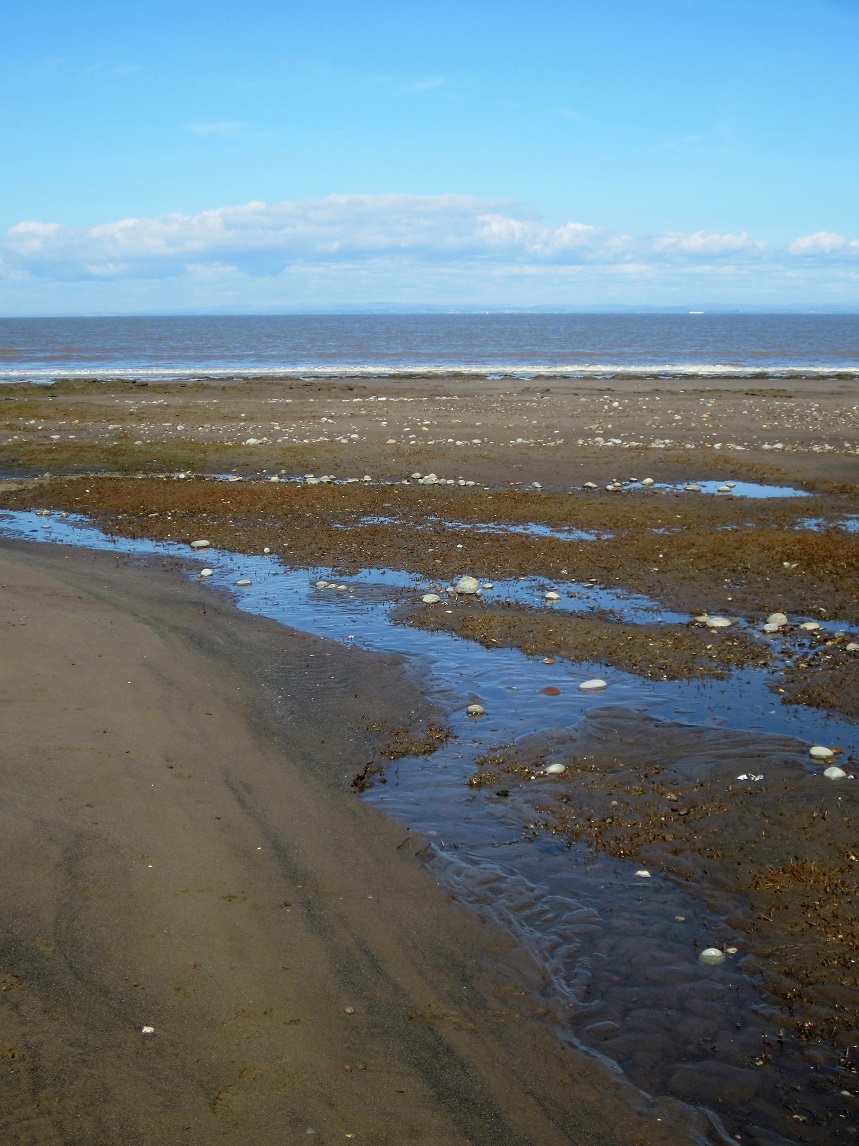 For one thing, there's all that renewable energy which could be tapped.
 For another, tsunamis.
 Looking in the opposite direction, the dark bulk of Brent Knoll, with the distinctive profile of Crook Peak behind it.
 And further along the coast Brean with Brean Down beyond it.
 While ahead lie Steep Holm, Flat Holm and South Wales.
 The blackthorn blossom's been amazing this spring. As striking as whitethorn.
 By now the tide was falling and we had to get home before the tip closed - where there was still a queue to get in. But we'd enough sun and sea to feel as if we'd been on a week's holiday, and that makes even waiting to dump carpet OK.


